
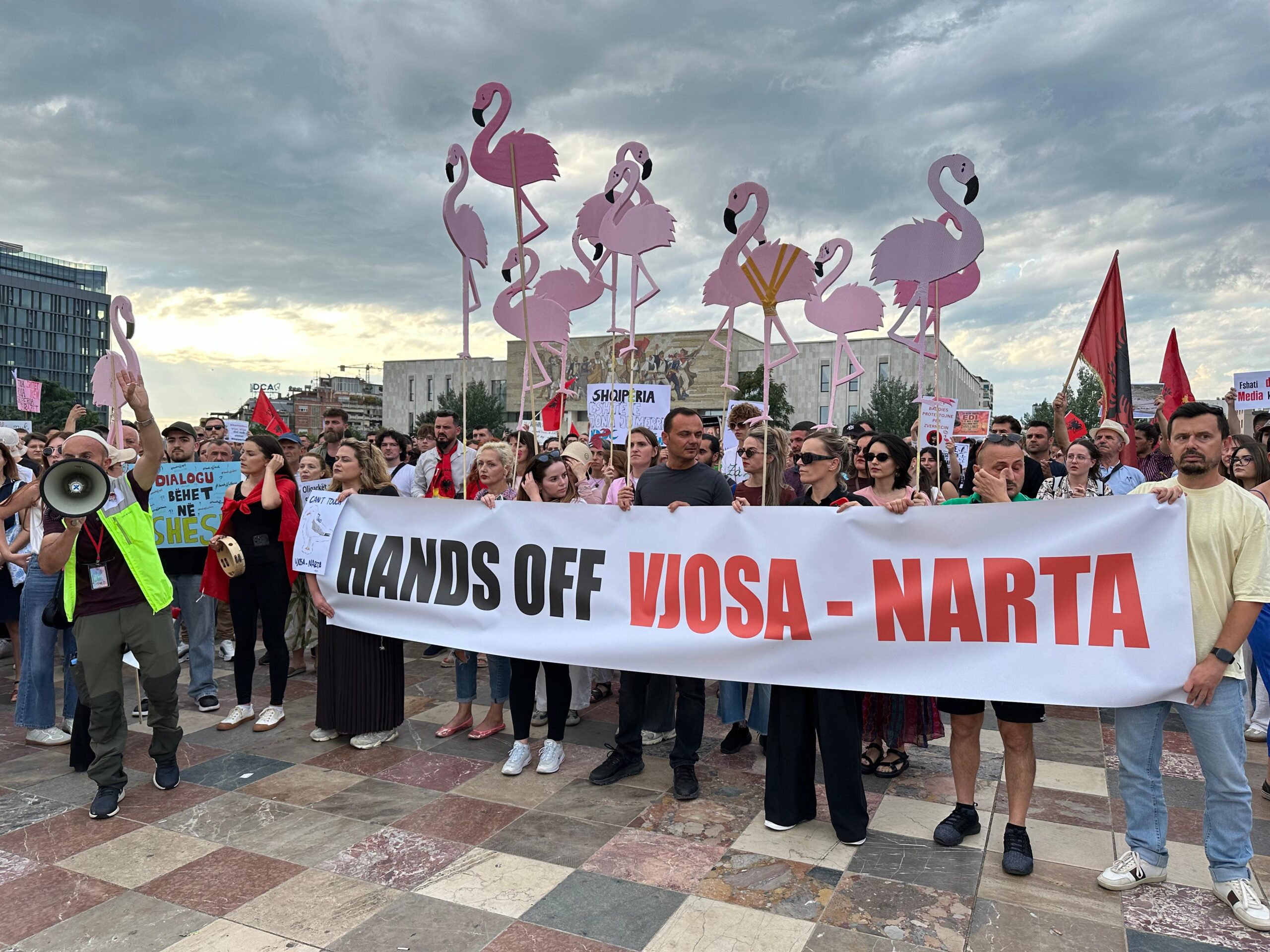
Flamingo Revolution Chronicles – The narratives that accompanied the “flamingo revolution” across the region
The protests against the project in Zvërnec did not remain solely an Albanian domestic story. Across the Western Balkans, they became linked to a range of narratives: alleged regional coordination, foreign funding, geopolitical theories, supposed support for Albin Kurti, and false videos that had not been filmed in Albania. Author: Jona Cenameri The original article is published here. Photo: Jona Cenameri What connects the student protests in Serbia with the protests against the project in Zvërnec? According to the Serbian tabloid Informer, “an important role was also played by Faktoje journalist Jona Cenameri.” But how? At the end of June, the Serbian outlet published an article claiming that Cenameri’s participation, as the only Albanian journalist present, at the Novi Pazar Youth Summit, her reporting on the protests in Tirana, and posts on her private social media accounts were evidence that she had played a role in connecting Albanian protesters from the “Flamingo Revolution” with the so-called “blockaders” in Serbia, a term used by the Serbian government and pro-government media to describe students who organise blockades as part of anti-government protests over the past two years. The narrative also mentioned articles that Cenameri had written about the “Flamingo Revolution” for Faktoje, where she works as a journalist, as well as her social media reporting on the issue. However, the claims were not accompanied by evidence. The SafeJournalists Network responded to the case, explaining that the summit was a regional event organised by the Youth Initiative for Human Rights Serbia, focused on democracy, human rights, media freedom and regional cooperation. According to the network, Informer had constructed an unfounded narrative by speculatively linking the journalist’s participation in the event, her professional reporting and her public posts. Cenameri rejected the allegations, clarifying that she had attended the summit as a journalist and invited speaker, not as a protest organiser or representative of any political movement. The articles published by Faktoje about the protests are part of her regular journalistic work at the organisation and are intended to provide impartial, fact-based reporting on political and social developments in Albania. Reporting on the protests in Tirana represents only one part of her coverage of current affairs in Albania and, above all, does not imply involvement with or support for any of the parties concerned. Accordingly, Faktoje clearly distances itself from any insinuation, speculation or unfounded claim seeking to link journalistic reporting carried out by its staff on behalf of the organisation with the organisation, support or coordination of political activities or protests, either inside or outside Albania. The reporting The Informer case was not the only one. Monitoring of media coverage and social media posts across the Western Balkans shows that the protest that began in Zvërnec was interpreted in different ways once the story crossed Albania’s borders. In some countries, it was portrayed as part of a coordinated regional protest network. Elsewhere, it was used to fuel geopolitical narratives or domestic political debates. In several cases, it was also accompanied by claims and videos that were later verified as false by independent fact-checking organisations. The “blockaders’ recipe” and the international funding network In Serbia, Informer and Alo portrayed the Albanian protest as part of the same model as the Serbian student protests. Their articles used the phrase “blokaderski recept”, the “blockaders’ recipe”, claiming that the protests in Tirana were being organised by the same infrastructure that, according to them, had organised the protests in Serbia. Another recurring narrative concerned foreign funding. Long-term funding received by Albanian environmental organisations such as PPNEA and EcoAlbania from EU programmes, the World Bank, the Critical Ecosystem Partnership Fund (CEPF), and other international donors was presented as evidence of a coordinated political operation, without providing evidence that those funds had been used to organise the protests. The protest in Albania was also used to revive debate over Jared Kushner’s project in Belgrade. The articles argued that Albanian protesters were following the same model that, according to them, had led to the failure of the Trump Tower project in Serbia, effectively turning the Albanian protest into an argument within Serbia’s own domestic political debate. This narrative was taken further by Informer’s editor-in-chief, Dragan J. Vučićević. He claimed that “some people from Serbia are also involved in the organisation, preparation and conduct of the violent demonstrations in Albania,” adding that “their bosses move them around as needed.” No evidence was presented for this claim either. From regional comparisons to geopolitical theories In North Macedonia, the Albanian protest circulated mainly through social media posts, where it was used as a point of comparison in domestic civic and environmental debates. One post asked why Albanians had been protesting for days against the transfer of an island to the Trump family, while Macedonians were not reacting over Lake Treska near Skopje, which, according to the author of the post, was being handed over to businessman Samir Mane. Along similar lines, another post called on citizens of North Macedonia to protest “like in Albania” against corruption and crime. In other posts, the Albanian protest was presented as an example of civic mobilisation. One stated that “Albania is on fire” and praised Albanians for taking to the streets against the project linked to Jared Kushner and Ivanka Trump. The post claimed that protesters had “burned the prime minister’s house.” Photo: Jona Cenameri In fact, the footage accompanying the claim was unrelated to the recent protests over Zvërnec. It showed Molotov cocktail attacks during earlier Democratic Party protests outside the Prime Minister’s Office. Alongside such comparisons, more speculative narratives also circulated. One media portal framed Jared Kushner’s investment as a choice between an “economic boom” for Albanian tourism and a “strategic geopolitical operation” aimed at securing military and energy control over the Adriatic. The article claimed that Sazan Island, because of its position near the Strait of Otranto, could serve as a strategic point for controlling maritime, commercial and energy traffic towards Central Europe. Another post linked the project to Gaza, sarcastically suggesting that, after being unable to build a luxury resort there, the Trump family had found its way to Sazan Island in Albania. Meanwhile, an analysis written in conspiratorial terms linked the project to Jared Kushner, the Trump family, George Soros, the “deep state,” Israel and “powerful families” across the Atlantic, claiming that major international deals and hidden interests lay behind the controversy over Sazan. None of these claims was accompanied by evidence of a geopolitical operation, military control or an international conspiracy behind the protests in Albania. “We want Albin Kurti” In Kosovo, the narrative took a different direction. Although media attention was primarily focused on the electoral process, several online profiles and portals shared videos from the Tirana protest with captions such as: We want Albin Kurti,’ protesters in Tirana chant” or: “Albania is calling for him: We want Albin Kurti.” In fact, the protesters were not chanting the name of Kosovo’s prime minister on duty. The chant heard in the video was: “Your end has come!” It was directed at Albania’s political class. Because of the similarity in sound, however, the chant was presented in these posts as an expression of support for Albin Kurti. The claim was not reported by professional media outlets in Albania or Kosovo, but circulated mainly through unofficial pages and social media accounts. Video from Spain presented as Albania’s “flamingo revolution” In Montenegro, the main piece of disinformation circulating online involved a video that was claimed to show crowds taking part in Albania’s “Flamingo Revolution.” Social media posts presented the footage as showing thousands of Albanian citizens protesting against the tourism project linked to Jared Kushner. Some captions also included the slogan: “Israel, get out! Our land is not for sale!” This framed the protest within narratives opposing foreign investment and claims that Albanian land was being sold off. In fact, the video was not filmed in Albania. Photo: Jona Cenameri Raskrinkavanje.me verified that the footage showed supporters of the Spanish football club Deportivo de La Coruña celebrating the team’s return to La Liga. Protests in Albania illustrated with footage from Spain and Poland In Croatia, another piece of false content circulated under the caption: “Albania, protest against Trump’s investment.” The video shared on Facebook consisted of two separate clips: one showing a crowd near a beach and another showing a large gathering in a city square. According to the accompanying description, the footage showed protests in Albania against the investment linked to Trump and Kushner. However, verification by Faktograf.hr found that neither clip had been filmed in Albania. The first was recorded in Galicia, Spain, during celebrations by Deportivo de La Coruña supporters, while the second was filmed in Kraków, Poland, during a gathering of Wisła Kraków supporters. One protest, multiple narratives From Serbia to North Macedonia, Kosovo, Montenegro and Croatia, the protests against the project in Zvërnec were accompanied by a range of claims: allegations of regional coordination and foreign funding, geopolitical theories, calls for civic mobilisation, misinterpretations of chants from the crowd, and the use of videos that had not been filmed in Albania. Once the story left Albania, it was reshaped across the region according to the domestic issues and political debates of each country.