
In focus category description
Roma in Bosnia and the Unfinished Violence of the 1990s
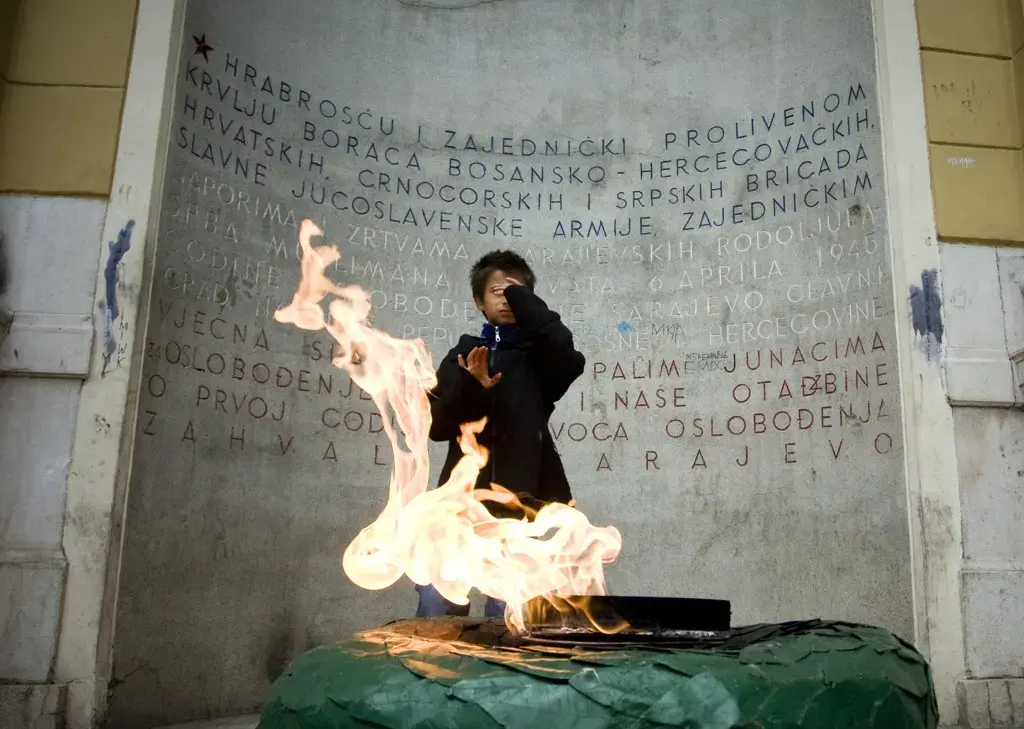
Historically speaking, the Roma population has been one of the most marginalised and discriminated groups in the Western Balkans. During the middle and new ages, Roma people were slaves to the other nations in the Balkans, with Roma slavery being officially abolished only in 1856 in Romania. Estimates say that up to half a million Roma people were killed during the Second World War by Nazi Germany and its fascist collaborators. According to data from the United States Holocaust Memorial Museum, tens of thousands of Roma in the territory of the former Yugoslavia under German occupation were sent to concentration camps such as Sajmište and Jasenovac. The Roma population in Croatia and Bosnia and Herzegovina was nearly decimated (Post-conflict Research Center, 2018, 4). A Roma child stands in front of the "Eternal Flame" in downtown Sarajevo. The plaque does not mention the casualties of Sarajevan minorities. Image by Jasmin Brutos. Bosnia, July 2008. Taken from: https://pulitzercenter.org According to the last available population census from 2013, Roma population in B&H amounts to 12,583 or 0,36% of the total population (Agency for Statistics of Bosnia and Herzegovina, 2019, 27), which makes them the biggest national minority in B&H an the fourth nationality. However, these figures do not depict the real situation for many reasons, two of them most important in the regard of this article. (1) Data collection like population census is carried out from door to door of households and this is the main obstacle since Roma people very often do not have a household in a usual sense of the word and reside in informal settlements where it is very challenging to keep track of the recorded households and their members. (2) Those who do take part in the data collection are hesitant to declare themselves as Roma due to the systemic and individual discrimination they have been experiencing for their whole lives. Instead, they either use their constitutionally guaranteed right not to declare their ethnicity/nationality or say that they are Bosniacs, Serbs or Croats. According to the report by the Institution of Human Rights Ombudsman of Bosnia and Herzegovina the estimation of the real number of Roma population in B&H is around 50.000 in total (Institution of Human Rights Ombudsman of Bosnia and Herzegovina, 2014, 23). Data shows that 71% of Roma households in Eastern Europe live in absolute poverty, a concept used to describe the living conditions in which people do not have enough resources to meet basic needs such as food, water, clothing and shelter (Singer, 1993, 218). The Institution of Human Rights Ombudsman claims that the Roma people do not exercise their human rights. Between 50% and 70% of Roma in B&H live in substandard housing, most often consisting of one room and no sanitary facilities. As far as 30% of Roma who participated in UNICEF research did not have a kitchen, while 17% lived without electricity (UNICEF, 2013, 24). When it comes to the legislative of the B&H, it is important to stress that “the Constitution of B&H does not recognize Roma and other minority groups as citizens with rights equal to those of their Bosniak, Croat, and Serb counterparts” (Post-conflict Research Center, 2018, 6-7). This gradually enables institutional discrimination and exclusion of Roma people, despite the ratification of international agreements that oblige B&H to fight against this kind of discrimination. Socio-economic status of Roma in B&H (Employment, healthcare, and education) Comprehensive, detailed and up to date data on socio-economic status of Roma in B&H is missing, but different reports and research results show that Roma in B&H is an especially vulnerable population. According to these findings, Roma people in Bosnia and Herzegovina face the highest level of discrimination in terms of employment opportunities and are almost completely absent from the workforce, which means that they have little choice but to find unregistered work in the informal sector (“grey economy”) or remain without an income. The unemployment rate among Roma is 56%, which is among the highest in the Western Balkan region and twice as high as that of non-Roma (European Commission, 2019, 55). Roma youth from Kakanj, a town 40 km northwest of Sarajevo, pose for a portrait. Image by Jasmin Brutos. Bosnia, September 2009. Taken from: https://pulitzercenter.org Main cause for the high unemployment rate among Roma is the inaccessibility of the labour market. This comes as a consequence of either being undocumented, living in informal settlements away and separated from the urban areas where the job offer rate is higher or the sheer lack of education, skills and required work experience (Civil Rights Defenders, 2018, 10-11). These deep systemic problems require intervention from the government, on all institutional levels. Qualitative analysis of the public policies which should result in a more satisfactory level of inclusion of Roma in B&H shows that the strategies only mention Roma briefly as one of the vulnerable groups and only few envisage Roma specific activities (Sarajlic, 2020). Most recent report of the European Commission points out that there is no significant progress in this area. Roma children are particularly vulnerable to the worst forms of child labour (European Commission, 2024, 41). Although Bosnia and Herzegovina’s healthcare system is formally based on principles of solidarity, inclusiveness, and accessibility, significant disparities between declared aspirations and real life persist. Unequal access to healthcare, poor service quality, financial opacity, outdated technology, and insufficient investment in new equipment remain key challenges. Vulnerable groups are often treated as homogeneous in policy documents, overlooking their diverse needs. Roma, in particular, face persistent barriers to healthcare, primarily due to a lack of personal identification documents and residence registration. Without these, they cannot access services like healthcare, social security, or education. The situation is even more challenging for those in rural areas, where healthcare services are less accessible (Sarajlic, 2020, 29-31). According to the results of the 2013 Multiple Indicator Cluster Survey, more than 30% of Roma children of school age in Bosnia and Herzegovina do not attend primary school. Additionally, less than half complete primary education on time - 46% of boys and only 34% of girls (CAHROM, 2016, 17-19). Since the end of the war in 1995, 294 Roma children have dropped out of primary school in the Federation of Bosnia and Herzegovina alone, despite support measures implemented by the relevant ministries (Civil Rights Defenders, 2018, 14). Given the importance of education, especially for children from vulnerable families, it is alarming that only 1.5% of Roma children attend preschool. In addition to the poor living conditions faced by the Roma population in Bosnia and Herzegovina, another contributing factor to high dropout rates and low preschool attendance may be the lack of recognition of Roma culture within the education system. The European Commission's 2016 Progress Report on Bosnia and Herzegovina highlights that the Roma language is not offered as an optional subject in any school in the country, nor are there alternative opportunities to learn it. Not only is education in the Roma language nonexistent, but it is also neither mentioned as a requirement nor considered a possibility in any official reports (European Commission, 2016). Roma in the Wars of the 1990s and as Refugees in Bosnia and Herzegovina As a result of the wars in the former Yugoslavia, tens of thousands of Roma from Bosnia and Herzegovina, Macedonia and Serbia were forced to leave their homes. In Bosnia and Herzegovina, hundreds of Roma were killed, but Roma were never recognised as victims of the war (Rorke, 2016). There is very little information about the exact number of Roma victims during these wars. Additionally, there is a lack of information about war crimes committed against Roma. According to a 2021 study by the Forum of Roma in Serbia, Roma over the age of 65 in Serbia testified that every twelfth elderly person had lost someone in the wars of the 1990s, and nearly the same proportion reported that a close family member had been wounded (Autonomija, 2024). Addressing war crimes is a problem that exists at the national level in BiH. War crimes researchers from non-governmental organizations have stated that Roma people were victims of all sides during the war, despite not being involved in starting the conflict. On top of that, unlike other ethnic groups, there were no paramilitary groups to protect Roma people. (DWP, 2024). To this day, only one case involving crimes against Roma has been prosecuted. The Skočić case involves members of the Simini Chetniks unit, who in July 1992 destroyed a mosque in the village of Skočić near Zvornik and killed 27 Roma civilians. They raped three Roma women, then took all the captured individuals in a truck to the village of Malešić, where the three women were singled out and taken to a house, where they were detained for several months. They were kept as slaves, raped, beaten, and forced to serve the members of the unit. One of them was 13 years old, and the other was 15. The remaining Roma men were taken to a pit in the village of Hamzići, where they were individually pulled out of the vehicle, killed with knives or firearms, and their bodies thrown into the pit. A bomb was then thrown into the pit. For these crimes, two members of the unit were sentenced to eight years, and one to five years, for the following acts: inhumane treatment, bodily harm, sexual humiliation, and rape. For example, one of the two sentenced to eight years, Zoran Djurdjević, committed the crime of raping a Bosniak woman a month before this crime, for which he was sentenced to 13 years (Nikolic, 2010). The Humanitarian Law Center points out that no one has been convicted for the murder of 27 Roma men, and that sentences for the prolonged sexual violence and rape of Roma women were significantly lighter than those for similar crimes against women of other nationalities. Based on this, the Center believes that Serbian institutions responsible for prosecuting war crimes are indifferent to investigating and prosecuting crimes against Roma during the conflicts in the former Yugoslavia. This lack of action, coupled with a clear absence of empathy for the victims, reveals a discriminatory attitude toward Roma within these institutions. (Humanitarian Law Center, 2019). The fact that cases of war crimes committed against Roma are rarely even initiated, and when they are, they result in lenient sentences, is alarming enough. Even more concerning is the fact that many accused and even convicted war criminals move freely and work across the former Yugoslavia, making the region highly unsafe for vulnerable groups such as the Roma people. As we have already noted, a large number of proceedings have yet to be initiated or are still in their early stages, and the Humanitarian Law Center has repeatedly warned about the potential dangers posed by the absence of lustration for war criminals. For example, a war criminal who was sentenced to 22 years in prison for the most serious crimes against the Muslim population was, with the approval of a primary school principal and the support of the mayor, allowed to give a lecture to children in a school in Novi Sad last year - on the topic of "heroism" (Bursać, 2023). Similarly, in the most recent elections held in Serbia, Vojislav Šešelj, who was convicted by the Hague Tribunal for hate speech, participated in the elections and is currently part of the ruling coalition in the country's capital (N1, 2023). Thus, individuals who participated in or supported war crimes remain embedded in the structures of power today. Given that Bosnia and Herzegovina has a three-member presidency, with each member representing one of the three constituent peoples, it is also worth noting that the party representing Serbs was founded by Radovan Karadžić, a convicted war criminal sentenced to life imprisonment by the International Criminal Tribunal for the former Yugoslavia (United Nations, 2016). The circumstances are even more challenging for Roma who left for foreign countries during the war and returned to Bosnia and Herzegovina afterward. The post-war political and social structures often excluded them, leaving many without access to housing, healthcare, or education. A large number of Roma lack proper identification documents, preventing them from obtaining refugee status or state assistance. Furthermore, the destruction of their homes and displacement disrupted their traditional ways of life, pushing many into extreme poverty. Reports from organizations such as the United Nations and Human Rights Watch have documented cases of discrimination against Roma in the post-war period. The United Nations even declared Roma as a Category of Persons from Bosnia and Herzegovina who are in Continued Need of International Protection after the war (UNHCR, 1999). Many Roma settlements were destroyed during the conflict, and those who attempted to return often faced hostility from local communities. For these reasons, the EU signed an agreement with Bosnia and Herzegovina, obligating the country to reintegrate all Roma who were deported from the European Union back to Bosnia and Herzegovina (Efendic & Ferré, 2023). To achieve this goal, national governments developed “reintegration policies.” However, these policies do not always take into account the specific situation of Romani returnees, particularly the discrimination and other forms of anti-Gypsyism they face. More concretely, they fail to address the lack of adequate housing and the limited access to the labor market that Roma experience due to their ethnicity. Moreover, the “reintegration policies” do not always acknowledge the different circumstances of returnees. For instance, Roma banished in the aftermath of the war in Kosovo who spent more than 15 years in Western Europe face a different situation upon return compared to Roma who left their home countries only a few years ago. Additionally, the measures outlined in these “reintegration policies” are not fully implemented, primarily due to a lack of financial resources (Civil Rights Defenders, 2018, 26). Thus, even when bound by an agreement, Bosnia and Herzegovina fails to provide adequate protection for returning Roma. The situation is significantly worse when Roma return from countries that are not EU members, as there is no regulation obligating Bosnia and Herzegovina to reintegrate them into society. Exclusion as a post-war reality The Roma population in Bosnia and Herzegovina faces deep-rooted systemic discrimination, socio-economic exclusion, and political marginalization. Despite being the largest national minority, Roma remain largely invisible in official policies, lacking fundamental rights such as access to education, employment, healthcare, and legal recognition. Their historical and contemporary suffering, including the atrocities committed against them during the wars of the 1990s, remains unacknowledged, perpetuating cycles of marginalization. The lack of institutional commitment to justice and inclusion, coupled with rising nationalist rhetoric, further exacerbates their vulnerability. Non-governmental organizations in Bosnia and Herzegovina, as well as international human rights organizations, often describe the position of Roma in BiH as a "vicious cycle." There is no doubt that Roma are excluded from society, and their integration requires a chain reaction that the government and institutions of Bosnia and Herzegovina show no willingness to initiate. Roma in Bosnia and Herzegovina are, above all, unsafe, exposed to violence that goes unpunished, and their frequent lack of access to healthcare makes them even more vulnerable. References Agency for Statistics of Bosnia and Herzegovina. (2019). Census of Population, Households and Dwellings in Bosnia and Herzegovina. Agency for Statistics of Bosnia and Herzegovina. https://www.popis.gov.ba/popis2013/doc/Knjiga2/K2_S_E.pdf Autonomija. (2024, August 31). MARKO MILOSAVLJEVIĆ: Romske žrtve jugoslovenskih ratova ostale marginalizovane i nepriznate. Portal građanske Vojvodine, Autonomija. https://autonomija.info/marko-milosavljevic-romske-zrtve-jugoslovenskih-ratova-ostale-marginalizovane-i-nepriznate/ Bursać, D. (2023, May 17). Bursać: Tišina tamo, ratni zločinac djeci drži čas! ALJAZEERA. https://balkans.aljazeera.net/opinions/2023/5/17/bursac-tisina-tamo-ratni-zlocinac-djeci-drzi-cas CAHROM. (2016). THEMATIC REPORT BY THE GROUP OF EXPERTS ON VOCATIONAL EDUCATION AND TRAINING FOR ROMA. Ad Hoc Committee of Experts on Roma and Traveller Issues. https://rm.coe.int/16806a9332 Chileva, A., Clarke-Habib, S., & Kut, G. (2021). A Manual for Trainers in the Western Balkans: Youth peer education for peacebuilding and conflict transformation. Regional Youth Cooperation Office. https://www.rycowb.org/wp-content/uploads/2022/03/Y-Peer_PB_Manual_English_web.pdf Civil Rights Defenders. (2018). The Wall of Anti-Gypsyism: Roma in Bosnia and Herzegovina. Civil Rights Defenders. https://crd.org/wp-content/uploads/2018/02/The-Wall-of-Anti-Gypsyism-–-Roma-in-Bosnia-and-Herzegovina-BiH.pdf DWP. (2024, Jun 22). Zločini nad Romima na području bivše Jugoslavije nikad nisu procesuirani. Dealing with the past. https://dwp-balkan.org/bs/zlocini-nad-romima-na-podrucju-bivse-jugoslavije-nikad-nisu-procesuirani/ Efendic, A., & Ferré, C. (2023). ASSESSMENT OF POLICY, INSTITUTIONAL AND SERVICE GAPS RELATED TO SUSTAINABLE SOCIO-ECONOMIC REINTEGRATION OF RETURNEES IN BOSNIA AND HERZEGOVINA. UNDP. https://www.undp.org/sites/g/files/zskgke326/files/2024-10/returnee_assessment_bih_report_final.pdf European Commission. (2016). Bosnia and Herzegovina 2016 Report. Europian Commission. European Commission. (2019). Commission Opinion on Bosnia and Herzegovina’s application for membership of the European Union. European Commission. https://eur-lex.europa.eu/legal-content/EN/TXT/PDF/?uri=CELEX:52019SC0222 European Commission. (2024). Bosnia and Herzegovina 2024 Report. European Commission. https://enlargement.ec.europa.eu/document/download/451db011-6779-40ea-b34b-a0eeda451746_en?filename=Bosnia%20and%20Herzegovina%20Report%202024.pdf Humanitarian Law Center. (2019, March 11). Sentences for rape of Roma women from Skočić too mild. Humanitarian Law Center. http://www.hlc-rdc.org/?p=36418&lang=de Institution of Human Rights Ombudsman of Bosnia and Herzegovina. (2014). Special report on the status of Roma in Bosnia and Herzegovina. OSCE Office for Democratic Institutions and Human Rights. https://www.osce.org/files/f/documents/2/a/110495.pdf International Criminal Tribunal for the former Yugoslavia, United Nations. (2023, September 23). THE ICTY INDICTED 161 INDIVIDUALS for serious violations of international humanitarian law committed in the territory of the former Yugoslavia. ICTY. https://www.icty.org/en/cases/key-figures-cases Kulkova, M. (2019). From Negative to Positive Peace in Western Balkans. Central European Journal of International and Security Studies, 13(3), 26-47. https://cejiss.org/images/issue_articles/2019-volume-13-issue-3/02-kulkova.pdf N1. (2023, November 1). Šešelj: Radikali u koaliciji sa SNS na beogradskim i lokalnim izborima. Danas. https://www.danas.rs/vesti/politika/seselj-radikali-u-koaliciji-sa-sns-na-beogradskim-i-lokalnim-izborima/ Nikolic, M. (2010, February 1). Prvi proces za zločine nad Romima. Radio Slobodna Evropa. https://www.slobodnaevropa.org/a/skocic_romi_zlocin/1944992.html Perviz, I. (2023, April 16). Dosije Stava: Sud BiH osudio najviše ratnih zločinaca u historiji. stav.ba. https://stav.ba/vijest/dosje-stava-sud-bih-osudio-najvise-ratnih-zlocinaca-u-historiji/ Post-conflict Research Center. (2018). Roma on the Margins. OSCE Mission to BiH. https://www.osce.org/files/f/documents/8/2/406001.pdf Rorke, B. (2016, July 20). 25 Years after Yugoslavia: Roma Exclusion (Part 1). European Roma Rights Centre. https://www.errc.org/news/25-years-after-yugoslavia-roma-exclusion-part-1 Sarajlic, A. (2020). Analysis of mainstream policies targeting Roma integration in Bosnia and Herzegovina. Regional Cooperation Council Roma Integration Action team. https://www.rcc.int/romaintegration2020/files/admin/docs/246777234263684e42c5e9739dfcbdab.pdf Singer, P. (1993). Practical ethics (2nd ed.). Cambridge University Press. Tokača, M. (2012). The Bosnian Book of the Dead. Istraživačko dokumentacioni centar. https://exyugenealogy.net/wp-content/uploads/2019/12/bosanska-knjiga-mrtvih_tom-i.pdf Trepanic, A. (2023, January 11). U BiH 172 potjernice za licima koja izbjegavaju pravdu u vezi ratnih zločina. BIRN. https://balkaninsight.com/sr/2023/01/11/u-bih-172-potjernice-za-licima-koja-izbjegavaju-pravdu-u-vezi-ratnih-zlocina/ UNHCR. (1999, May 1). Update of UNHCR's Position on Categories of Persons from Bosnia and Herzegovina who are in Continued Need of International Protection. UNHCR. https://www.unhcr.org/news/update-unhcrs-position-categories-persons-bosnia-and-herzegovina-who-are-continued-need UNICEF. (2013). Položaj Romske djece i porodica u Bosni i Hercegovini. UNICEF. https://www.unicef.org/bih/media/436/file/Položaj%20romske%20djece%20i%20porodica%20u%20Bosni%20i%20Hercegovini.pdf United Nations. (2016, March 24). Karadžić (IT-95-5/18). International Criminal Tribunal for the former Yugoslavia. https://www.icty.org/en/case/karadzic War Crimes Database. (n.d.). WAR CRIMES TRIALS DATABASE AT A GLANCE. Retrieved February 2, 2025, from https://www.warcrimesdatabase.net Zatega, E. (2025, January 28). Hiljade ratnih zločina u BiH vjerovatno nikad neće biti sudski procesuirano. Slobodna Evropa. https://www.slobodnaevropa.org/a/ratni-zlocini-bih-sudovi/33290353.html

History Did Not Begin in 1999
Ovaj članak možeš pročitati na naškom ovde. Author: Ana Milosavljević On the anniversary of NATO’s bombing of Serbia, a look at what public discourse remembers — and what it erases. A banner outside the Serbian parliament condemning NATO’s killing of children Every year on March 24, the same narrative dominates public discourse in Serbia: over 2,000 civilians killed in an illegal, unprovoked NATO aggression under the pretext of saving Kosovar Albanians. Politicians, the media, and unfortunately, many part of the so-called left in Serbia focus on the very real damage that the bombing inflicted, but do so without any recognition of what the Serbian state was doing in Kosovo in the years preceding the bombing. I spoke with two Albanian Kosovars and one Kosovar Serb about their interpretation of today’s commemoration, their thoughts on NATO and Serbian state violence, and what it will take for Serbs and Albanians to unite in a common struggle. Today, politicians and media outlets (both regime and opposition) frame the events of 27 years ago as one wherein Serbia was the sole victim. They frequently convey Albanian suffering at the hands of the Serbian state as a conspiracy conjured up by the West in order to justify intervention. The facts tell a very different story. NATO bombing of Novi Sad, Serbia in 1999 Between 1998 and 1999, Serbian forces displaced around 850,000 Albanians from their homes in Kosovo. By the end of the war, over 10,000 Albanians were killed and thousands were raped or tortured. Mass graves of Albanians were later found in multiple locations in Serbia, with nearly 1,000 bodies transferred and buried in secret. Many people are still missing to this day. Soldier testimonies are similarly disregarded in Serbian public discourse. One Serbian commander of a tank unit was recorded stating, “For the entire time I was in Kosovo, I never saw a single enemy soldier and my unit was never once involved in firing at military targets. The tanks which cost $2.5 million each were used to slaughter Albanian children… I am ashamed.” Regarding the systematic exclusion of these historical realities from today’s discourse, I spoke with Kosovar Albanians: Lea1, living in Prishtina, and Arbër, part of the Kosovar Albanian diaspora in London. Lea remarked that the presentation of the NATO bombing without any recognition of the suffering Albanians went through leaves her feeling “gaslit” and “dehumanized.” “It’s not a starting point that we can engage with…Because on our side there has also been a lot of work done to recognize victims of the war who were Serbs” she adds. Arbër similarly commented that “it feels like a slap in the face in many ways,” saying that such a narrative reflects a broader trend of erasure of the experiences Albanians in Kosovo have faced, not only during 1998–1999, but throughout the 20th century. This erasure did not begin in 1999. For Albanians, it reflects a longer history of repression, from early 20th century Yugoslav colonization campaigns to institutional discrimination and violence in the 1990s. A map from the 20th century that reads “Post-war colonization in southern Serbia” and includes Kosovo and North Macedonia. It’s not only Albanians who criticize this discourse. Marija Savić, from Gnjilana, Kosovo described the Serbian mainstream portrayal of the bombing as one of “selective memory” which “serves to reproduce a nationalist narrative.” “The focus is exclusively on Serbia as a victim of external aggression, while there is no systemic reckoning with the continuous repression of the Albanian people in Kosovo: from colonial policies and violence in the early 20th century, through institutional discrimination in Yugoslavia, to the open system of apartheid and repression against Albanians during the 1990s,” she said. It is precisely that context which helps explain why many Kosovar Albanians welcomed NATO’s intervention, which brought an end to Serbian rule in Kosovo. As Lea explains: “The intervention in 1999 stopped the war and enabled us to go back to our lives, homes, institutions. It can be true that the intervention was colonial in nature and caused civilian casualties and had other negative effects, and also that the period after the war and after the declaration of independence in 2008 brought a lot of hope to a lot of people here, who just a decade before were living their everyday lives in constant fear.” Arbër similarly described his own contradictory feelings about NATO: “Although I acknowledge NATO’s presence in Kosovo removed Serbia, which was a regional colonizer of us as a community, I also acknowledge the problems of NATO as a governing body as well… I’m not going to feel indebted for the rest of my life, and I’m not going to be morally manipulated by NATO as a governing body to erase the realities and the problematic things that they do as an institution.” Newspapers in Kosovo reporting the declaration of Kosovo Independence on February 17, 2008. Marija similarly stressed that it was necessary to critically assess both NATO and the Serbian state and that the two are not mutually exclusive. “The discourse in Serbia on this issue is entirely binary; if you criticize the role of the Serbian state, you are labeled an NGO traitor, while if you criticize NATO aggression, you are labeled a Serbian nationalist - yet neither of these is true. NATO and the Serbian state are very similar in their repressive and colonial policies.” Statements by US officials reinforce the argument that NATO’s intervention was not humanitarian in nature. As Strobe Talbott, US Deputy Secretary of State from 1994 to 2001, wrote: “It was Yugoslavia’s resistance to the broader trends of political and economic reform — not the plight of Kosovar Albanians — that best explains NATO’s war.” Lea and Arbër both expressed a willingness to critically examine NATO’s role in Kosovo — on the condition that Serbian society confronts its own revisionist narratives. “I’m open to participating in any conversation that critiques the existence of NATO, but I feel a responsibility to first contend with the prejudices that prevent us from being equal participants in such conversations,” Lea said. As Arbër puts it, “on a fundamental basis, you can’t be in solidarity with people who don’t want you to have the same level of equality that they do.” The perception that Serbs do not want to live in equality with Albanians can be seen in many instances, most recently with the use of the pejorative word for Albanian used in chants against Serbian President Vučić at anti-government protests in the past year. Marija describes her own journey in confronting these realities: “It took a great deal of unlearning to free myself from anti-Albanian sentiment and nationalism… I believe that internationalism and class unity in the struggle against capitalism are the only path to the liberation of all Balkan peoples.” A lack of information about the oppressive role of the Serbian state against Albanians makes overcoming such biases difficult. After witnessing Serb after Serb not know basic historical facts about Kosovo, Arbër founded the educational and cultural platform Balkanism in 2020. Balkanism strives to deconstruct ethno-nationalist narratives from across the region through celebrating similarities and differences, while acknowledging historical oppression of various communities. “I understand that within a nation-state framework, all of us have associated ourselves with our state as an extension of ourselves. But I feel like the moment we start deconstructing that and see ourselves more as vessels of culture, history, and identity that overlap, we’re able to communicate in a way that feels much more human-centered” he says. Cover of Balkanism magazine’s first issue, published in September 2024. While Marija transformed through education and a reckoning of her own anti-Albanian biases, she believes that meaningful transformation cannot be reduced to the individual. “Anti-Albanian sentiment and the refusal to confront the past are deeply rooted in the ideological apparatuses of the Serbian state.” To adequately transform Serbian society, its political and economic systems must be changed, she says. For her, that necessitates a class-based analysis which sees that workers in Serbia and Kosovo have common interests against the ruling capitalist elite in both countries. She believes the approach should be two-fold: Serbians should unconditionally recognize Kosovo’s right to self-determination, dismantle the myth of Kosovo as the “heart of Serbia”, and rebuild class politics and internationalism. On the other end, the working class in Kosovo should reject their own ruling elite and work to expel imperialist forces from its territory, she says. Whether such unity is possible, Lea and Arbër are split. “Considering the deep distrust that exists, and so much pain and lack of accountability, it is hard to imagine how that can be overcome. And we see with how Albanians are being treated in Serbia in 2026, the irredentist Kosovo graffiti and anti-Albanian chants, that nothing has changed. On our side there is a lot of what feels like insurmountable enmity as well. Due to how the war and our political situation shaped me, there’s a part of me that for a while now has been mentally preparing for another war. And that is what gives me urgency to get involved with this conversation” Lea revealed. For Arbër, working towards a common future begins with forging genuine connections across ethnic lines. “I’m a very hopeful individual. A part of my own practice in my life is all about forging relations with communities from supposedly “the other side.” This has been a core aspect of my life and my practice. I see it as righting historical wrongs and undoing the colonial violence that was imposed on Kosovo, and establishing relations with communities that we share so much with historically and culturally,” he said. In various contexts, history is presented as beginning at a politically convenient moment. In Palestine, Western mainstream media and political elites would have you believe history began on October 7, 2023. In Serbia, a similar establishment class claims history began on March 24, 1999, rendering what came before irrelevant. This approach weaponizes a lack of education to justify systemic prejudices that ultimately do not serve the interests of ordinary people. As the conversations in this piece suggest, confronting these narratives requires more than information alone. It demands a willingness to listen, to question inherited assumptions, and to engage with uncomfortable truths. The path towards lasting peace in the Balkans does not include selective memory, but is instead based on an honest, objective look at the past: one which makes space for all those whose experiences have long been denied. This article was originally published on author's Substack, where more of her critical writing is available.

Color Revolution between Protests and Media Narratives
How the term “color revolution” is misused in Serbian pro-government media to delegitimize student protests Author: Luka Murišić, PhD student of History at the University of Belgrade Railway station incident in Novi Sad deeply influenced public discourse in Serbia. Question of responsibility very quickly emerged as priority topic in media and allegations for corruption and non-transparent construction deals resulted in public outcry for prosecution of all officials responsible for death of sixteen people. Students’ protests which are still ongoing since December 2024 showed that government and politicians are not willing to respond on public calls and to fulfill demands. The media as a unique image of one society at a specific time reveals the dichotomy in reports and attitudes towards the protests and its participants. Some media related to government officials tended to report on protests in an unprofessional manner, followed by various etiquettes of political and historical connotations. This paper will try to shed light on one aspect of the negative presentation in issue of the usage of the term “colored revolution”. This research is based on news articles containing term “color revolution” and academic articles addressing the topic of protests at the end of the second and the beginning of the third millennium. Also, I used the articles from media outlets with critical attitude towards the policy of Serbian Progressive party. Sourced from https://protesti.pics What Exactly Is a “Color Revolution”? This particular question ought to reveal what is actually a “color revolution” and what is the meaning of the term. Understanding original meaning and insight in academic papers dealing with various examples of civic protests is essential for analysis and this article in general. Political and social changes in former socialist countries produced various consequences, where one of them is political instability. Collapse of Soviet Union and socialist regimes did not mean immediate democratization of state apparatus and society in general but left enough space for rise of authoritarian and semi-authoritarian regimes. Democratization therefore was not an instant outcome of the processes at the end of the twentieth and at the beginning of the twenty-first century. Change of governments, followed by elections and non-violent protests which aim was a democratization of society are called “color revolutions”. Peculiar name does not refer to their outcome, but to the symbol or color protesters had used. As different articles show, the most referred examples of these “revolutions” are from Serbia (2000), Georgia (2003) and Ukraine (2004, 2014). Mentioned term also comprises events in other cases such as Slovakia (1998), Kyrgyzstan (2005) and unsuccessful examples in cases of Russia and Belarus. Key characteristic in all mentioned cases is a non-violent protests. Semi-authoritarian and authoritarian regimes, in which elections are marked with various scandals and breachment of laws, create setting for the adoption of “electoral model” of protests, where citizens tend to defend their victory on elections and protect the voting results. Nonetheless, this model is often seen as appropriate due to its non-violent character. However, the studies reveal that “revolutions” are not happening following the identical pattern, neither they must be successful. Various cases show that success of the protests lies in multiple factors which, even though they are similar in all cases, are not key for accomplishment. Factors such as unity of oppositional parties, massive and non-violent protests, participation of youth movements and elections may not be decisive. Scholars and protest experience emphasize the importance of country’s economic situation, its position in international relations, government reliance on coercion apparatus as equally important for outcome of the protests. Examples from Serbia, Ukraine and Georgia clearly show the importance of the mentioned factors. While in Serbian case difficult economic situation and losses in war campaigns gave impetus for protests, in case of Ukraine’s Orange revolution (2004) and Revolution of Dignity (2014) war and economic situation were not relevant factors. Still, the Georgian and Serbian case stress the importance of country's relations to its neighbors and attitude of important police and security officials towards the current government. Demonstrations against Shevardnadze and Milošević more relied on mass mobilization of citizens and united political opposition with common leader, while in Ukrainian examples the same cannot be confirmed. However, three cases have similarities regarding the participation of youth movements, financial and logistical support for protesters and civil society organizations, and the role of oppositional, independent media. Moreover, it is evident that protesters from different countries used similar methods, keeping in mind that they were empirically proven to be successful, and activists and organizations maintained their mutual international connections. Photo by Jana Krstic, editorial board of Balkan Talks How the Term “Color Revolution” Is Used in Serbian Media Various newspapers and media outlets took part in the media campaign of labelling the students as “foreign mercenaries” and their struggle as “colored revolution”, but despite that, it must be examined how media used the mentioned term and what eventually they wanted to emphasize. Moreover, it is important to see how pro-government politicians understand the term “colored revolution” and on what they are alluding to while using the term. For this purpose, I analyzed 64 news articles from two daily online newspapers with pro-government stances, Večernje Novosti and Kurir. Used articles can be found under tag “obojena revolucija” and they are posted in period between January to May 2025. In all of them, “color revolution” is mentioned in either title or text itself. The articles show that term is mentioned at least once, very often can be seen only in headlines. Government politicians, including most notable ones such as president, prime minister and ministers used this term to describe the events on the streets. Their statements are marked with a call for attention, in which they tend to label protests as something dangerous and destructive. The development of a specific attitude towards the “color revolution” during a period of time can be traced. During the selected period, the attitude in statements varied from acknowledging potential threat to expression of victory. Both statements could be seen during the same month or short time period. Moreover, statements about “color revolution” also come from foreign politicians and state officials. The given statements are different depending on the actual real-time context. Politicians insist in statements that every big gathering of citizens is an attempt of color revolution and consequently that it will not bring any change. That was the case with protest on 15th of March which was labeled as the attempt of “color revolution”. Articles from this period show some typical notions in the regime’s attitude towards the mentioned term. For government representatives, the color revolution is always sponsored by external factors, acting through non-governmental organizations such as USAID or NED. External factors finance the oppositional parties and non-governmental organizations, and sponsor professional media. Protests follow clear patterns which are practiced in countries where protests have already taken place. Methods of civil disobedience are trained with the assistance of civil society organizations, who are seen as elements of foreign influence. “Revolution”, as we can conclude from statements, cannot bring any positive change. Revolution has a negative connotation and directly implies negative consequences such as poverty, instability and loss of national sovereignty on society and state in general. Statements show that “color revolutions” lead countries into poverty and destabilization. The rhetorics of government officials often tends to picture protests as backlash to development of Serbian economy and society in general. For them, the only consequence of “revolution” is “weak Serbia on its knees”. Students and citizens therefore are being manipulated and tricked while taking part in the destruction of their country. The revolution implies the usage of violence. In particular, the relation between protests in Eastern Europe and the whole government narrative of “color revolutions” can be followed. As something completely negative, the same can be related for Orange revolution and Revolution of Dignity which happened in Ukraine. Through the lens of these articles, there is a monolithic, black-white image of these events. They are externally supported, they had only negative consequences on Ukraine, they were represented as unwanted scenario of the protests. Ukraine is seen as geopolitical playground and unstable country. Also, these events represent a pattern for protests which will be used in Serbian case. The Political Context in Serbia Protests are inseparable from the social and political context in which they took place. Context is marked with the rule of Serbian Progressive party and its impacts on Serbian society in general. The canopy disaster was a strong impetus for protests and wider expression of popular dissatisfaction with the regime. Experts and analysts very often refer to Serbia as stabilitocracy, where the country and society lay somewhere in between democracy and autocracy, and European Union and Russia. Specific political background is shaped by clientelism, suspension of ordinary politics, undermined system of separation of power, and permanent campaign mode of ruling party. The past decade since 2012 was marked with democratic backsliding which severely impacted professional journalism and media rights. Moreover, various individuals who criticized the politics of government and Serbian Progressive Party have been object of media campaign of disinformation and abuse. The rule of Serbian Progressive party was also marked with historical revisionism used for propaganda purposes. Regime officials and intellectuals tended to promote revised, black-white image of the past, especially of the twentieth century. Sourced from https://protesti.pics Media Spin and Delegitimization of Student Protests In context of protests, pro-government media developed various media spins in their reports on students’ protests. Journalists already identified more than ten different media spins used to put off responsibility from the government for railway station disaster and to legitimize their media campaign against protests. Having that in mind, it is not unusual to see that students’ protests are followed with accusations from pro-government media of ongoing “colored revolution”. News outlets and media in general became instruments of political struggle for power and repression. The mentioned term is used to discredit the students and civil protests, but also to drive other citizens away from protests and therefore to suppress any kind of dissonant voice. Ultimately, the idea of ongoing “color revolution” is nothing more than a product from pro-government media, who are prone to lead negative media campaigns against any political actor who seems oppositional. News articles referring to the “colored revolution” including statements of politicians and analysts reveal how members of the ruling party perceive civic protests in general and how the term itself reflects peculiar moral and ideological values. Labeled as threat, “revolution” is seen as negative, moreover, the statements reveal that “revolution” is an attack on personality of the president and in general an attack on the Serbian country and nation. Consequently, the politicians from regime have moral obligation to protect Serbia by suppressing the dissonant voices. The protests are nothing more than expression for need for power, while demands represent paravane. For regime which legitimacy is being questioned, the popular voice of dissent is expected to be named as “color revolution”. As it was explained earlier, this accusation is an attempt to regain support and evade responsibility for corruption. Is the Threat Real? Mass protests led by students cannot be understood as “color revolution” at all. Their length (the protests began in December 2024, and they are still ongoing), student’s call for parliamentary elections and mass gatherings in combination with small protests around Serbia very clearly stand out from all protests who can be described as “revolution”. Even the initial four demands are something different from the events which happened in Ukraine and Georgia. Also, the whole political setting in Serbia is different from the circumstances which have led to fall of Milošević in 2000. While there is a non-democratic regime, there is no united political opposition in the country and no common candidate to replace the current regime. Political parties are fragmented on a series of questions, where one of which is support and attitude for student protests. Simultaneously, the students are declining any offer for cooperation with political parties, at the same time introducing local assemblies (zborovi) as a new method of social organization. Ultimately, it is debatable whether there is any international support for protests. While Russian politicians perceive the protests in the same manner as the government, European officials, even though acknowledging the civic need for effective institutions and rule of law in Serbia, remain reluctant to openly place on either of two sides and therefore still give recognition to the current regime. Conclusion: A Manufactured Narrative To conclude, narrative on the ongoing “color revolution” is part of the regime’s media campaign to discredit the protests and preserve its status while pointing to the danger of the national interests. The mentioned term is used to create false narratives about protests and to completely discredit the students. Media reports filled with historical connotations also must provide moral and historical legitimacy for government’s actions. At the same time, students and young people are represented as manipulated and instrumentalized. Articles show that examples from recent Ukrainian history - Orange revolution (2004) and Revolution of Dignity (2014) are used as scarecrow to mobilize citizens against ongoing protests and discredit the leaders of oppositional parties and students. In that sense, colored revolution, no matter when and where it happened, is seen as danger for any country and society and brings violent change of government, infiltration of foreign elements and their intelligence activity and ultimately the collapse of society. Protests are always followed with activities of foreign intelligence services, which represent one-sided narrative on complex historical events. At the same time, students were labeled and connected with historical figures and events which have negative connotation in revised history of the twentieth century in Serbia. The diversity of politicians and public figures whose statements about ongoing revolution are used in research must provide a sense of genuity and warn public opinion on potential threats.