
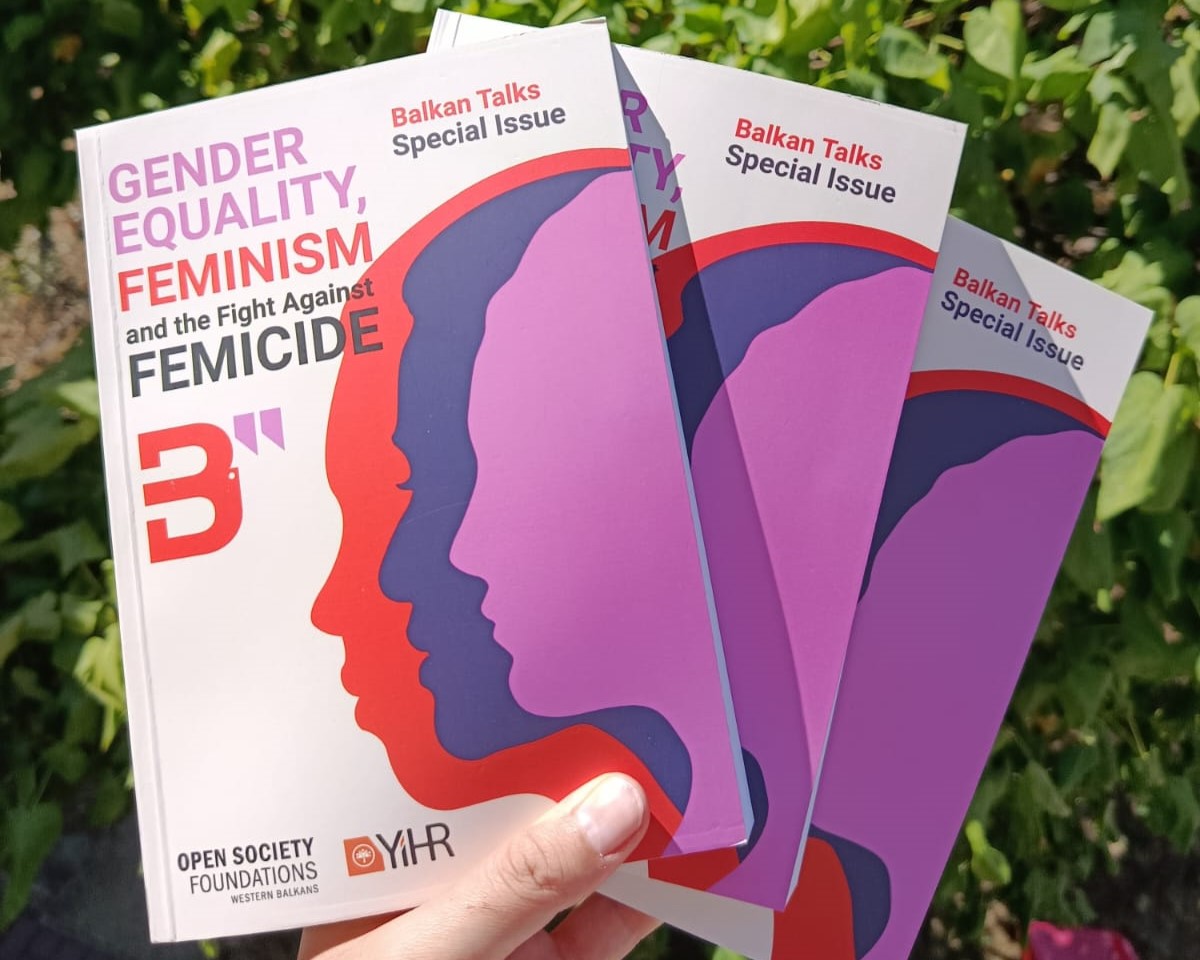
Balkan Talks Special Issue Is Here!
After more than a year of writing, researching, editing, discussing and working across borders, we are happy to share the Balkan Talks Special Issue: Gender Equality, Feminism and the Fight Against Femicide. Across more than 250 pages, the issue brings together 20 authors from 10 countries: Albania, Bosnia and Herzegovina, Bulgaria, Croatia, France, Greece, Montenegro, North Macedonia, Serbia and Slovenia. They are high school students, university students and young researchers, coming from different disciplines and experiences, but sharing a willingness to ask difficult questions about the societies in which we live. This publication grew from something that has been at the heart of Balkan Talks since its beginning: the conviction that young people across the Balkans should have a space to speak in their own voices and to speak to one another. That matters particularly in a region that is still so often described through its divisions. We come from different countries, speak different languages and carry different historical experiences. We do not need to erase those differences in order to work together. Balkan Talks has shown us that crossing them allows us to recognise how many questions we share about equality, safety, memory, discrimination, democracy and the institutions that shape our lives. The message coming from these pages is remarkably clear: young people across the Balkans do not want division to determine the limits of our conversations. Balkan Talks Special Issue Gender Equality, Feminism and the Fight Against FemicideDownload From research to the institutional arena Gender equality, feminism and femicide are the central concerns of this Special Issue, but they open the door to a much broader conversation. The texts address feminist anti-war activism, wartime sexual violence and its aftermath, motherhood and media pressure, sex-selective abortion, women in politics, LGBTQ+ solidarity, Roma women’s empowerment, artificial intelligence and misogyny, cultural representation and women’s resistance. And we wanted different forms of knowledge to have a place here. The issue therefore moves between policy work, research essays, opinion pieces, interviews, poetry and reviews. Some contributions are academic, others are personal. Some investigate institutions, while others turn to literature, film or lived experience. This diversity is deliberate: Balkan Talks gives young authors the freedom to decide which questions are urgent and how they want to approach them. There is, however, a reason why the first major chapter after the foreword is called “Balkan Talkers in the Institutional Arena.” At its centre is Recognising Femicide as a Standalone Crime: Policy and Advocacy Recommendations from Albania, North Macedonia and Serbia, written by Edit Babameto, Angela Dimovska and Jana Krstić. The paper examines legal and institutional responses to femicide in the three countries and develops country-specific recommendations intended for advocacy towards institutions, authorities and the wider public. Its place at the beginning of the publication reflects something important about how we understand Balkan Talks. Our texts are also part of our struggle. Our voices are a form of participation. Research can help us understand the societies around us, but understanding them is not where our responsibility ends. When young people document institutional failure, challenge the language through which violence is normalised, formulate policy recommendations or bring neglected experiences into public discussion, they are already intervening in the world they study. The policy paper itself emerged from the conclusion that another accumulation of data is insufficient when existing research already documents the problem: young researchers and youth leaders also need to bring that knowledge into visible, cross-border advocacy. That is what we mean by entering the institutional arena. We want our work to reach beyond our own pages. 20 authors, many forms, one conversation The Special Issue begins with the policy work of Edit Babameto, Angela Dimovska and Jana Krstić. In Balkan Talkers and the Socially Engaged Academia of the Future, Silvia Fabijanić examines women as agents of change in nonviolent protests in Ukraine and the Balkans; Ema Selimović explores feminist transnational counter-discourse through epistolary exchange during the dissolution of Yugoslavia; and Teodora Milovanović analyses media pressure surrounding motherhood in Serbia. The opinion section brings together Jana Krstić, Dunja Stojanović, Lora Zaharievska, Milica Marković, Almin Šemić, Nina Anžić, Tao Romevo, Stamena Kozić, Jovana Petković and Bojana Vuletić, writing from across the region about wartime sexual violence, sex-selective abortion, femicide and institutional responsibility, women in politics, gender and smoking, the erasure of women through seemingly positive stereotypes, generative AI and LGBTQ+ solidarity. Mary Drosopoulos speaks with Balkan women authors about solidarity with Palestine, while Orida Dajko tells the story of Brisilda Taço and Roma women’s empowerment in Albania. Poetry by Aleksandra Đorđević and Jana Krstić makes room for another language through which gender and lived experience can be expressed. Finally, Milica Jovanov, Almin Šemić and Eirini Tsordia turn to books, theatre and film, asking what culture can tell us about women’s lives and resistance. Together, these contributions refuse the idea that young people are simply waiting for their turn to participate. They are already researching injustice, creating knowledge, questioning inherited assumptions and building relationships across borders. Thank you, Balkan Talkers Above all, this publication belongs to the people who filled its pages. Our deepest thanks go to all of its authors: Edit Babameto, Angela Dimovska, Silvia Fabijanić, Ema Selimović, Teodora Milovanović, Dunja Stojanović, Lora Zaharievska, Milica Marković, Nina Anžić, Almin Šemić, Tao Romevo, Stamena Kozić, Bojana Vuletić, Jovana Petković, Mary Drosopoulos, Aleksandra Đorđević, Eirini Tsordia, Milica Jovanov, Orida Dajko and Jana Krstić. Special thanks go to Milica Jovanov, who created the illustrations and layout for this Special Issue, and Bojana Vuletić, responsible for proofreading and copy editing. The publication was edited by Jana Krstić and published by the Critical Education Centre (CKO), with a print run of 200 copies. Our gratitude also goes to the Balkan Talks editorial board: Jana Krstić, Bojana Vuletić, Eirini Tsordia and Tao Romevo, and to the people whose volunteer work keeps Balkan Talks alive throughout the year: Antonio Nojić, who maintains our website; Jelena Jaćimović and Emilija Krstić, for their design contributions; and Jovana Petković, whose social media work helps our authors and ideas reach young people across the region. We are also grateful to the professors of the CEU's Global Invisible University programme, within whose Balkan courses many of these texts, and Balkan Talks itself, first began to take shape. Balkan Talks remains a volunteer-driven initiative. Behind its articles, illustrations, website, social media and this publication are people who have decided that a regional space for young voices is worth their time and work. Now we want to hear your voice Publishing this Special Issue is a milestone, but it makes sense only if the conversation continues. We want more young people from across the Balkans to enter it. We want voices we have not heard yet, questions we have overlooked and disagreements that force us to think again. We want Balkan Talks to keep growing as a community where education and regional exchange meet. So read the Special Issue. Question it. Disagree with us. Continue an argument that one of our authors has started. Send us your research, essay, poem, review or an idea that does not fit neatly into any of those categories. Become a Balkan Talker. Because every time a young person from Sarajevo reads someone from Skopje, someone from Belgrade works with someone from Tirana, or a conversation begins between people who were taught to think of one another primarily through borders, something important happens. We do not become the same. We become better able to stand together while remaining different. And perhaps that is one of the clearest messages these 260 pages send: the young people of the Balkans are capable of crossing the divisions we inherited and speaking together about the societies we want to build. Follow our web journal and @talksbalkan to find upcoming calls, educational programmes and new opportunities to become part of the community. These are our voices. These are our struggles. And this is a community we are building across borders. Let’s keep Balkan talking! The publication of the Balkan Talks Special Issue and our advocacy for the recognition of femicide as a distinct criminal offence were made possible with the support of the Open Society Foundations (OSF) and the Youth Initiative for Human Rights Serbia (YIHR).

How to Teach Philosophy Differently: Insights from Southern Serbia
How Can We Make Philosophy Teaching FAIR? – Principles of Feminist Reconstructed Philosophy Education is a groundbreaking book that reimagines how philosophy can be taught in high schools—making it fairer, more just, and more inclusive. Developed through action research in classrooms across southern Serbia, this book is both a critical reflection on traditional teaching and a practical handbook filled with ready-to-use lesson ideas. The authors explore one central question through a feminist lens: How can philosophy help change the world? Download the book for free here:👉 Get the PDF The book’s author at the launch event, photo by Emilija Krstic What’s Inside? The book offers: A clear analysis of the current education system in Serbia, mapping challenges and exploring why previous reforms often fell short. Principles and methods for FAIR (Feminist Reconstructed) philosophy teaching, where theory and practice come together as equally important tools. Detailed lesson plans, workshop ideas, and classroom activities, from discussions on gender stereotypes to creative exercises that connect philosophy to everyday life. Open-access materials, all available to download via QR codes in the book, so teachers can easily apply this approach. Accessible even to those new to feminist or education theory, the book draws on current research and real experiences from classrooms. It’s intended for philosophy teachers—and educators in other social sciences—who want to make learning more relevant and engaging. The authors stress that this is not a quick-fix recipe but an invitation to rethink, question, and learn together with young people, in a spirit of solidarity and respect. Action Research That Inspired the Book The book is rooted in action research carried out in late 2024 and early 2025 in five high schools in Niš, Bujanovac, Bela Palanka, and Vlasotince. The authors worked closely with students and teachers to design and test a new approach to philosophy. Lessons were fully participatory—students discussed, shared ideas, and reflected on what they learned and how it made them feel. Many encountered feminist philosophy for the first time, opening space for important conversations about equality, identity, and democracy. The research showed that young people—especially girls—are eager to see contemporary topics and gender equality reflected in their education. A Call for Change Based on this experience, the authors prepared an official proposal to update Serbia’s philosophy curriculum. The proposal calls for: Introducing more women philosophers and gender perspectives. Adopting interactive, student-centered teaching methods. While the Institute for the Improvement of Education has formally received the proposal, it hasn’t yet been approved. Officials have said it will be considered during curriculum revisions planned for late 2025 and early 2026. Meanwhile, the authors and their partners are continuing to advocate for change. They invite teachers, students, parents, and anyone interested to join this effort—by discussing it, sharing information, or reaching out to institutions. This isn’t just about feminist philosophy; it’s about building an education system where critical thinking and fairness truly matter. What Reviewers Are Saying This book was shaped by a community of scholars, teachers, students, and activists. Reviewers describe it as an ambitious and much-needed innovation in Serbian education. Here’s what some of them said: “One of the book’s greatest contributions is that it avoids pseudo-feminist critiques and superficial trends, and instead seriously engages with the question: How does philosophy change the world?”– Eva D. Bahovec, Professor of Philosophy, University of Ljubljana “This is one of the pioneering efforts in our education system, filling a gap that has existed for far too long.”– Daša Duhaček, Professor of Political Theory, University of Belgrade “I hope future generations will learn about feminism early enough that something finally changes—and that girls will feel safer walking alone.”– Adrijana Tomić, high school student, Bujanovac Download the Book How Can We Make Philosophy Teaching FAIR? – Principles of Feminist Reconstructed Philosophy Education is available as a free PDF.👉 Download here Feel free to share it with colleagues, students, and anyone interested in more inclusive and thoughtful education. This project was supported by the National Coalition for Decentralization, Proaktiv, and the Human Rights Committee Niš, funded by the European Union in Serbia.
Challenging Patriarchal Norms: Education as a Tool for Gender Equality in Serbia
In Serbia today, a significant gap persists between the promise of gender equality enshrined in law and the realities of women's lives. While the Constitution guarantees equal rights, and gender quotas mandate at least 40% representation in government bodies, the situation on the ground tells a different story. Women often achieve higher levels of education than men but earn less on average and remain underrepresented in leadership roles. This systemic imbalance highlights the urgent need for action. While non-governmental organizations and research institutes, like the Institute for Philosophy and Social Theory, have long advocated for change, one avenue stands out as particularly transformative: education. But not just any education—comprehensive, inclusive adult education designed to empower women as equal citizens. Education That Deconstructs Patriarchy Why focus on adult education? Traditional schooling often reinforces patriarchal norms under the guise of preserving national identity, particularly in Serbia. Orthodox Christianity, a cornerstone of this identity, has frequently been wielded to uphold "traditional values" that stifle women's progress. This dynamic came to the fore in 2021, when Serbia adopted the Law on Gender Equality. The law aimed to tackle structural inequality but quickly met resistance, particularly from the Serbian Orthodox Church, which actively campaigned against it. Today, the law remains suspended, pending a review by the Constitutional Court. For education to truly liberate, it must address these cultural and ideological barriers head-on. This means engaging with the narratives that have historically oppressed women and offering alternative interpretations. For instance, Christian theology need not be an ally of patriarchy. Feminist interpretations of Christianity emphasize personal freedom and equality, values that align with the goals of women’s emancipation. A Critical Pedagogy for the Western Balkans The method for such education lies in critical pedagogy—a theory of learning rooted in dialogue, empowerment, and social justice. Inspired by Paulo Freire’s work with marginalized populations, critical pedagogy emphasizes not just literacy in reading and writing but also in human rights, democracy, and dignity. In the Western Balkans, where patriarchal and heteronormative "family values" dominate, such an approach could be revolutionary. By teaching adults to critically analyze the cultural and religious narratives shaping their lives, we can dismantle the ideologies that perpetuate inequality. This isn't about rejecting tradition outright but about questioning who benefits from certain interpretations of tradition and whose voices have been excluded. The Role of Christianity in Feminist Pedagogy Christianity's relationship with critical pedagogy is complex. In South America, Freire’s work drew heavily on liberation theology, a movement within Christianity that aligns closely with feminist ideals of love, equality, and freedom. In North America, critical pedagogues like Henry Giroux and Peter McLaren have used similar frameworks to confront evangelical fundamentalism and promote inclusive, democratic education. In the Balkans, however, Christianity often aligns with patriarchal family values, resisting discussions on gender equality and sexual education. Yet, even in Serbia, there are theological traditions that advocate for liberation and equality. Incorporating these perspectives into adult education programs could offer a powerful counter-narrative to the dominant patriarchal discourse. Why Education Matters Education is a slow but powerful force for change. By equipping women with the tools to analyze and challenge oppressive structures, we create a ripple effect that can transform entire communities. Adult education, in particular, allows women who may have missed earlier opportunities to engage with empowering ideas and build new futures for themselves and their families. The Western Balkans is at a crossroads. As traditional values clash with modern aspirations for equality, the region must decide whether to cling to outdated ideologies or embrace a future where everyone—regardless of gender—has an equal chance to thrive. Through critical, inclusive education, we can begin to tip the scales toward the latter.