
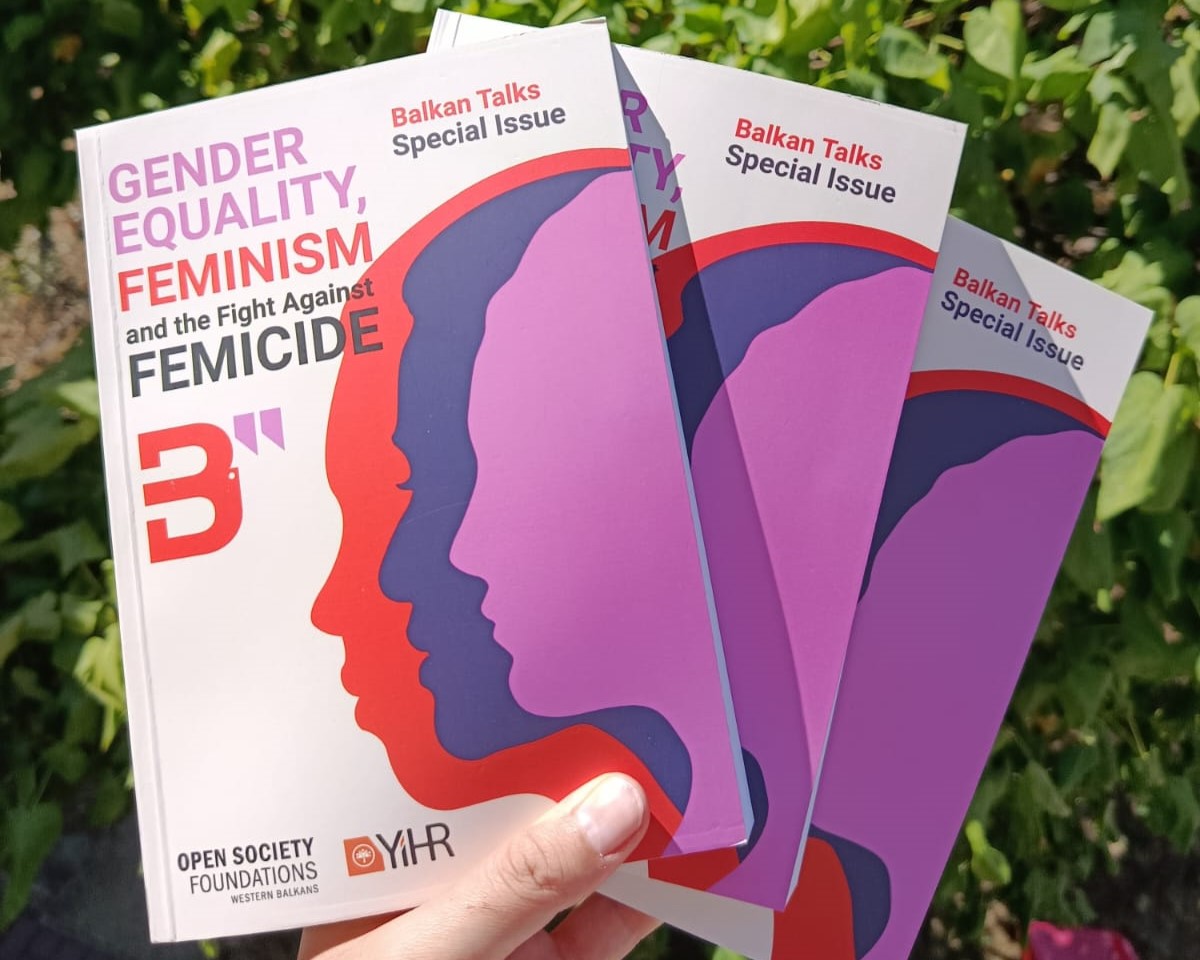
Balkan Talks Special Issue Is Here!
After more than a year of writing, researching, editing, discussing and working across borders, we are happy to share the Balkan Talks Special Issue: Gender Equality, Feminism and the Fight Against Femicide. Across more than 250 pages, the issue brings together 20 authors from 10 countries: Albania, Bosnia and Herzegovina, Bulgaria, Croatia, France, Greece, Montenegro, North Macedonia, Serbia and Slovenia. They are high school students, university students and young researchers, coming from different disciplines and experiences, but sharing a willingness to ask difficult questions about the societies in which we live. This publication grew from something that has been at the heart of Balkan Talks since its beginning: the conviction that young people across the Balkans should have a space to speak in their own voices and to speak to one another. That matters particularly in a region that is still so often described through its divisions. We come from different countries, speak different languages and carry different historical experiences. We do not need to erase those differences in order to work together. Balkan Talks has shown us that crossing them allows us to recognise how many questions we share about equality, safety, memory, discrimination, democracy and the institutions that shape our lives. The message coming from these pages is remarkably clear: young people across the Balkans do not want division to determine the limits of our conversations. Balkan Talks Special Issue Gender Equality, Feminism and the Fight Against FemicideDownload From research to the institutional arena Gender equality, feminism and femicide are the central concerns of this Special Issue, but they open the door to a much broader conversation. The texts address feminist anti-war activism, wartime sexual violence and its aftermath, motherhood and media pressure, sex-selective abortion, women in politics, LGBTQ+ solidarity, Roma women’s empowerment, artificial intelligence and misogyny, cultural representation and women’s resistance. And we wanted different forms of knowledge to have a place here. The issue therefore moves between policy work, research essays, opinion pieces, interviews, poetry and reviews. Some contributions are academic, others are personal. Some investigate institutions, while others turn to literature, film or lived experience. This diversity is deliberate: Balkan Talks gives young authors the freedom to decide which questions are urgent and how they want to approach them. There is, however, a reason why the first major chapter after the foreword is called “Balkan Talkers in the Institutional Arena.” At its centre is Recognising Femicide as a Standalone Crime: Policy and Advocacy Recommendations from Albania, North Macedonia and Serbia, written by Edit Babameto, Angela Dimovska and Jana Krstić. The paper examines legal and institutional responses to femicide in the three countries and develops country-specific recommendations intended for advocacy towards institutions, authorities and the wider public. Its place at the beginning of the publication reflects something important about how we understand Balkan Talks. Our texts are also part of our struggle. Our voices are a form of participation. Research can help us understand the societies around us, but understanding them is not where our responsibility ends. When young people document institutional failure, challenge the language through which violence is normalised, formulate policy recommendations or bring neglected experiences into public discussion, they are already intervening in the world they study. The policy paper itself emerged from the conclusion that another accumulation of data is insufficient when existing research already documents the problem: young researchers and youth leaders also need to bring that knowledge into visible, cross-border advocacy. That is what we mean by entering the institutional arena. We want our work to reach beyond our own pages. 20 authors, many forms, one conversation The Special Issue begins with the policy work of Edit Babameto, Angela Dimovska and Jana Krstić. In Balkan Talkers and the Socially Engaged Academia of the Future, Silvia Fabijanić examines women as agents of change in nonviolent protests in Ukraine and the Balkans; Ema Selimović explores feminist transnational counter-discourse through epistolary exchange during the dissolution of Yugoslavia; and Teodora Milovanović analyses media pressure surrounding motherhood in Serbia. The opinion section brings together Jana Krstić, Dunja Stojanović, Lora Zaharievska, Milica Marković, Almin Šemić, Nina Anžić, Tao Romevo, Stamena Kozić, Jovana Petković and Bojana Vuletić, writing from across the region about wartime sexual violence, sex-selective abortion, femicide and institutional responsibility, women in politics, gender and smoking, the erasure of women through seemingly positive stereotypes, generative AI and LGBTQ+ solidarity. Mary Drosopoulos speaks with Balkan women authors about solidarity with Palestine, while Orida Dajko tells the story of Brisilda Taço and Roma women’s empowerment in Albania. Poetry by Aleksandra Đorđević and Jana Krstić makes room for another language through which gender and lived experience can be expressed. Finally, Milica Jovanov, Almin Šemić and Eirini Tsordia turn to books, theatre and film, asking what culture can tell us about women’s lives and resistance. Together, these contributions refuse the idea that young people are simply waiting for their turn to participate. They are already researching injustice, creating knowledge, questioning inherited assumptions and building relationships across borders. Thank you, Balkan Talkers Above all, this publication belongs to the people who filled its pages. Our deepest thanks go to all of its authors: Edit Babameto, Angela Dimovska, Silvia Fabijanić, Ema Selimović, Teodora Milovanović, Dunja Stojanović, Lora Zaharievska, Milica Marković, Nina Anžić, Almin Šemić, Tao Romevo, Stamena Kozić, Bojana Vuletić, Jovana Petković, Mary Drosopoulos, Aleksandra Đorđević, Eirini Tsordia, Milica Jovanov, Orida Dajko and Jana Krstić. Special thanks go to Milica Jovanov, who created the illustrations and layout for this Special Issue, and Bojana Vuletić, responsible for proofreading and copy editing. The publication was edited by Jana Krstić and published by the Critical Education Centre (CKO), with a print run of 200 copies. Our gratitude also goes to the Balkan Talks editorial board: Jana Krstić, Bojana Vuletić, Eirini Tsordia and Tao Romevo, and to the people whose volunteer work keeps Balkan Talks alive throughout the year: Antonio Nojić, who maintains our website; Jelena Jaćimović and Emilija Krstić, for their design contributions; and Jovana Petković, whose social media work helps our authors and ideas reach young people across the region. We are also grateful to the professors of the CEU's Global Invisible University programme, within whose Balkan courses many of these texts, and Balkan Talks itself, first began to take shape. Balkan Talks remains a volunteer-driven initiative. Behind its articles, illustrations, website, social media and this publication are people who have decided that a regional space for young voices is worth their time and work. Now we want to hear your voice Publishing this Special Issue is a milestone, but it makes sense only if the conversation continues. We want more young people from across the Balkans to enter it. We want voices we have not heard yet, questions we have overlooked and disagreements that force us to think again. We want Balkan Talks to keep growing as a community where education and regional exchange meet. So read the Special Issue. Question it. Disagree with us. Continue an argument that one of our authors has started. Send us your research, essay, poem, review or an idea that does not fit neatly into any of those categories. Become a Balkan Talker. Because every time a young person from Sarajevo reads someone from Skopje, someone from Belgrade works with someone from Tirana, or a conversation begins between people who were taught to think of one another primarily through borders, something important happens. We do not become the same. We become better able to stand together while remaining different. And perhaps that is one of the clearest messages these 260 pages send: the young people of the Balkans are capable of crossing the divisions we inherited and speaking together about the societies we want to build. Follow our web journal and @talksbalkan to find upcoming calls, educational programmes and new opportunities to become part of the community. These are our voices. These are our struggles. And this is a community we are building across borders. Let’s keep Balkan talking! The publication of the Balkan Talks Special Issue and our advocacy for the recognition of femicide as a distinct criminal offence were made possible with the support of the Open Society Foundations (OSF) and the Youth Initiative for Human Rights Serbia (YIHR).