

Discursive Veto. How Kosovo and Historical Narratives Enable Serbia to Maneuver Between East and West?
Author: Daria Vorobiova Serbia in the modern geopolitical situation is perceived as a country caught between two fires: the West and the East. Its indicative neutrality, not associating itself with any global organization and acting as a "third party," is telling. In reality, this political ambivalence has calculated mechanisms used by statesmen to preserve their political position and policy of "securing funding without additional obligations," while in return manipulating public opinion. Illustration photo. Retrieved from Pexels (www.pexels.com) Neither to the West, nor to the East Looking at survey results on the political preferences of Serbs reveals a deeply divided population: for instance, a telling example is the 2023 WFD survey. It showed that 43% of Serbs believe they should rely on Russia in international relations, and only 25.8% of respondents stated they should rely on the European Union. Also notable is the question of whether Serbia belongs to the West or the East: 42% of respondents answered that Serbia is not part of either, while the same proportion answered logically about belonging to the West or the East. Serbian society is extremely fragmented in its political preferences: this problem leads to a general instability of civic engagement in politics, as without consensus among the sides, it is impossible to exert strong civic influence on the political life of the state as a whole [1]. How much does the state influence the political preferences of Serbs? Following data from the same survey, it is evident that 59.2% of respondents note that they view political information about events in Serbia through television. The state exerts sufficient influence on television, considering channels like RTS, RTV Pink, Happy TV, which are known for publishing information deliberately portrayed in a light favorable to the state. Under such conditions, the question arises – if a large number of citizens receive such information, can their political preferences be genuinely logical and justified? [2] Also, television programs have been observed deliberately portraying the EU in a bad light, while Russia is presented in the moral image of a fraternal state. The key problem with this presentation of information is the excessive moralization of "good" Russia and "bad" European Union. Typically, this moral assessment is based solely on subjectivity, in no way appealing to rational reflections on the benefits of such "friendship" for Serbia [3]. And it is precisely the "moral" justification, as well as the "moral boundaries of the permissible," that allow Serbian politicians to maintain their position for as long as possible, instilling in citizens an unstable pluralism of opinions to weaken their civic stance. The problem of "moralizing" politics as a key factor of ambivalence This appeal to everything moral begins with historical origins and serves as the foundation for forming nationalist narratives. The narratives consist of three components: the "victim question," the "pride question," and the main unifying factor, the moral discursive veto point. By combining these components, it becomes possible to manipulate public opinion, set the boundaries of discourse to slow down potential civic activity, and at the necessary moment say: "here is the boundary you must not cross." The "victim question" is characterized by a moral appeal to grievance, primarily towards the West, which in the narratives is viewed as a military aggressor (following the events of 1999) protecting Kosovo (which is a sacred question of the origin of statehood), and also as an economic usurper (the European Union as an economic organization where, upon accession, Serbia would lose its informal independence). An image of an enemy is created, but also an image of a savior, a potential "fraternal state" that can selflessly help Serbia escape crude dependence on the "humiliating" West. Russia occupies this role, but in the case of investments and their positive influence, China can also be considered. The "pride question" is characterized by a centuries-long history of battles (for example, the Battle of Kosovo) and the preservation of the nation and its culture during long periods of statelessness. This factor is supposed to act as a unifying force ("we have only ourselves, and no one will help us except us") and one that reduces the factor of destabilization, since there are "enemies" against which Serbia must be ready to act as a united front in case of danger. The unifying factor is the Kosovo question – less as a territorial issue and more as a discursive veto point: it marks the limit beyond which reform, recognition, or alignment becomes politically illegible. Since many reforms for EU accession and funding require normalization of relations with Kosovo and its recognition as a separate state, Serbian politicians (for example, Aleksandar Vučić) support the aforementioned narratives precisely on this issue. A. Vučić's speech on 04.11.2025 in Brussels: «Neću da priznam Kosovo da bismo ušli u EU» ("I will not recognize Kosovo so that we enter the EU") [4]; In an address to the people of Kosovo: «ne postoji „dobro rešenje kosovskog problema za Srbe“ i da ga nikada neće biti» ("there is no 'good solution to the Kosovo problem for Serbs' and there never will be"), «Srbi bili najstradalniji narod na Kosovu» ("Serbs were the most suffering people in Kosovo") [5]; speech at the Palace of Serbia: «Vučić je rekao da je Kosovo (...) našom zemljom u skladu sa Ustavom Republike Srbije i Poveljom Ujedinjenih nacija i Rezolucijom 12.44» ("Vučić said that Kosovo (...) is our land in accordance with the Constitution of the Republic of Serbia and the Charter of the United Nations and Resolution 1244") [6]. These three factors help form a stable national narrative, which allows simultaneously maintaining the image of the EU as an "enemy" while preserving active economic relations. Naturally, it is assumed that when using this funding as outlined in the documentation, Serbia should join the European Union after meeting all conditions. Is such a policy feasible? Active neutrality Serbia's neutrality is not an absence of policy but its active form, maintained by state elites through media propaganda, fragmenting Serbian society and helping to brake at the right moments and shift the blame to the "enemy," not to Serbia. The European Commission has noted that Serbia is moving too slowly in implementing necessary reforms, especially those related to freedom of speech, eliminating corruption, and normalizing relations with Kosovo [7]. The question of slowness also became important in cases where the EU itself delayed necessary payments to Serbia, demanding additional guarantees that the funds would be spent in the intended direction [8]. Such neutrality helps Serbian political elites navigate relations with the European Union: maintaining the possibility of obtaining economic and political resources while keeping a political distance from it, simultaneously shifting responsibility for the stagnation of reforms onto "enemies" and unsolvable historical traumas inflicted by these same "enemies." The price of this strategy is the weakness of fragmented civic pressure, the slowdown of necessary reforms, and the dependence of the political course on a constantly perpetuated conflict that does not approach resolution if Serbia truly chooses a European path. In this context, the key question is not which side Serbia will join in the future, but how long civil society can exist in a state-managed ambivalence, how long it can survive without the reforms it tries to grasp through protests. Bibliography: “Opinion Poll Report: Socio-political Views of Serbian Citizens in 2023.” WFD. Westminster Foundation for Democracy (WFD), Serbia, 2023. https://www.wfd.org/sites/default/files/2023-04/wfd_nws_2023_eng_final.pdf. “Defunding Disinformation in the Balkans. How International Brands Support Russia’s Agenda.” by BFMI & CRTA, n.d. https://crta.rs/wp-content/uploads/2023/12/CRTA_BFMI_Defunding_Disinformation_in_the_Balkans_Report.pdf. “Media Monitoring of Foreign Actors.” CRTA. https://crta.rs/en/media-monitoring-of-foreign-actors-november-2024/. B92. “Vučić: Neću Da Priznam Kosovo Da Bismo Ušli U EU; Postoji Mogućnost Da Otvorimo Klaster 3 Pre Kraja Godine.” B92.net, November 4, 2025. https://www.b92.net/info/politika/178701/vucic-necu-da-priznam-kosovo-da-bismo-usli-u-eu-postoji-mogucnost-da-otvorimo-klaster-3-pre-kraja-godine/vest РТС. “Vučić Za Veltvohe: Potrebno Kompromisno Rešenje Za KiM, a Ne Da Albanci Dobiju Sve, a Srbi Ništa,” n.d. https://www.rts.rs/lat/vesti/politika/5462184/vucic-za-veltvohe-potrebno-kompromisno-resenje-za-kim-a-ne-da-albanci-dobiju-sve-a-srbi-nista.html. Urednik. “Vučić Odgovorio Evropskom Diplomati: Kosovo Je Dio Srbije - Top Portal.” Top Portal, November 6, 2025. https://topportal.info/vucic-odgovorio-evropskom-diplomati-kosovo-je-dio-srbije/. Belgrade, N1. “EC Report Says Serbia Slow on Credible Reforms.” N1 Info RS, November 4, 2025. https://n1info.rs/english/news/ec-report-says-serbia-slow-on-credible-reforms/. Rakic, Snezana. “Why Is Serbia Still Waiting for EU Funds That Its Neighbours Have Received?” Serbian Monitor, May 23, 2025. https://www.serbianmonitor.com/en/why-is-serbia-still-waiting-for-eu-funds-that-its-neighbours-have-received/.
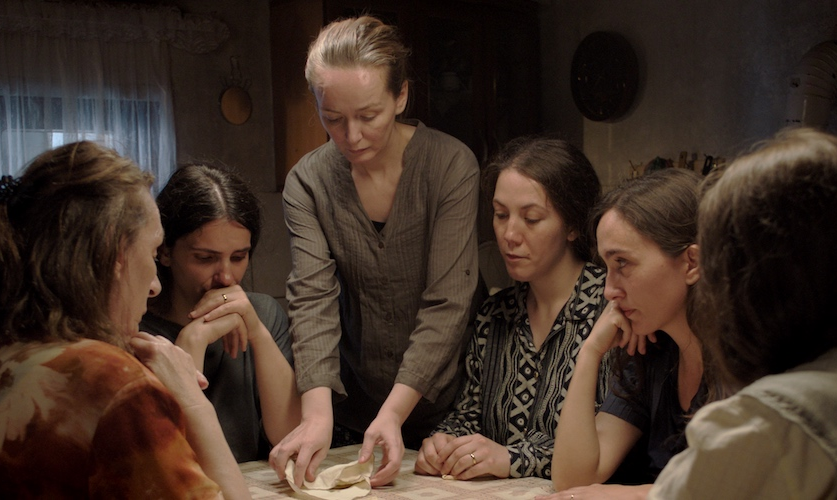
Hive (2021): A Powerful Tale of Resilience and Empowerment in Kosovo Cinema
Since Serbian militias entered villages in the Kosovar province in 1999, many boys and men have been missing, including Fahrije’s husband—a single parent who had been caring for their two children and her disabled father-in-law. Left to ensure her family’s survival, Fahrije takes matters into her own hands. She first obtains a driver’s license, then starts a small business, actions that provoke the wrath of the conservative, patriarchal local society. The director, Blerta Basholli, originally from Kosovo, first encountered Fahrije Hoti’s story during an interview she gave on American television, in which she discussed the backlash she faced for seeking independence and proposing a cooperative to provide work for other widows in her community. At the time, the director was living in New York on a scholarship. Initially, she mistook the story for a joke due to her emotional and geographical distance from Kosovo. However, upon realizing the seriousness of Fahrije’s situation, she was inspired to delve deeper. Captivated by the story, the director began writing and directing what would eventually become Hive in 2011. A decade later, the film made history by winning all three major awards in the World Cinema section at the Sundance Film Festival—the only film to ever achieve this feat. Basholli approaches the story with restraint and confidence, avoiding unnecessary melodrama or overemphasis. This is a tale of humanity and resistance, framed by a clear feminist perspective. In Hive, patriarchy is represented not only through visible actions—such as stones smashing Fahrije’s car windows, her father-in-law’s objections or an attempted assault by a supplier—but also through the absence of a male protector. The ghost of patriarchy lingers in the perception that Fahrije’s efforts to support herself dishonor her missing husband. Her grief is entangled with guilt: if her husband is dead, her actions are seen as a confirmation of his death, dissolving their marriage, and rejecting her eternal dependence on him. If, by some miracle, he were alive, many believe he would feel ashamed of her. Fahrije’s husband thus becomes like Schrödinger’s cat—both alive and dead—while society seeks to confine her autonomy. The backdrop of numerous missing persons and the ongoing search for their remains adds an emotionally charged layer to the narrative, making Hive reminiscent of Parallel Mothers by Pedro Almodóvar. However, unlike Almodóvar’s melodramatic approach to historical tragedy, Basholli masterfully integrates the collective trauma of a community with one woman’s personal journey toward emancipation. Fahrije’s struggle becomes an example for the other widows in her village, who rally around her. Central to Fahrije’s transformation is her evolving relationship with her late husband’s beehive, which gives the film its title. Initially, she is a foreign presence, vulnerable to stings despite protective gear, and haunted by the notion that her husband had "never been stung." However, as she confronts societal obstacles and normalized misogyny disguised as tradition, she finds her strength. She emerges as the queen of the hive, uniting the worker bees to create an independent, resilient ecosystem that requires no male master. This symbolism underscores the real-life success of Fahrije and her colleagues, celebrated in the film’s credits. This way, Hive highlights the critical importance of women’s solidarity in challenging male dominance. Fahrije’s story is one of hope in a nation still haunted by the ghosts of a brutal war. The fact that the narrative is based on true events and a real woman makes its impact even more profound.