
Flamingo Revolution Chronicles – The protest versus Rama’s “algorithm”: voices from the square speak out
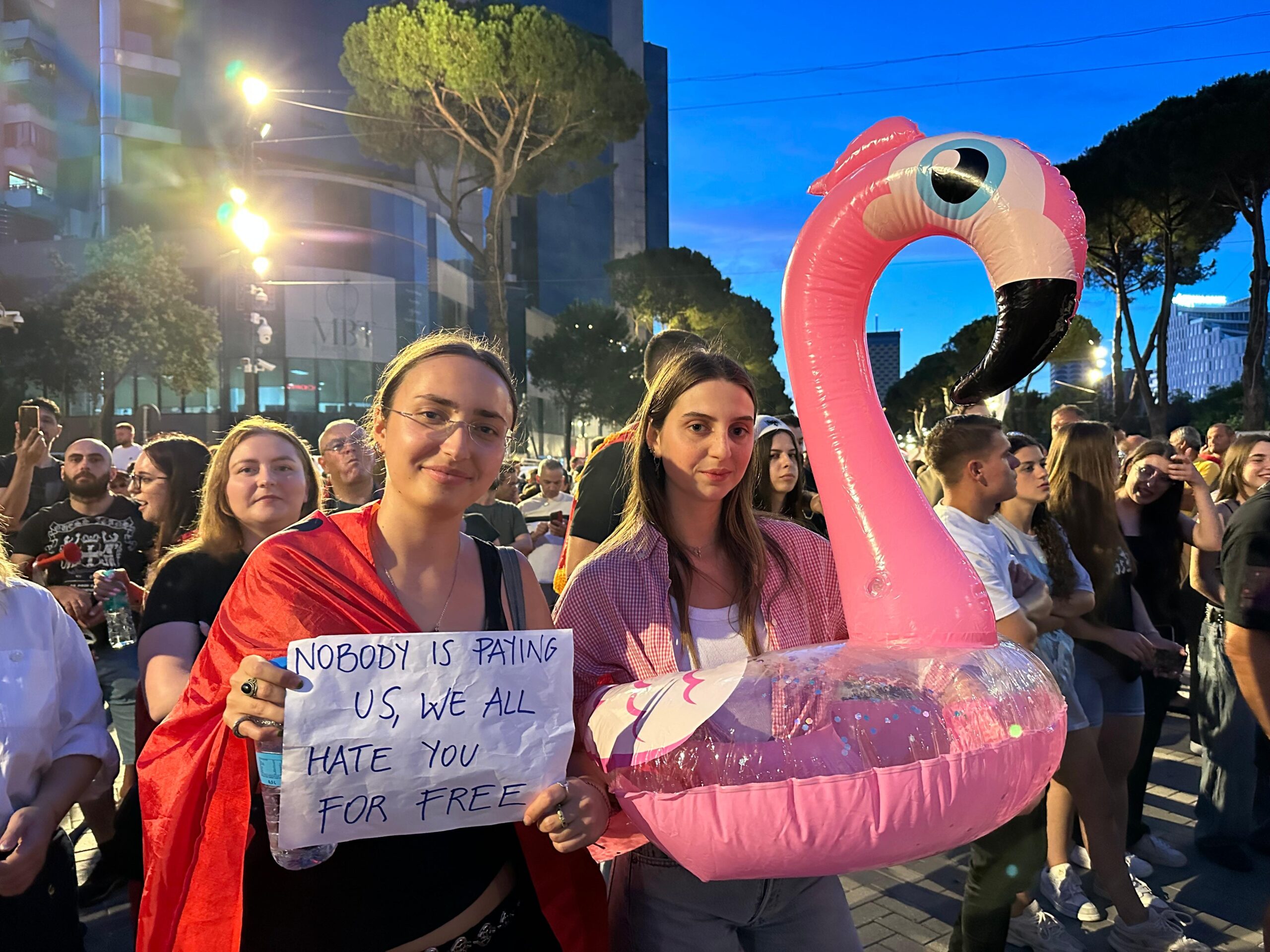
Rama described the square as a “television studio for the algorithm.” Eight voices involved in the protest tell Faktoje how work is divided on the ground, where different approaches clash, and what may come after day 51. Author: Jona Cenameri The original article was published on Faktoje, you can read it here. Photo: Jona Cenameri “The square is simply a television studio for the algorithm. It is the place where material is filmed to feed the algorithm and justify it,” Prime Minister Edi Rama said on June 20 during a meeting of the Socialist Party Parliamentary Group. Rama argued that the algorithm rewards conflict, outrage and intimidation, while describing the protest in these terms: “A protest is no longer a protest. It is a stage, a marketplace, a marketplace of emotions, clicks, morality, and even careers.” On July 11, during a conversation with young people in Jalë, the prime minister added nuance to this position. “I did not say that the algorithm was the reason for the protest,” Rama said. He acknowledged that the protest had causes rooted in citizens’ everyday lives, but argued that the algorithm amplified noise, dissatisfaction, manipulated videos and fake news, which, according to him, “pour fuel on a fire that was not started by the algorithm, but by people.” Rama added that the algorithm was not the organiser of the protest and that a distinction had to be made between “where the protesters’ genuine motivation ends” and where manipulation by other actors begins. On July 19, protesters gathered in Tirana for the 50th consecutive day to demand Prime Minister Rama’s resignation. The nightly protest in the capital, which began as a reaction to violence and in defence of Zvërnec, has continued without interruption since May 31, 2026. What is happening? To understand what is happening beyond the content circulating on social media, Faktoje interviewed eight people involved in the protest in different ways. Their accounts do not represent the entire protest and do not claim to summarise the views of every participant. They are some voices among the many voices, groups and currents that coexist in the square. Nevertheless, they help shed light on the origins of the discontent, the way the protest is organised, the role of digital platforms and the debates over how it should continue. Zvërnec For environmental expert Olsi Nika, the events in Zvërnec were “the last straw,” though not necessarily the only event that could have triggered such a reaction. According to him, the spark could just as easily have come from the dragging of a woman in Rrjoll, the protest by mussel farmers in Butrint, or an issue such as the treatment of cancer patients, among others. “The glass has to fill before it overflows. This was the drop that made it overflow,” Nika says. He considers it significant that the spark this time was environmental, since interventions in the territory and protected areas had long generated dissatisfaction but had never before provoked such a broad reaction. For Nika, Zvërnec should not be seen only as the place where the episode that triggered the protest occurred. He describes it as “one of the most representative images” of the problems created during Albania’s transition. In his view, “Zvërnec brought together unresolved property disputes, the dominance of private interests, the role of private security and the lack of an immediate institutional response.” He sees the fence and the violence against the protester as “symbols of a relationship in which the citizen is confronted not by institutions, but by private interests operating on the ground.” Nika also criticises the way part of the media covered the event and the protest. According to him, the incident in Zvërnec initially did not receive the attention it deserved, while later coverage focused mainly on the microphone and the speakers outside the Prime Minister’s Office, leaving out other voices from the square. “Zvërnec is a mirror that showed how things are done in Albania,” he says. According to Nika, the protest quickly moved beyond its initial environmental cause. Photo: Jona Cenameri The leadership Those interviewed generally agree that the protest is not being directed by a single hand. “Is there one central organiser? No. Are there groups coordinating in order to contribute? Yes, and there are several of them,” says Migen Qiraxhiu, activist and co-founder of Civic Resistance. According to him, one of the reasons the protest has maintained participation is the belief among citizens that they are not being used to serve a single individual or political force. Within the protest, Qiraxhiu says, there are young people who take care of the children’s area, students who create installations and placards, the drum and flamingo group, people who manage the sound area, and young people who organise the march after the formal part of the protest outside the Prime Minister’s Office ends. “The protest has many voices, many groups and many forms of contribution, and that is precisely one of its greatest strengths,” Qiraxhiu says. Natasha Paja, a designer and member of the Trivet Art group, describes the organisation through the concrete division of tasks. “Someone makes sure the microphone runs smoothly, someone takes care of the children’s creative corner, someone handles the rhythm of resistance, someone else the chants. There are people who contribute to communication with the diaspora and a group that takes care of the evening march,” she says. According to Paja, the organisation is horizontal: people become involved wherever they are able to contribute, without a leader who has the legitimacy to make decisions on behalf of the entire protest. Entela Ndrevataj, a feminist activist and member of the Feminist Collective, a voluntary and autonomous community, also says the protest does not have a classical structure, but that this is precisely what has created space for different groups. “The square is a shared space and, as such, no group has imposed itself over another,” she says. For Ndrevataj, corruption is also “intertwined with an authoritarian and patriarchal way of exercising power, where decisions are made from above and public wealth is treated as private property.” The flamingos Sokol Çunga, an activist, historian and translator, participates as an individual rather than as part of an organisational structure. He describes the protest as sincere and articulated not only through the microphone, but also through placards and the flamingos. When it comes to the level of coordination, Çunga is more sceptical. “The only coordination I see is the time and place, and ‘who is going to transport the flamingos?’” he says. According to him, the crowd changes every day in form, size and composition and does not come to the square under direction or with a completely unified goal. For this reason, Çunga does not believe that the protest, as a single body, can draft detailed political or institutional plans. “The next steps remain simpler and more tangible: every day on the boulevard!” The organising group Unlike participants who see only dispersed coordination, Ilir Xhemalaj, activist and founder of the National Union of Telephone Operators, says that from the first day there has been a group of activists responsible for the smooth running of the formal part of the protest. According to him, the group is made up of environmental activists, trade unionists, oil workers and people from other fields. They take care of the sound system, the speakers and the organisation of the gathering outside the Prime Minister’s Office. “The sound system comes at a cost, which all of us activists have paid out of our own pockets,” Xhemalaj says. He explains that, apart from several intellectuals who were invited at the beginning, the other speakers wait their turn to take the microphone. “The only criterion for speakers is to wait your turn. One person comes off, another goes on, and everyone speaks about their own views and concerns,” he says. According to Xhemalaj, the group’s responsibility ends when the speeches finish. The march that follows and other actions may be organised by different people and are not automatically decisions made by the same group. For Xhemalaj, the importance of digital platforms has been undeniable. “It is precisely social media that has made it possible for this protest to function, develop and grow in size. Gen Z has managed to use social media very effectively to call on people to come out into the square,” he says. Photo: Jona Cenameri The algorithm Migen Qiraxhiu turns the prime minister’s argument about the algorithm in the opposite direction. According to him, Rama had no problem with the algorithm when digital communication kept attention focused on the government and on Rama himself. “The problem begins when the algorithm is no longer on his side. The algorithm does not create events by itself; it follows the interest, reaction and attention generated by a real event,” Qiraxhiu says. In his view, the protest “has taken not only the square and the public debate, but the algorithm as well.” Arnen Sula clarifies that the organisation he leads is not part of the protest’s organisational structure and that he participates as a citizen and activist. “Every protest is measured by the people who take part in it, not by algorithms,” Sula says. “Digital platforms can help with organisation and communication, but they cannot replace the physical presence of citizens.” According to him, when citizens continue to come to the square for weeks, it shows that there is a concern that cannot be reduced to a social media phenomenon. Olsi Nika interprets Rama’s focus on the algorithm as an attempt to avoid responsibility for the causes that produced the protest. “To deny that there is a protest when people are in the square, when the protest is being covered across the media and when there is an extraordinary outpouring of anger online as well, and to call all of this simply an algorithm, is a tactic belonging to a failed strategy,” he says. The microphone The very element that Xhemalaj presents as organisational work, the sound system and the speaking order, is viewed sceptically by Olsi Nika. Nika says that the people around the microphone represent only one part of the protest. “Both technically and physically, there is another protest where the microphone can no longer be heard,” he says. According to him, the cameras’ focus on the improvised podium creates the impression that the speakers represent the entire square, while leaving out participants standing farther away and their reasons for protesting. Nika also sees the microphone as carrying the risk of personal protagonism and the controlled release of revolt. “I consider the microphone to be the instrument that kills the protest and kills the revolt,” he says. For Xhemalaj, the sound system is necessary infrastructure for giving different groups and citizens a voice. For Nika, focusing on the microphone can create a hierarchy of visibility within a protest that presents itself as horizontal. Politics There are also activists and representatives in the square with political affiliations. Emiljando Kita, an activist with Together Movement (Lëvizja Bashkë), says he supports the demands articulated by protesters, from the repeal of the contested laws to the resignation of the prime minister. “When people take to the streets, coordination happens naturally because the objective is shared,” he says. The protest has also brought representatives and activists from other political forces into the square, including the Opportunity Party (Partia Mundësia), the Albania Becomes Movement Party (Partia "Lëvizja Shqipëria Bëhet") and the Democratic Party (Partia Demokratike), the latter mainly through its youth members. Migen Qiraxhiu argues that one reason the protest has not become fully identified with any single political force is that its messages have been critical of the two main political figures of Albania’s transition, Edi Rama and Sali Berisha. The “National Assembly” The clearest disagreement over the future of the protest concerns the idea of creating a “National Assembly” or citizens’ assembly. Ilir Xhemalaj says the initiative is not intended to speak on behalf of the protest or to establish parallel institutions. It is meant to serve as a space where citizens and intellectuals can offer ideas about how the protest should continue. Xhemalaj clarifies that the Assembly has not yet been created; only a few meetings of the working group for its formation have taken place. “We are preparing for a marathon, we are preparing for a long battle, and naturally we need everyone’s ideas,” he says. Other protesters view the initiative with reservations. Migen Qiraxhiu says he had joined a WhatsApp group where the idea was being presented, but left after reading the materials. He considers it legitimate to create new initiatives, including organisations or political parties, but opposes any claim to speak on behalf of the entire protest without a clear mandate. “Every initiative has the right to organise and propose ideas, but it must be clear that it represents only its founders and supporters, not automatically all protesters,” he says. Arnen Sula also believes that a National Assembly could create the perception that one group is assuming representation of a square that has no centralised structure. Natasha Paja calls the initiative “an old method for an old concept,” while Entela Ndrevataj says that, at this stage, the square should remain the main space and that one group should not place itself above the majority. For Sokol Çunga, the information circulated about the initiative was unclear and gave the impression of a chaotic process. He does not believe that such an assembly could confront the existing political forces and sees mass, peaceful protest as the main instrument. Olsi Nika is more critical. He regards such structures as parallel ones and argues that change should come through existing mechanisms: the vote, parliament, the justice system and the media. According to him, the energy of the square should exert pressure on these mechanisms to function, rather than replacing them with a structure that has no mandate from all protesters. Photo: Jona Cenameri What comes next After 51 days of protest, those interviewed do not present a single strategy. Their positions can broadly be divided between continuing pressure in the square, moving towards institutional action, and the need for more structured organisation. Sokol Çunga calls for a continued daily presence on the boulevard. Natasha Paja also sees the square as the priority, but says that work should continue in parallel on legal aspects, communication with European institutions and actions in other parts of the country. Entela Ndrevataj believes it is still too early to create a movement with a leadership and formal representation. She proposes closer cooperation among legal, media and environmental experts while preserving transparency and the horizontal character of the protest. Arnen Sula places emphasis on sustainability and on linking public pressure with justice institutions. “The protest cannot replace justice, but it can support it by demanding accountability and by not allowing issues to be forgotten,” he says, mentioning SPAK and other responsible bodies. Migen Qiraxhiu proposes legal initiatives, institutional requests, monitoring, documented reports of wrongdoing and stronger mechanisms of civic oversight. “The wounds of 36 years of transition cannot be healed in 43 days,” he says. For Qiraxhiu, one of the most important outcomes of the protest could be a change in the relationship between citizens and those in power: from citizens asking politicians for photographs to citizens filming them and demanding accountability. Ilir Xhemalaj calls for broader organisation, stronger links with regions outside Tirana and with the diaspora, and preparation for continuing through the summer. “The protest will continue without stopping until September,” he said during the interview, describing the summer as the main challenge to maintaining participation. Emiljando Kita sees the way forward as a combination of pressure in the square, political action and legal complaints. Olsi Nika offers the most critical assessment of the stage the movement has reached. According to him, the protest clearly knows what it does not want, the government and the current way in which power is exercised, but has not yet managed to articulate with equal clarity the political and institutional model it wants to build. “The protest is dead; long live the protest,” Nika says. He calls for lawyers, economists, journalists, analysts and experts to reorganise so that the energy of the protest can be transformed into argument, institutional pressure and concrete action. According to him, the protest could enter a phase in which it is “smaller in numbers, but much stronger in argument,” a process he believes could take shape in September. Social media Social media has played an important role in the mobilisation, growth and visibility of the protest. None of the voices interviewed denies this. But behind the online content there is also real organisation, even if it remains dispersed and without a single centre of leadership.
Flamingo Revolution Chronicles – How Rama’s position on protected areas changed
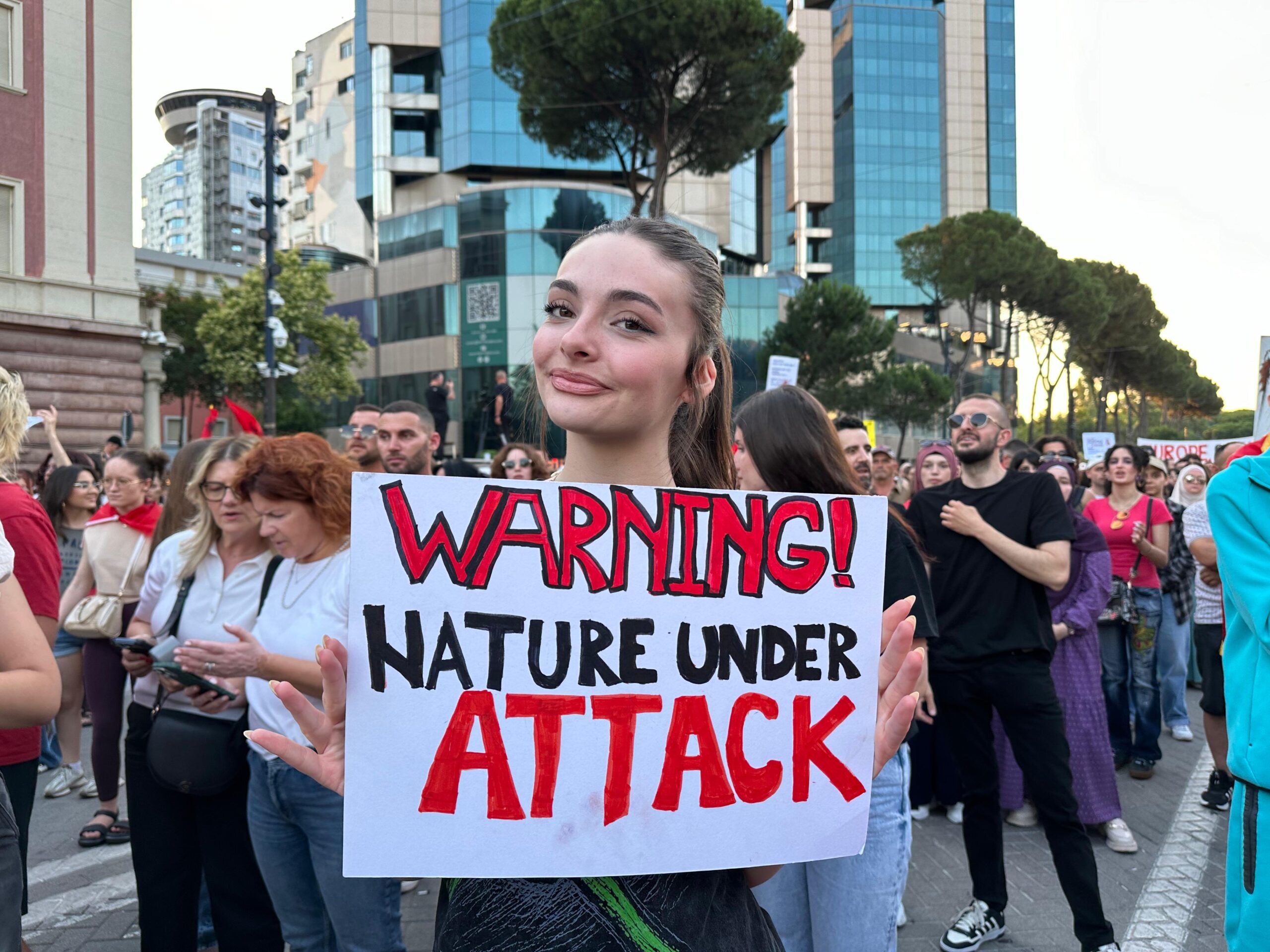
After the adoption of Law No. 21/2024, Rama said the amendments were “100% aligned with the European Union.” Today, his position has changed. Author: Jona Cenameri This article was originally posted on Faktoje, you can read it here. Photo: Jona Cenameri The Law on Protected Areas, which Prime Minister Edi Rama has defended for more than two years as an instrument for balancing nature conservation with economic development, will now be revised to bring it into line with European Union standards. The announcement was made on July 14 in Brussels, during the ninth Albania-EU Intergovernmental Conference, at a time when the repeal of the 2024 amendments had already been included among the five formalised demands of the protest that began on May 31. European Commissioner for Enlargement Marta Kos said that, before the protests began, the European Commission and the Albanian government had agreed that the 2024 amendments to the Law on Protected Areas would be repealed during 2026, along with the Law on Strategic Investments. According to Kos, the changes are necessary for the closure of negotiations on Chapter 27, which covers the environment and climate change. Rama intervened to draw a distinction between repealing the Law on Strategic Investments and revising the Law on Protected Areas. Regarding the latter, he insisted that there was “nothing to repeal,” describing it as one of the government’s best laws. At the same time, however, the prime minister acknowledged that anything within the law that does not comply with European standards would be changed, and that the law would be adjusted until it reached “100%” compliance with those standards. This wording contrasts with the statements made by Rama and then Minister of Tourism and Environment Mirela Kumbaro when the legal amendments were proposed and adopted. “We do not accept moral lectures” Rama’s defence of the amendments was already evident in December 2023, when the initiative was still under discussion. During an event dedicated to the Vjosa National Park in December 2023, Rama explained that the revision of the legal framework had been driven by requests from municipalities and by pressure for economic development. According to him, a “harmonious balance” had to be found between nature conservation and development. The prime minister also said that Albania needed luxury tourism, saying that such investments would generate higher revenues that would also benefit ordinary citizens. Faced with criticism from environmental experts, Rama said the government would not accept “moral lectures” on how it should treat nature. He repeated this position in March 2024, just weeks after the amendments had been adopted. Rama said that, considering what the government had done over the previous 10 years for nature and cultural heritage, no one was in a position to lecture it. He presented high-end tourism as a way to increase revenues without relying solely on a higher number of tourists, arguing that success depended on achieving a balance between protection and development. The law was “100% aligned with the EU” The amendments were adopted by Parliament on February 22, 2024, through Law No. 21/2024. Following a reaction from the Delegation of the European Union, which said it would closely monitor the implementation of the new provisions, Rama stated that the government was “100% aligned with the European Union.” According to him, the amendments strengthened the path towards sustainable development and would help Albania become a high-end tourism destination while simultaneously protecting biodiversity. Then Minister Mirela Kumbaro also defended the law. She said the amendments did not harm the environment and did not violate EU directives. According to her, there were “red lines” that would not be crossed, while any interventions allowed under the law would be ecological, environmentally friendly and controlled through strict rules. The official position in 2024 was, in essence, that the amendments did not weaken territorial protection and were in line with European obligations. Photo: Jona Cenameri The protest and the defence of the law The protest that began on May 31, 2026 brought the law back to the centre of public debate. Alongside opposition to the tourism project in the Pishë Poro-Nartë area, one of the first demands was the repeal of the amendments adopted in 2024. In his first reaction following the protest, Rama gave no indication that the government intended to step back from the law. On June 1, he said the government had not removed any territory from protected areas and that the protection categories had been brought into line with the highest international standards. According to him, Pishë Poro was a Category V protected landscape, where nature protection did not exclude development. His position became even firmer on June 9, during a meeting with journalists and media representatives from EU countries. Rama said that no one could lecture the government on the environment and described as a “lie” the claim that the law had been amended in order to pave the way for the project linked to Jared Kushner. According to him, the 2024 amendments were intended to clearly define the activities permitted within the different categories of protected areas. The prime minister insisted that, under European standards as well, a protected landscape is an area where construction may be permitted. He said the aim was for the project to serve as proof that nature and development could coexist. Rama did not present the law as an act that needed correction in order to comply with EU standards. On the contrary, he argued that both the amendments and the classification of the area were based on European standards, while dismissing as a “lie” the claim that the law had been changed specifically for the project. The Revision The first change in the language used by Rama appeared on June 18, following the adoption of a resolution by the European Parliament. Rama rejected the claim that the resolution represented the protest’s first victory. He said protesters had already had their “victory in their pocket” before the demonstrations began, because environmental protection was already a government priority. At the same time, however, he acknowledged that the amendments to the Law on Protected Areas were part of the EU negotiation agenda and that, during the analytical process with the European Commission, any provision that did not comply with European criteria and standards would be identified. The July 14 statement took this acknowledgement further. Rama publicly said that the law would be adjusted until it achieved full compliance with European standards. “As for the Law on Protected Areas, we have nothing to repeal, even though there has been a resolution in the European Parliament calling for this. In fact, we will revise this law on the basis of all European standards and we will change anything within it that is not in line with European standards…” Rama said. Rama continues to defend the law as one of the government’s best and rejects the term “repeal.” However, his acknowledgement that the law may contain provisions that are not compliant with EU standards marks a shift from the unequivocal defence he offered in 2024 and during the first days of the protest. The case of the Law on Strategic Investments is different. As early as February 2026, before the protest began, it had been announced that the current law would expire on December 31, 2026, and that the government was preparing a new legal framework.
Flamingo Revolution Chronicles – Week 6: How the protest is changing, from flamingos to a fatigue that refuses to give in
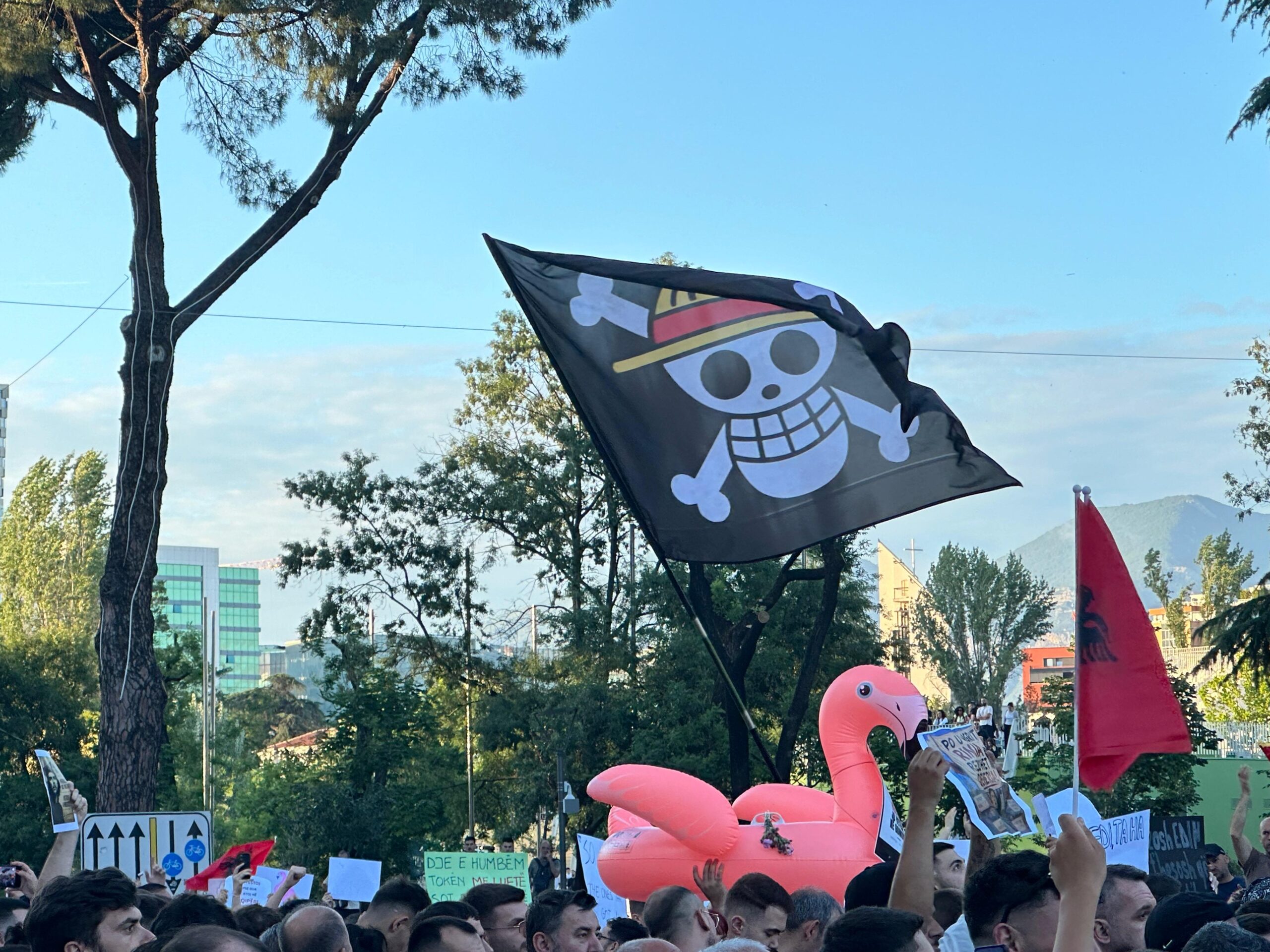
In its sixth week, the protest against the project in Pishë Poro-Nartë has entered a more fatigued, but also more hard-edged phase: participation fluctuates, political demands are becoming more visible, the issue has returned to the European Parliament, while tensions with the police and disagreements over how the movement should continue have made the protest more fragile, but it is still there. Author: Jona Cenameri This article was originally posted on Faktoje, you can read it here. Photo: Jona Cenameri In the sixth week of the protest, two young people who have been there since the first days happen to catch each other’s eye and smile. Without saying much, like people who know they are tired, but also know they have not given up. Because after 38 days, the protest against plans for a tourist resort in the protected Pishë Poro-Nartë area is no longer measured only by the number of people in the square. It is also measured by those who arrive late after work, those who stay for only a few minutes, those who ask each other, “Were you here yesterday?”, and those who have left the country but continue to support the protest through social media. When the protest began on May 31, no one could have predicted that July, instead of finding Albanians on the beaches, would still find them in the square. But by its sixth week, what began as a rebellion against a project in Zvërnec that had yet to receive final approval had evolved into a broader revolt against the way public decisions are made, the way common property is treated, the way the state treats its citizens, and the way those in power respond when challenged. “It has changed a lot,” says a middle-aged man, summing up the protest in one sentence: “From resistance to a single project, it has become a determined protest against a distorted model of governance.” At first, it was Zvërnec. It was the images of the fence and the bulldozers, the confrontations with residents and activists, and the sight of a Zvërnec resident being dragged away by private security personnel in front of the State Police. It was the debate over the protected area, the legal amendments, the lack of transparency and the fear that one of the country’s most important ecosystems was being opened up to intensive construction. Then the revolt moved to Tirana. Tirana It began on May 31, while on June 1, International Children’s Day, the crowd initially appeared uncertain, mixed together with another protest taking place in Skanderbeg Square. Gradually, through chants and announcements over a megaphone, the direction became clear: those protesting for Narta were to head towards the Ministry of Environment. They were protesting against what they saw as a “project advancing without transparency and at the expense of public assets.” There was no single leader, no podium controlling the crowd and no single message. People had come out because of Zvërnec, but they were also talking about corruption, emigration, pensions, healthcare, the lack of prospects for the future, the media, the police, the government and the opposition. The chant that closed the first night was simple: “More of us tomorrow!” During the first days, the protest took on the face of Gen Z. Instead of traditional political placards, the square filled with memes, anime references, television catchphrases, Spotify screenshots, AI-generated illustrations and flamingos that quickly became a symbol of the movement. TikTok, Instagram and the protest seemed to have merged into one. A video became a story, a placard became a meme, one friend invited another, and a repost brought dozens of new young people into the square. In those days, the protest had humour and rhythm. Its chants were harsh, but its form was light. There was anger, but also playfulness. There was patriotism, but also irony. There were flags, drums, songs, placards and endless photographs taken on young people’s phones. “The protest was magnificent during the first three days,” says a 20-year-old student from Tirana. But according to him, something changed when the protest began to take on a more structured form. “The moment they installed the sound system, it turned into a party rally. And let’s not even get into the level of some of the people who go up there and speak. Get rid of the sound system. Give the protest back to the people, not to a hierarchy,” he says, asking not to be identified by name. The debate This is one of the debates that has continued within the protest itself. Should it remain a protest that leads itself? Or should it have a structure, clearly articulated demands, speakers and representation? In the first days, the absence of a leader was one of its strengths. By the sixth week, that same absence has also become a dilemma. Photo: Jona Cenameri The demands From its earliest days, the protest had five articulated demands. Protesters called for the resignation of the government; the repeal of the status and legal framework related to strategic investors; the cancellation of the so-called “Mountain Package”; the repeal of the amendments to the Law on Protected Areas; and the repeal of amendments to the Cultural Heritage Law, which they argue put the country’s natural and historical heritage at risk. Initially, the demands were linked to the environmental cause, cultural heritage and a development model that protesters viewed as being geared towards private interests. But as the days passed, they expanded. The platform On the 23rd day of the protest, the organising group presented broader political demands. These included the resignation of the prime minister and the government, the establishment of a non-partisan transitional technical government with a 12-month mandate, constitutional and electoral changes, the retention of the original demands concerning the contested laws, and the drafting of a new social contract between citizens and the state. It was the moment when the protest attempted to translate itself into a more comprehensive political platform. A few days later, a group of 13 signatories issued an ultimatum in the name of the “coordinating group.” The question mark But in the square, this did not resolve the question of representation. For many protesters, the ultimatum exists more on social media and in media reports than in the everyday reality of the protest. Ask people in the square and not everyone knows it exists. Not everyone knows what it contains. Not everyone knows who signed it. And not everyone feels represented by it. In the square, each person still seems to arrive carrying their own concern. A resident talks about Zvërnec and about the fear that one day they may no longer recognise their own home. An activist talks about the Law on Protected Areas and about laws being changed without citizens being heard. A young person demands Rama’s resignation because he no longer feels represented. A citizen standing opposite the police talks about a state that is supposed to protect him, but which many protesters experience instead as a wall. Someone else criticises the media because they feel that what happens in the square is not reported the way it looks from inside the protest. A young woman talks about her sister not receiving the healthcare she needs and about the exhaustion of an entire family. A parent talks about education, about children and about the question of what kind of country is being left to them. A pensioner talks about financial hardship and growing old without dignity. So although the protest now has written demands, a political platform, an ultimatum and a group of signatories, it has not yet transformed into a single political body. The organisers speak in the name of the protest. But the square continues to speak in many voices. The demand that has not changed In the evenings, however, the demand heard most loudly remains the resignation of Prime Minister Edi Rama. It is repeated through the sound system, by the crowd, on placards and by the groups that march every night outside the Prime Minister’s Office. Zvërnec was the spark. But it is no longer the only reason people are taking to the streets. One young woman, an emigrant living in the European Union, says she has to leave again in the third week of July. But since the protest began, she has put her other commitments aside and remained in the square indefinitely. She says she will come back again. Another young man, a content creator living in London, continues to support the protest on Instagram after having to leave Albania. A man in his thirties from Tirana jokingly called himself a “deserter” because he had gone away on holiday for a few days. Others come every other day. Some cannot make it at the beginning and join later. Some stay for only a few minutes. The diaspora Participation peaked over the weekend of June 20 and 21. During those days, the square was fuller, the energy stronger and international attention more visible. People from the Albanian diaspora, as well as from Kosovo and North Macedonia, were there to join the protest. Photo: Jona Cenameri The European Parliament Members of the European Parliament visited Albania, spoke at the protest, met citizens and also held meetings with the Minister of Environment. In June, the European Parliament adopted a resolution on Albania calling for an immediate moratorium in the Vjosa-Narta area and a review of the legal amendments concerning protected areas, while expressing concern over developments in the area. On July 1, the “Flamingo Revolution” returned once again to the European Parliament, this time through a discussion organised by MEP Pasquale Tridico of The Left group, titled “Democracy, Rule of Law and Civic Participation in Albania.” Members of the European Parliament, representatives of left-wing parties from several European countries and participants from Albania attended the meeting. The issue of Vjosa-Narta was discussed in connection with democratic standards, the rule of law, civic participation, emigration and Albania’s relationship with the European integration process. For several days, it seemed as though Pishë Poro-Narta had become a public test of Albania’s relationship with the environment, democracy, the European Union and private interests. The fluctuations But after the peak, participation began to fluctuate. It was the end of June. Then came July. The heat, beach season, holidays planned long in advance and accumulated exhaustion all began to take their toll. The protest has now lasted more than a month and entered its second. It no longer has the same momentum every evening that it had at the beginning. There are fewer humorous placards. There are fewer people who come simply out of curiosity. “There is more violence now,” says a young professional in her twenties when asked how the protest has changed. And July changed the tone. Clashes outside parliament On July 2, the second protest near Parliament was marked by violence. Afterwards, participation increased again, this time driven not by enthusiasm, but by anger. For several days, protesters marched towards Police Station No. 3, where detained protesters were being held. In the square, chants directed at the police became harsher. The relationship between citizens and the State Police, already strained since the beginning of the protest, appeared to have broken down. A video went viral on social media showing a woman standing face to face with a police officer positioned near the Prime Minister’s Office. She was holding a placard that read: “I am disappointed in you.” Representatives of the governing majority used the violence of July 2 as evidence that the supposedly “peaceful” protest had finally shown its true face. Protesters, on the other hand, saw this as an attempt to delegitimise the entire movement through a single incident. Prime Minister Edi Rama, who at the beginning had extended an invitation for a public meeting with a group of protesters, later defended the project and has frequently attacked the protest, public figures who support it and individual participants associated with it. The Zvërnec protest is not only a confrontation with many of the country’s problems. It has also become a moment in which everyone’s public stance is being measured. Photo: Jona Cenameri Who spoke? Who remained silent? Who took a position? Who stepped back? And who will be remembered for it? On July 4, the prime minister’s birthday, the protest once again took on a satirical form. Cakes carrying different symbolic messages were brought into the square. Songs were sung. The daily demand for Rama’s resignation was repeated once again. A symbolic political coffin for Rama also appeared in the square, an image that was strongly criticised by representatives of the governing majority. The contradictions By the sixth week, however, the contradictions have become more visible. The protesters oppose violence, yet some of them are increasingly saying quietly that chants alone may no longer be enough. Among groups of young people, questions can now be heard that were not voiced so openly at the beginning. Are the repeated chants “Rama, resign,” “Your time is up,” and “Rama in prison, Berisha in prison” simply lulling the protest into passivity? Should the tactics change? Is the government simply waiting for summer, the holidays and exhaustion to take their toll? Will everything eventually fade away without producing any result? Placards have also invoked the memory of January 21, the Socialist Party protest held when it was in opposition, the clashes, the burning cars, Tirana in flames and the four citizens who were killed. For some protesters, that memory raises the central question facing the movement: How is change achieved in a country where those in power do not step down simply because people demand it? By its sixth week, the protest is no longer the same crowd that once enthusiastically chanted: “More of us tomorrow!” It is something more tired now. But it is still there.
Towards a South-South dialogue: Lessons from civil mobilisations in the Balkans for Latin America
Manuel Férez, Alberto Hurtado University, Chile Between 2020 and 2025, the Balkan region experienced an unprecedented wave of civil mobilisations: environmental protests against lithium mining in Serbia, anti-corruption demonstrations in Bosnia, social unrest in Albania, and student movements in Montenegro. These mobilisations, however, remain virtually invisible in Latin American academia, media, and cultural institutions—despite striking parallels with recent Latin American protests such as Chile's 2019 social explosion, the 2021 demonstrations in Argentina and Colombia, and ongoing citizen mobilisations in Mexico. Photo: Unsplash/Bree Anne This article examines this intellectual and artistic gap through a dual analysis of two leading Latin American journals (Foreign Affairs Latinoamérica and Letras Libres) and Balkan-related exhibitions in museums across Chile, Argentina, and Mexico. By exposing how Latin American public discourse reduces the Balkans to either a frozen narrative of 1990s trauma or a nostalgic account of successful immigration, this study proposes concrete pathways for establishing a South–South dialogue that recognises contemporary Balkan civil agency as a mirror for Latin America's own struggles for environmental justice and democratic resilience. The research project focuses on analysing how Latin American academia has processed, researched and reflected on civil society mobilisations in the Balkan countries, using Chile, Argentina and Mexico as case studies for accessibility reasons, and how it has presented the Balkans to the general public. Part One: an analysis of two widely circulated specialist journals in which Latin American academics publish Why analyze Foreign Affairs Latinoamérica and Letras Libres? Although other popular science magazines focusing on international affairs are available in Spanish, I have chosen Foreign Affairs Latinoamérica and Letras Libres due to their extensive circulation throughout Latin America and Spain. These academic journals are widely consulted and cited by Latin American students and academics working on international issues. They publish exceptional academic articles written by scholars from institutions across Latin America. Therefore, analyzing the content of these publications will help us understand perspectives, themes, and voices concerning the Balkans. Foreign Affairs Latinoamerica (FAL) This academic journal is the result of a collaboration between the Council on Foreign Relations (CFR) and the Instituto Tecnológico Autónomo de México (ITAM). Since its inception in 2000 as Foreign Affairs en Español, the journal has provided a platform for discussing significant international issues, with a particular focus on Latin America. It has established itself as a leading forum for Ibero-American perspectives on global affairs, encouraging diverse approaches and the highest standards of critical thinking. The journal is published every three months and has a circulation of 5,000 copies, which are distributed throughout Latin America, the United States, and Spain. Letras Libres (LL) Founded in 1999, Letras Libres is a monthly magazine of criticism and creation and the heir to the tradition and spirit of Vuelta, the magazine founded by Octavio Paz. With editions in Mexico and Spain, Letras Libres brings together leading thinkers to address urgent global issues, while offering readers samples of the finest prose and poetry. The Letras Libres website has evolved to offer a wide range of content, catering to diverse interests, voices, and forms of expression. FAL Published on 10 October 2022, the article The Balkans Facing Enigmas and Interventions was the only piece dedicated exclusively to the Balkans published by FAL. This article provides an overview of the political situation in the Balkans, with a particular focus on foreign interventions. The author, Mauricio D. Aceves, holds a degree in International Relations from the University of the Valley of Mexico (UVM), as well as a master’s degree in public security and public policy from the IEXE School of Public Policy. However, he does not cite any specialised bibliography on the Balkans, nor does he demonstrate any formal study of the region. The topics that included references to the Balkans can be grouped into the following categories: international order and international organisations; European issues (mainly elections and security matters); NATO; and the wars in Gaza and Ukraine. Additionally, there was one article dedicated to the Coronavirus and another to MERCOSUR that mentioned Balkan countries. In the category of international order and international organisations, notable articles included Requiem for 1991: From Hope to Global Uncertainty (9 December 2021), The Paradox of Funding a Refugee Crisis without Refugees (13 July 2020), Why International Organisations and Multilateralism Matter (29 November 2021), Diplomatic Saints (3 July 2023), Recent Log of (Illegal) Politics (12 January 2023), Towards a New Global Model of Security and Defence (28 March 2022) and Central Asia: The Path to International Order (27 April 2022). An analysis of the content of these articles reveals that the Balkans and the countries that comprise it were only mentioned in passing and as examples of dynamics related to the international order and/or the actions of international organisations. In another section entitled 'European Issues', articles were compiled addressing European issues that also mentioned the Balkans in some way. Cyprus at the Schengen Crossroads (24 July 2025) mentions the Balkans as an area that could be affected by Cyprus's political dynamics, while The 2024 European Elections (20 June 2024), The Security of the European Union (19 August 2020), Euroscepticism isn't shining, but it's not slowing down either (11 July 2024) and Eurovision 2025: Anxiety, Hatred and Resilience (29 May 2025) mention countries such as Bulgaria, North Macedonia and Serbia as part of the debate on the European defence system, the European Parliament elections and the growth of Euroscepticism among young Europeans. Initially, it was thought that it would be interesting to compare the media coverage of Gaza and Ukraine with that of the Balkans. However, throughout the entire analysed period, only three articles were found in Foreign Affairs that did so: Russia: A Challenge for the West' (11 May 2020), From Gaza to Kyiv (8 January 2024) and Ukraine and International Law (1 March 2022). The first article mentions the Balkans as one of the early challenges to the European order and its relationship with Russia. The other two articles focus on aspects of international law in Gaza and Ukraine, set against the backdrop of the history of the Balkans during and after the breakup of Yugoslavia. The other two articles focus on aspects of international law in Gaza and Ukraine, set against the backdrop of the history of the Balkans during and after the breakup of Yugoslavia. Three other general topics addressed or mentioned the Balkans. The first was NATO, with the article NATO's Role in the Conflict Between Russia and Ukraine (7 December 2022), which focuses on the conflict between Russia and Ukraine and mentions the Balkans as a historical reference for NATO's political and military action. The Political Repercussions of the Coronavirus Pandemic Worldwide (13 May 2020) references Bulgaria and the impact of the virus in the country. Finally, Ratification of the Agreement between the European Union and Mercosur (22 January 2024) specifically mentions Macedonia in the context of the rapprochement between the European Union and Mercosur. LL - 16 articles Unlike the journal FAL, which focuses almost exclusively on the analysis of international conflicts and dynamics, LL adopted a more diverse approach to the Balkans, covering literature, culture, music and history. Two articles published before 2020 are included in LL's count. These articles offer expert perspectives on the Balkans and are therefore included. Five articles dedicated to the Balkans were found in LL (two of which were published before 2020), as well as a further 16 articles that indirectly addressed topics related to the Balkans with a different central theme. The two articles published before 2020 were I Don't Want Serbia to Be the Russian Gibraltar in the Balkans: Interview with Dragan Velikić (June 30, 2017) and The Balkans: Aftermath of War (March 31, 2002). The first article is an interview with Velikić, who expresses concern that Serbia will become a Russian Gibraltar. The second article, written by David Rieff, discusses his experience as a journalist during the siege of Sarajevo and the main forms of entertainment there (alcohol, tobacco, sex, and conversation). Three articles focused on the Balkans during the analyzed period: In The Political Thriller of Serbia (1991–2025), Javier González-Cotta discusses the history of Serbia as if it were a political thriller. The article describes the power struggles in the streets of Serbia and how they defined the social character of the Serbian people and influenced national audiovisual production. In A Manual for Killing Flies (March 19, 2025), Carlos Hortelano examines the work of Croatian writer Slavenka Drakulić. Drakulić was present in The Hague in 2003 to attend the trials following the Balkan Wars, and she captured her experience there in her book They Wouldn't Kill a Fly. In his July 3, 2024, publication, A Brief Dictionary of Kadare, Mauricio Montiel Figueiras discusses the work of Albanian writer Ismail Kadare. These three articles are noteworthy because they offer readers reflections on the works of Balkan authors and those of a journalist who was present during the Yugoslavian war. However, they do not address the current situation in the region. The 16 articles published in LL that mentioned the Balkans or countries within it were divided into two categories: culture (literature, visual arts) and political situation. Articles like A Journey Through Greece and Albania with a Child and a Reflection on the Ubiquity of War, Guided by Homer and Ismail Kadare by Iván Hurtado, y Zülfü Livaneli Revisits History in a Novel by Jean Meyer (August 1, 2025) in which he discusses Livaneli's book “Riding the Tiger”, which focuses on Ottoman Sultan Abdul Hamid II; and Precise Literary Mechanism by Gonzalo Gragera (April 28, 2022) in which he discusses the Spanish publication of “The Poisonous Mirrors”, a collection of unpublished stories by Serbian writer Milorad Pavic (1929–2009) exemplify Letras Libres' literary approach to the Balkans The second category of articles focuses on political issues. Authoritarians are winning the game. Interview with David Rieff by León Krauze (April 1, 2025); Doubling Down: A Western Strategy for Ukraine and Itself by various authors (March 7, 2025) and War, the epidemic we don't see coming by Daniel Delisau (July 1, 2024) are examples of articles published by LL that included the Balkans in contemporary topics such as the Russian invasion of Ukraine and the emergence of armed conflicts. In Populism Through the Looking Glass, Christopher Dominguez Michael (September 1, 2024) finds similarities between López Obrador's style of governing in Mexico and that of leaders such as Narendra Modi (India), Recep Tayyip Erdoğan (Turkey), and Viktor Orbán (Hungary), while Ibsen Martínez, in Petkoff, Bulgaria, and the Weapons of Algiers (August 1, 2024), reflects on Petkoff and his political transformations from a Latin American perspective. These two articles aim to find similarities and political affinities between countries such as Hungary and Bulgaria and Latin America. Special attention should be given to Branko Milanovic's articles published in LL. These articles were translated into Spanish because they had previously been published elsewhere. Milanovic, a regular contributor to LL, authorizes the magazine to publish Spanish versions of his contributions to other media outlets. Before the police arrive: bookstores on Saturdays (February 25, 2024); Democracy of Convenience, Not by Choice: Why Eastern Europe Is Different (February 1, 2022) and A Communist Party in a Turbulent Era and a Difficult Country (April 23, 2020) showcase Milanovic's reflections on topics ranging from the literature he read as a child in his home country to thoughts on the future of Eastern Europe and the adaptations of communism worldwide. Milanovic is a notable Balkan author whose columns are regularly published in LL. The Transformation of War Journalism (July 1, 2024), in which Marga Zambrana reflects on changes in the journalism industry dedicated to armed conflicts; Global Sepharad (October 1, 2021) by Ricardo Dudda, in which recounts the history of the Levy family, Balkan Jews, and their experiences at the beginning of the 20th century; The Maturity of Balkan Literature in Spanish (April 22, 2021) in which Miguel Roán discusses the increase in the number of books in Spanish published by authors from the Balkans; and Madrid-Pristina Connection: The Spanish Passion of the Kosovars (July 8, 2020) by Juan Manuel Montoro, who reflects on Spain's non-recognition of Kosovo's independence, complete the list of LL articles that address the Balkans to some extent. Analysis of the FAL and the LL Taken overall the two sources' primary similarity is their limited focus on contemporary events and the social, political, cultural, and economic dynamics of Balkan countries. Although LL, with its broader scope, included articles that addressed contemporary Balkan affairs to some extent, the lack of intellectual attention struck me given to current social trends in the Balkans by both sources. It should be noted that the Balkans are not a central theme for either publication. One possible reason for this marginal interest is the absence of Latin American specialists in the region and Balkan diaspora communities in Latin America. Another similarity is the focus of the articles in both publications. A perspective on international relations and history takes precedence, with social issues relegated to a secondary role. While LL tries to showcase the region's cultural and artistic aspects, its political analyses tend to focus on Yugoslavia or the Balkan countries' relationships with the European Union, Russia, or the U.S. rather than on internal social tensions within each country. The limited attention that FAL pays to the Balkans, and to its constituent countries in particular, was surprising. Before this research, I had assumed I would find more articles on the subject, given that FAL is the Spanish-language magazine in Latin America that focuses the most on international issues. All of the authors in FAL are Latin American and come from academic fields including international relations, history, Latin American studies, international security studies, international law, and political science. The articles did not cite any specialized bibliography on the Balkans, and none of the authors appeared to have undertaken specialized studies on the region. Meanwhile, LL has the advantage of featuring Branko Milanovic, a Serbian-American economist from the Balkans who provides historical and economic insights on the region. Milanovic authored three articles in which Yugoslavia and its economic and political contradictions were central themes. Javier González-Cotta's article, The Political Thriller of Serbia (1991–2025) (June 2, 2025), was the only one to address the current social unrest in Serbia and its connection to cultural expressions, such as audiovisual production. The absence of academic references in the FAL articles, which offered general reflections on the political positions of Balkan countries, was notable. This lack of specialized academic literature was especially apparent in a journal that promotes academic thought and research, making it worth considering the reasons for this absence, which will be addressed in the second part of this research. LL's contribution to the cultural sphere was valuable and noteworthy. Two articles discussed the work of Croatian writer Slavenka Drakulić, and another examined Balkan literature translated into Spanish. These articles demonstrate that it is possible to publish content about the Balkans that engage readers and goes beyond topics related to international politics. LL frequently addressed topics such as Kosovo, the war in the former Yugoslavia, democratization processes, and the emergence of authoritarian leaders; in contrast, FAL tended to focus its publications on international issues, incorporating some mentions of the Balkans into these dynamics. _________________________________________________________________________ Part Two: The presence of the topic in museums in Chile, Argentina and Mexico Chile: Museum of Croatian Immigration in Magallanes (Punta Arenas): permanent exhibition exclusively on Croatian immigration (19(th)-20(th) centuries), emphasising their economic and social contributions to Patagonia. Regional Museum of Magallanes – secondary mention in the immigrants' hall. Argentina: Muntref Museum of Immigration (Buenos Aires): archival and bibliographic references to Croatian and Yugoslavian immigration. Mitre Museum: temporary exhibition “Serbia 1914: The Female Face of the Great War”. Mexico: Museum of Memory and Tolerance in Mexico City has a permanent exhibition called 'Former Yugoslavia', featuring maps, photographs of Sarajevo, and testimonies of the Bosnian genocide (1992–1995). Findings and analysis As with the publications of FAL and LL, museums present a rigid historical narrative that freezes the Balkans at two specific points in time: the early Balkanic (Croatian) immigration of the 19th and 20th centuries, and the Yugoslav wars of the 1990s. This curatorial choice reflects both the lack of Latin American specialists in Balkan studies and the limited influence of the contemporary Balkan diaspora. While museums commemorating other tragedies often maintain educational programmes that connect the past with the present, the Balkans are reduced to static display cases. Consequently, the Latin American public is presented with a fossilised image of the region: either as a place of successful immigrants to Latin America or as a distant tragedy, but never as a living space of civic agency. The case of the Croatian diaspora in Chile is paradigmatic in understanding how the presence of an influential migrant community can paradoxically contribute to the 'freezing' of the image of its region of origin in the recipient's imagination. According to Marinkovic Contreras's (2018) research, this community has historically exerted significant pressure and influence to secure state recognition and legitimise its national identity within Chile. This narrative of success and recognition, centred on integration and contribution to national development, is reflected in a regional museum exhibition which highlights the epic story of migration and the milestones of the 20th century. However, by adopting the 'geographical perspective' defined by Kraser et al. (2016) as being rooted in the history of socio-spatial conflicts and fragmentation, these institutions reduce the complexity of Southeastern Europe to a static territory of origin. Consequently, while contemporary cultural production attempts to process traces of the post-war period up to the present day, public narratives in the Southern Cone and Mexico remain fixated on the nostalgia of migration or the trauma of the 1990s wars. This phenomenon renders the political agency and civil mobilisations of the 2020–2025 period invisible, presenting the Balkans as a region whose history appears to have ended with the consolidation of its diaspora or the signing of international peace treaties. Latin American museums of memory, such as the Museum of Memory and Tolerance in Mexico and the Museum of Memory and Human Rights in Chile, operate according to a logic of 'trauma pedagogy'. While this is necessary, it ultimately freezes the region's image in the 1990s. In these spaces, the Balkans are almost exclusively presented through the lens of Yugoslav disintegration and mass human rights violations. This institutional narrative reflects an academic trend that reduces the region to its historical and legal evolution. Interest in this trend is confined to analysing the legitimacy of external military interventions or the complex processes of international recognition of new entities, such as the Republic of Kosovo. This topic is present in both FAL and LL, but is approached from the perspective of international law and international relations. As previously mentioned, by focusing their curatorial approach on ethnic conflict and the response of international organisations, these museums adopt a perspective centred on the socio-spatial dynamics of historical fragmentation, as described by several analysts. This results in a disconnect from the current reality in the Balkans: while recent intellectual and literary output processes the aftermath of the war up to 2023, the Latin American museographic discourse concludes with the genocide. Moreover, there is a clear chronological gap. While academia and comparative literature are already addressing the period 1990–2023, museography seems to have come to a standstill in 1995. This failure to keep up to date is largely a consequence of the shortage of local specialists mentioned in the previous section. Without researchers to connect the history to the 2020–2025 protests, museums can only reproduce the traditional narrative of the conflict and the post-war period. Critical curation proposal To overcome this 'stagnation', we need to transition from 'curation of nostalgia' or 'curation of horror' to 'curation of resistance'. Although temporary exhibitions such as 'Serbia 1914' at the Mitre Museum demonstrate an attempt to broaden the perspective, they remain anchored to war-related anniversaries. One alternative would be to organise exhibitions that link extractivism in the Balkans with socio-environmental conflicts in Latin America, thereby fostering a South–South dialogue. A concrete example is the mass protests in Serbia (2021–2024) against the “Jadar” lithium project by Rio Tinto. These protests were not just about the environment; they also denounced the lack of transparency and the influence of corporate interests on the state. This conflict reflects the same 'extractive imperative' that sparks waves of protests in Latin America, where local communities challenge mining projects in defence of water and territorial autonomy. The protests against Rio Tinto in Serbia (2021–2022) achieved a historic victory by forcing the government to temporarily revoke the mining licences. This demonstrates that the protests were not just a ‘protest’, but an effective display of political action by citizens. This development bears a direct resemblance to the movements in Chile and Panama that succeeded in halting similar extractive projects. In both the Balkans and Latin America, the struggle is ecological and concerns sovereignty over resources in the face of transnational corporations – an aspect that has received little analysis or visibility to date. The link between resistance movements in the Balkans and Latin America is evident in the context of lithium mining. While the debate in the Lithium Triangle centres on the global energy transition, the 'Kreni-Promeni' movement and the 'Ecological Uprising' in Serbia have demonstrated that civil mobilisation can directly challenge giants such as Rio Tinto. This has been achieved through street protests, resulting in the cancellation of projects. Latin American museums overlook this 'agency of victory' by focusing solely on past trauma and ignoring the fact that Balkan citizens are today at the forefront of defending their territory, just like socio-environmental movements in our region. Museums could create a gallery on the 'Geopolitics of Dispossession', displaying posters from the Belgrade protests alongside records of struggles against mega-mining in Colombia or Panama. This would position the Balkans as a contemporary ally in environmental resistance. Another example is civil resilience in the face of authoritarianism. The 'Serbia Against Violence' movement (2023–2024) and protests against 'competitive authoritarian' regimes in the Western Balkans have given rise to forms of 'active citizenship' that aim to democratise institutions from the ground up. These developments are similar to the processes of democratic backsliding currently occurring in countries such as Mexico, Brazil, El Salvador and Nicaragua. Memorial museums could showcase these 'shared struggles', challenging the perception of the Balkans as a 'failed state' and presenting them as a laboratory for democratic innovation instead. Demonstrating that these protests in both the Balkans and Latin America are not just directed against 'corruption' in general, but against systems where democratic institutions exist in name only yet are undermined by executive control of the media and judiciary, allows us to establish a shared analytical framework for both regions. This helps Latin American academics and museum specialists to view the Balkan conflict as a political phenomenon with which they are familiar, rather than as something 'ethnically alien'. Conclusion: Towards a Thaw in the Latin American Perspective on the Balkans The invisibility of Balkan civil protests (2020–2025) in Latin America's public and academic spheres is not accidental, but the consequence of dual hermeneutic closures—both academic and institutional. This study has demonstrated that Latin American discourse on the Balkans operates through two dominant yet limiting frameworks: an academic focus on historical and legal development, and a museographic approach that petrifies the region either in migratory nostalgia or the pedagogy of trauma. Both perspectives adopt a geographical outlook centred on fragmentation and static origins, thereby rendering contemporary political agency and mobilisations for environmental or anti-corruption causes invisible. The analysis of Foreign Affairs Latinoamérica and Letras Libres revealed a striking pattern: Balkan countries appear primarily as peripheral references in discussions of international order, European security, or historical conflicts, with minimal attention to current social dynamics. While Letras Libres offers valuable cultural contributions through literary and artistic coverage, neither journal engages systematically with the region's contemporary civil society. Similarly, museums in Chile, Argentina, and Mexico present a fossilised image of the Balkans—either as a place of successful immigrants or as a distant tragedy—never as a living space of civic agency. This chronological gap, where museography appears to have stalled in 1995 while Balkan intellectual production processes the post-war period up to the present, reflects a broader shortage of Latin American specialists in the region. To break this cycle, three concrete pathways are proposed: 1. Reform academic cooperation models: Expand existing Jean Monnet Chairs at leading Latin American universities beyond their traditional focus on EU–Mercosur trade relations to include specific modules on the Western Balkans. These modules should analyse 'bottom-up' democratisation processes and current citizen mobilisations, moving away from post-war paradigms. 2. Institutionalise specialised training: Establish regional summer schools on Balkan studies offering transferable academic credits to train a new generation of specialists in international relations, sociology, and geography. These programmes should prioritise contemporary social dynamics over historical conflict narratives. The establishment of regional summer schools specialising in Balkan studies is a structural response to the shortage of specialists identified in this study. The absence of Latin American academics specialising in the region is not due to a lack of interest, but rather a systemic failure to fund fields of study considered 'non-traditional' at universities in Chile, Mexico and Argentina. Postgraduate programmes in international relations and sociology tend to prioritise a focus on global powers or hemispheric regional integration, which leaves the Balkans on the intellectual periphery. To break this cycle, summer schools should offer transferable academic credits that enable undergraduate and postgraduate students to specialise in the region while remaining in their home programmes. Furthermore, these programmes must incorporate direct engagement with activists, journalists, and academics from the Balkans to avoid the Eurocentric mediation that has dominated knowledge production about the region. By establishing South–South collaborative networks, these schools could train a new generation of researchers who would be able to analyse the Balkans not as a case study of ethnic conflicts or international interventions, but as a contemporary laboratory of civil resistance, democratic innovation, and the struggle for environmental justice — issues that resonate deeply with Latin American realities. 3. Transform curatorial practices: Develop temporary exhibitions in Latin American museums that offer perspectives on contemporary Balkan society and its similarities with Latin American struggles. Exhibitions such as a 'Geopolitics of Dispossession' gallery—linking Serbian protests against the Jadar lithium project with socio-environmental conflicts in Colombia or Panama—would foster South–South dialogue and position the Balkans as a contemporary ally in environmental resistance. Only through the institutionalisation of dedicated spaces for study and a curatorial approach that restores political agency to Balkan citizens will the region cease to be a 'grey area' on the Latin American intellectual map. The Balkans should become not merely a case study for international law or a repository of historical trauma, but a mirror in which Latin America can recognise its own struggles for environmental transparency, democratic resilience, and social justice. This thaw in perspective is not merely an academic exercise—it is a necessary step toward building genuine transregional solidarity in an era of shared global challenges. References (Soto, 2022). Análisis de la intervención militar efectuada por la Otan en Kosovo… [Tesis de pregrado, Universidad de Chile]. Recuperado el 28 de febrero de 2026 de https://repositorio.uchile.cl/handle/2250/186317 Bilić, J. B., Cúneo, P., & Franić, I. (2023). El croata como lengua de herencia en Argentina. Íkala, 28(1), 86–104. Recuperado el 28 de febrero de 2026 de https://www.redalyc.org/journal/2550/255076325006/html Foreign Affairs Latinoamérica. (s.f.). Recuperado el 28 de febrero de 2026 de https://revistafal.com Letras Libres. (s.f.). Recuperado el 28 de febrero de 2026 de https://letraslibres.com/ (Contreras, 2018). Croatas en Chile: presiones e influencias para el reconocimiento de un Estado [Tesis de magíster, Universidad de Chile]. Recuperado el 28 de febrero de 2026 de https://repositorio.uchile.cl/handle/2250/167835 Museo de la Inmigración Croata en Magallanes. (s.f.). Recuperado el 28 de febrero de 2026 de https://www.registromuseoschile.cl/663/w3-article-120369.html Museo Memoria y Tolerancia. (s.f.). Ex Yugoslavia. Recuperado el 28 de febrero de 2026 de https://www.myt.org.mx/memoria/ex-yugoslavia Museo Mitre. (s.f.). Recuperado el 28 de febrero de 2026 de https://museomitre.cultura.gob.ar Museo Regional de Magallanes. (s.f.). Recuperado el 28 de febrero de 2026 de https://www.museodemagallanes.gob.cl Muntref Museo de la Inmigración. (s.f.). Recuperado el 28 de febrero de 2026 de https://untref.edu.ar/muntref/es/museo-de-la-inmigracion (Gómez, 2012). El devenir histórico y legal de Kosovo. Anuario Mexicano de Derecho Internacional, 12, 65–106. Recuperado el 28 de febrero de 2026 de https://www.redalyc.org/articulo.oa?id=402740628003 (Cerda, 2024). Reconocimiento de la República de Kosovo… [Tesis de licenciatura, Colegio de San Luis]. Recuperado el 28 de febrero de 2026 de https://colsan.repositorioinstitucional.mx/jspui/handle/1013/1714

What Did the Student Protests Bring Us?
Author: Vladimir Stojkovic The student protests that followed the fall of the canopy are certainly not the first protests to take place in the modern history of Serbia. In many aspects, they resemble the protests of previous decades. However, what distinguishes these student protests is the level of general mobilization that is, the awakening of the broader community. This awakening did not occur only in urban centers, but also extended to rural areas, which had long been politically marginalized. Sourced from https://protesti.pics For months, now more than a year, students have been walking proudly along their path of freedom. Many had considered this generation to be completely lost and apolitical, yet the students proved the opposite through their actions. Beyond the powerful and inspiring slogans reminiscent of the protests of the 1990s, these demonstrations have played a crucial role in raising social awareness across various spheres of life. They addressed issues ranging from respect for individual and minority rights to the importance of independent state institutions. Of course, activists, party members, NGOs, and individuals had been pointing out social problems long before these protests, and their persistence deserves recognition. However, students managed to find a formula that reached a much wider audience, including the rural parts of the country that had often been overlooked. As students moved across Serbia, from cities, across fields and meadows, to the smallest villages, they awakened hope and initiated a form of social catharsis. They jolted people out of long-standing apathy and fear. Decades of injustice, particularly intensified over the past thirteen years, had accumulated within society. The arrival of students in remote villages helped dismantle that fear. They restored people’s pride, encouraged them to stand upright once again, and revived a sense of solidarity that had been sorely lacking. Under the influence of the student movement, citizens began participating more actively in public life. Public assemblies and discussions emerged, and people became increasingly interested in social and political issues. The students managed to wake society from a prolonged state of political passivity. The long-term effect of this awakening will be greater civic engagement, especially through participation in democratic processes such as elections, whether as observers, controllers, or candidates. What matters most is the realization that citizens hold power in their own hands. Students have faced attacks from various ideological positions. Some label them clerofascists, while others accuse them of being Eurofanatics. Such criticism ignores the fact that students represent a heterogeneous community, and total homogeneity would be both unrealistic and dangerous. Their diversity has not hindered dialogue; on the contrary, it has fostered tolerance and mutual respect. The authorities in Serbia, along with similarly minded political actors, fear scenes of unity, people of different religions embracing one another, or showing solidarity regardless of sexual orientation. Such moments represent a defeat for politics built on division and hatred. Ultimately, the most significant outcomes of the student protests include the disappearance of fear, increased interest in social affairs, and greater awareness of individual rights. The students also delivered a powerful lesson on corruption, helping citizens better understand its direct impact on their lives. The flame of the student protests has spread throughout Serbia, and it is clear that nothing will be the same again. The spirit of freedom has escaped the bottle, the waves of change have been set in motion, and it is now up to all of us to sustain that energy and work toward improving our society.

Falling Into the Underground: How Niš Youth Reclaims Culture Through Rebellion
While official cultural institutions in Serbia remain trapped in bureaucracy and underfunding, something else is growing beneath the surface — fragile, improvised, but stubbornly alive. In Niš, the country’s third-largest city, a generation of young artists and musicians is carving out its own spaces, reshaping culture beyond state control. Their most visible experiment is Underground, a music and art festival that, in just three years, has become a focal point for what many now call the “new new wave” of Niš rock and alternative culture. Photo by Strahinja Jovanovic From 2 to 5 October this year, Underground will take over the Niš Cultural Centre with twenty bands across four nights, ranging from punk and stoner rock to synth-pop. The program is eclectic but coherent, rooted in the belief that independent music is not just entertainment but a political gesture. The festival’s history reflects this stance: its first edition in 2023 was put together in just two weeks, without institutional support, sustained purely by community energy. Since then, it has grown — with compilations, benefit events, and a steadily expanding audience — while remaining true to its DIY roots. But what sets Underground apart is not only the sound. It is the image — quite literally. Each year, the festival develops a distinctive visual language designed by young artist Jelena Perić, who has become one of its central creative forces. Her posters are not promotional tools in the traditional sense; they are manifestos. “The visuals change every year, but I try to keep a recognisable identity — something people immediately associate with Underground,” Perić says. “It’s about reflecting the energy of the city and the scene into the artwork.” This year’s design depicts a young person in freefall. It is an unsettling but also strangely liberating image. For Perić, the fall is not about defeat. “It’s about descending into our underground — into a space of honesty, community, and resistance,” she explains. The poster overturns the usual meaning of falling: what might seem like a collapse becomes a deliberate choice to abandon the surface world of stagnation and enter a deeper, truer dimension. Underground poster The aesthetics carry unmistakable political undertones. Serbia’s cultural sector has been systematically neglected: for years, less than one percent of the national budget has been allocated to culture, leaving independent initiatives with little chance of survival. In this vacuum, the underground scene becomes more than a subculture — it is a necessity. The visual motif of falling into the underground crystallises that necessity: if official culture cannot sustain life, then life must create its own parallel ecosystem. The festival’s community-based financing reflects the same ethos. Underground relies on fundraising parties and donations, with local partners such as the Critical Education Centre providing support. This mode of survival is itself a form of critique — exposing the absence of public commitment to culture while demonstrating that art can thrive without state structures. “We don’t see Underground as a once-a-year event,” Perić notes. “It’s an ongoing process, a constant effort to hold space for something independent and real.” Jelena Perić, Underground promotion The atmosphere of rebellion also runs through the music. One of the most talked-about acts this year was Bunt — literally “Rebellion” — a young band that recently released Nisam sam (“I Am Not Alone”), a song inspired by student protests and blockades. Their presence on the festival stage directly links Underground to the wider social climate, where young people have turned cultural spaces like Belgrade’s Student Cultural Centre (SKC) into arenas of political and artistic expression. In such moments, art and activism cease to exist as separate spheres: a concert becomes a protest, and a poster becomes a call to action. Underground is therefore not merely a festival but a living archive of the struggles, hopes, and aesthetics of a generation. Its posters, music, and gatherings together form a counter-narrative to the dominant discourse that treats culture as expendable. The festival reveals that cultural production can still be a site of collective meaning, that rebellion can be joyful, and that falling into the underground is sometimes the only way to rise above the surface. To outsiders, Niš may not appear to be the capital of cultural innovation. Yet anyone who has witnessed a packed hall at Underground fest — where sound, image, and solidarity collide — understands that something more than a local festival is at stake. This is what culture looks like when it is reclaimed: messy, improvised, fragile, yet fiercely authentic! And in that authenticity lies its greatest strength.