
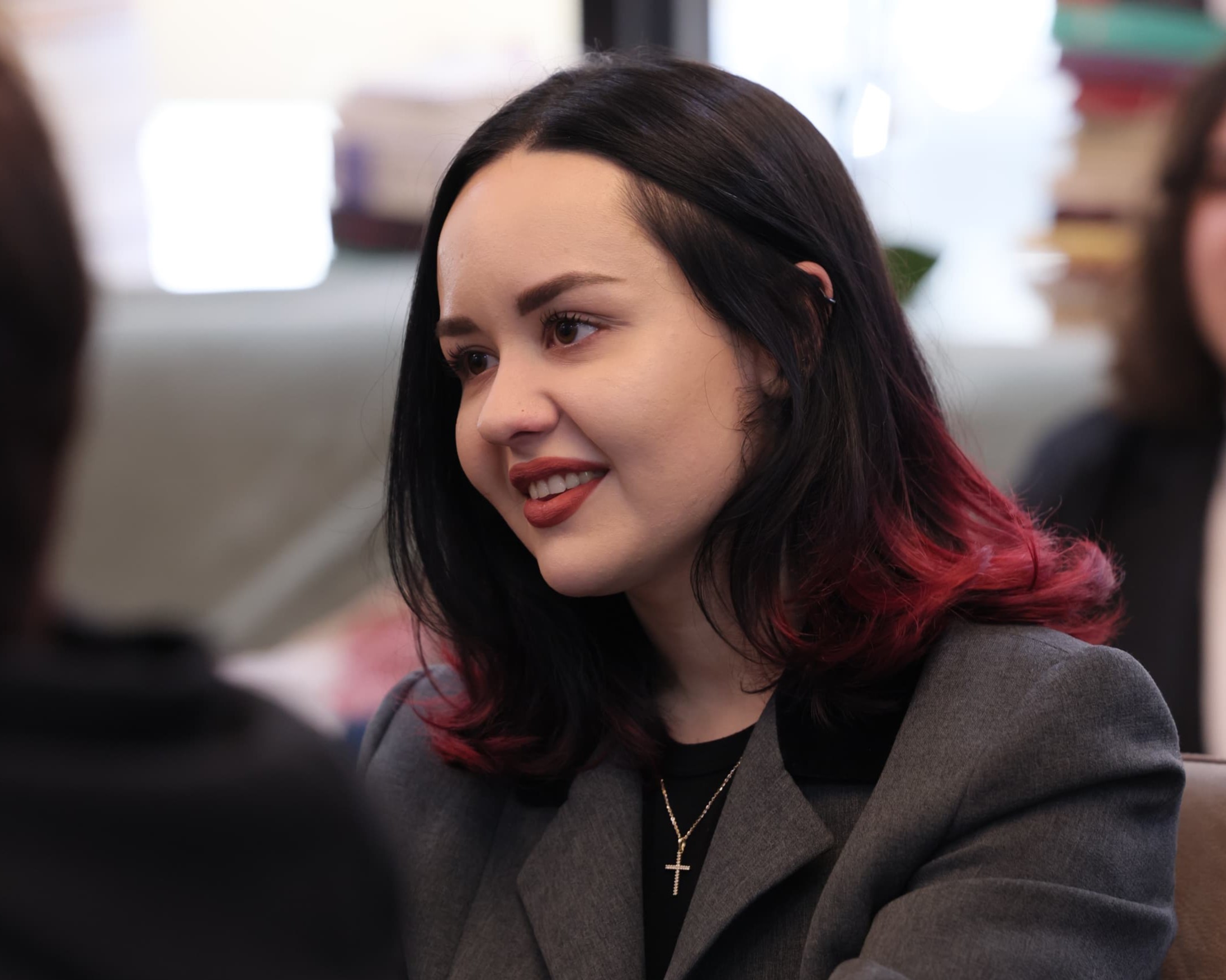
Balkan Talks Stands with Jona Cenameri
The editorial team of Balkan Talks stands in full solidarity with our colleague and friend Jona Cenameri, who has become the target of a smear campaign by Serbian pro-government tabloids. We strongly condemn the actions of Informer and other regime-aligned media outlets that continue to target young people from Serbia and across the Western Balkans who are working to build peace, regional cooperation, and democratic societies. These campaigns do not simply attack individuals; they seek to intimidate an entire generation determined to imagine a different future for our region. Photo: Jona Cenameri, private archive Jona is a journalist at Faktoje.al, one of the leading fact-checking media organizations in Albania and the Western Balkans. Her commitment to evidence-based journalism, accountability, and public interest reporting is precisely what makes her a target for media that thrive on disinformation and political polarization. Over the past few days, Jona participated in the Youth Summit in Novi Pazar, organized by the Youth Initiative for Human Rights, together with students and young activists from across the region. Speaking to Balkan Talks, Jona questioned why media reports attacking the summit featured images of Albin Kurti when he had neither attended nor been mentioned during the event. Her remark illustrates how quickly facts can give way to manufactured narratives whenever independent voices challenge the stories that certain media seek to promote. Unfortunately, this kind of targeting has become increasingly common in Serbia. Since the beginning of the student protests, pro-government tabloids have repeatedly attempted to portray students, journalists, academics, and activists as enemies rather than citizens exercising their democratic rights. Such campaigns foster hostility, encourage harassment, and place real people at risk. What stands out in this latest wave of attacks is the attempt to link the Serbian student movement with Albania's Flamingo Revolution as though regional solidarity itself were something suspicious. In reality, these movements emerged independently, responding to different local circumstances. Yet they share many of the same democratic aspirations: demanding transparency, accountability, protection of public goods, and institutions that serve citizens rather than political elites. They also reflect a generation that refuses to accept corruption, state capture, and the privatization of resources that belong to everyone. Across the region, young people have increasingly recognized that many of the challenges they face are interconnected. Debates around public land, urban development, environmental protection, democratic participation, and the influence of powerful political and business interests do not stop at national borders. Whether discussing the Albanian coastline or public assets in Serbia, these conversations are rooted in a broader struggle over who has the right to shape the future of their communities. This growing regional dialogue is precisely what makes initiatives such as the Youth Summit in Novi Pazar so important. They create spaces where young people from different countries can meet not as enemies defined by the past, but as partners committed to justice, democracy, and a more peaceful future. At Balkan Talks, we witness this every single day. Our platform exists because young people throughout the Western Balkans want dialogue instead of hatred, cooperation instead of nationalism, and reconciliation instead of division. Every article we publish, every conversation we host, and every story we amplify demonstrates that another Balkans is not only possible, but it is already being built by those who refuse to inherit old conflicts. Attempts to divide us through fear, smear campaigns, and media harassment will not succeed. To those who spread hatred, we answer with solidarity. To those who try to isolate courageous young voices, we answer by standing closer together. And to Jona, as well as to every young journalist, student, activist, and researcher who faces intimidation for speaking the truth: you are not standing alone. Balkan Talks stands with Jona Cenameri. Today and always.
Andrej Zlatović from Green Youth of Serbia: “We have firm plans to work on reconciliation in West Balkan”
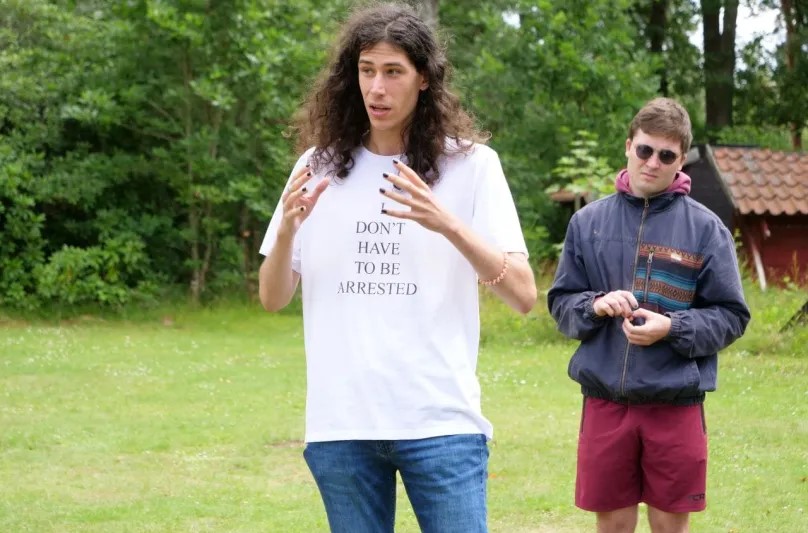
Last week, a group of European Green Youth activists protested in Brussels during the session of the European Parliament. Rebelling against fossil fuel subsidies, this group of people calmly unfurled a banner in the Parliament. However, this act did not receive a positive reaction from the authorities. On the contrary, some of the activists were arrested and held in custody until the end of the day. Among them was Andrej Zlatović, a young activist of the Green Youth of Serbia. We talked with Andrej about this stormy reaction, the general green idea, and what it means for reconciliation in the Balkans. Why do you think the police used such a repressive measure as arresting during a peaceful protest? How do you comment on that? What does it mean? If we try to look at it objectively, it's a mix of factors. One reason why we were detained is that we chose a day when a large Extinction Rebellion (XR) protest was taking place. The police was prepared to be especially cruel to climate protesters and even inspected the banner before deciding to detain us. As the Belgium and European elections are approaching the state is on alert for anything that could be considered to influence voters’ behavior. However, just a few weeks before, a banner-drop protest for climate justice took place in the European Parliament (EP). No one was detained there, so I have no clue why we were met with such manners. We didn't break any laws of the state of Belgium, nor did the police even claim we did. For someone looking for a more thorough understanding of why we were detained, it lies in the continued erosion of the right to protest all around Europe and the world. Look at the laws being passed in the UK regarding the right to protest; in the EP, a couple of days before, the right for a peaceful but disruptive protest was attacked. This is not something unique to Western Europe. However, in Serbia for example, we saw brutal protest repressions in December, although in the Balkans, we were often expected to look up at Western Europe and their freedom of speech, which I think a lot of people are now aware stands true more in theory than in reality. What is your assessment? Is there less freedom in the Western Balkans regarding civil disobedience? Have you ever had problems with the police in the countries of the Western Balkans? Here in the Western Balkans, our relationship to civil disobedience is different than in Western Europe. We traditionally feel more like pawns and targets for our systems, and people here don't have a long heritage of peaceful protest like in the West. That being said, we do feel that the police we have in the Balkans is the worst in all of Europe, barring maybe Belarus and Russia, which leads to people having more on the line when participating in civil disobedience. If it comes to this, they usually take the form of mass disruptive protests, which are street walks and blockades, which take place over a few hours, and everyone then returns to the status quo. Actions such as the ones we did, a banner drop and a speech disrupting a public event, are rare and lead to little outreach here, but they are more likely to result in criminal prosecution. Personally, as a Belgrade local, I often had issues with the police and dreaded whenever I had to call them or rely on them. Since the ability of police officers to stop and search anyone is regularly (ab)used, I have often been the target of searches lasting somewhere from 15 minutes to an hour, sometimes multiple times per week. This, while it does not constitute direct assault, is degrading and stressful. Crossing the border anytime is like a test of patience, where, despite having no criminal record, I must reiterate that I am not smuggling contraband, and I must state the reason for my travel. The result when someone is disproportionately targeted by law enforcement just because of how they style their hair, dress, or express themselves is that after a while, they start feeling guilty just for walking around the city like they are incapable of not looking suspicious or lawful. Additionally, acts of violence are something I have seen before, as also the mistreatment of detained individuals and disrespect of their rights. In one of the main streets in Belgrade, police regularly question people; these are usually citizens of Roma background or darker-skinned individuals. This showcases that even here, the police periodically resort to racial profiling, where precisely the stereotype that Roma people are thieves is permeated in society, which you can imagine takes a toll on their role in this same society. We see that despite all the difficulties and police brutality, you continue to fight for the green idea. Can you tell us something more about the idea? Does it concern only the preservation of the planet, or does it have a more comprehensive ideology? Usually, when we say green politics, people only think of ecology; however, it is equally in part inclusivity, democracy, and non-violence. To fully understand green values, we must also consider conflict aversion, reconciliation, and peacebuilding when conflict erupts. We must also achieve social justice to achieve climate justice, as our environment will be stable only in a peaceful world. These ideas are interlocked and cannot be unspooled from each other if we aim to truly achieve a better society. Specifically, our portal is interested in your movement's attitude towards reconciliation in the Western Balkans.Can reconciliation of the countries at war in the Western Balkans in the nineties be achieved through green ideas and politics? These topics are of immense importance for the Western Balkans, and we, as green activists, are the only ones who truly postulate these ideas in the region. It is no wonder that green movements are gaining traction in both Croatia and Belgrade. Having strong representation in capital cities in both countries is quintessential for us to work towards closer relationships amongst neighboring countries. Countries that fought a bloody war that left so many dead and displaced. To heal this period's wounds, we must build bridges and work on promoting reconciliation instead of stoking fears and tension as the right wing usually does. As a person of both Croatian and Serbian heritage who has faced widespread discrimination due to his background, I hold the peacebuilding aspect of green values quite dear and try to always keep it in mind when working as an activist. In the end, can you tell me what measures the Green Youth of Serbia takes or will take to fight for reconciliation in the Western Balkans? With the Green Youth of Serbia, we have solid plans to work on reconciliation. We are aware we cannot change Serbia's foreign policy. Still, we will take clear stances on questions of international politics in the region to cooperate and learn from our neighbors. When we work with people from the area in the Balkans, it carries a much different message than when let's say, a French and a Spanish person cooperate since their countries have had close ties for years because of the European Union. In that sense, it takes more effort than people outside our region know. We still have actions that have strengthened regional cooperation so far. Recently, our members went to Prizren to talk to young Kosovo Albanians about reconciliation and how civic initiatives can help build peace. Croatian and Bosnian organizations and NGOs are often at our side when doing projects, like the one we had about railways within the Western Balkans. This is an example of what I was talking about earlier: peacebuilding and ecological actions go hand in hand in green politics – we were talking about an idea for railways in Croatia, Greece, Montenegro, North Macedonia and Serbia and how to connect these countries. These trains would not only work on reducing pollution but would further ease travel in the region, therefore empowering neighborly ties. The world is an interconnected system, and by employing one of our policies, we also find ways to support our other ideas. This is necessary to show people that the Western Balkans are equally a part of Europe, as right now, we are often discredited and seen as separated or isolated. We know that learning about yourself means learning about those that surround you, so we always have activists from the region meet and talk in a safe space. In the upcoming months, there will be a green academy in Montenegro that some of our members will support as organizers, and activists from the whole region will be there. Additionally, if it goes as planned, a camp in Serbia promoting green ideas will happen this summer, but we will have more information about that soon. If you want to stay updated about this, follow GYS and see us implement these ideas! Green Youth of Serbia web page Green Youth of Serbia Facebook Green Youth of Serbia Instagram