
Roma in Bosnia and the Unfinished Violence of the 1990s
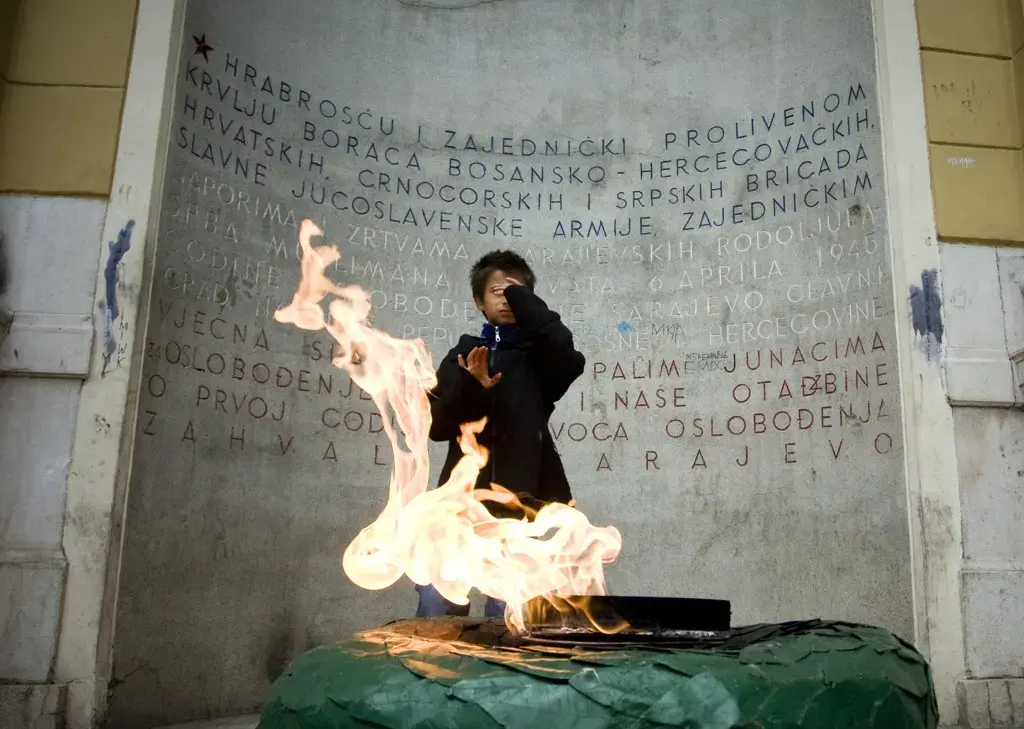
Historically speaking, the Roma population has been one of the most marginalised and discriminated groups in the Western Balkans. During the middle and new ages, Roma people were slaves to the other nations in the Balkans, with Roma slavery being officially abolished only in 1856 in Romania. Estimates say that up to half a million Roma people were killed during the Second World War by Nazi Germany and its fascist collaborators. According to data from the United States Holocaust Memorial Museum, tens of thousands of Roma in the territory of the former Yugoslavia under German occupation were sent to concentration camps such as Sajmište and Jasenovac. The Roma population in Croatia and Bosnia and Herzegovina was nearly decimated (Post-conflict Research Center, 2018, 4). A Roma child stands in front of the "Eternal Flame" in downtown Sarajevo. The plaque does not mention the casualties of Sarajevan minorities. Image by Jasmin Brutos. Bosnia, July 2008. Taken from: https://pulitzercenter.org According to the last available population census from 2013, Roma population in B&H amounts to 12,583 or 0,36% of the total population (Agency for Statistics of Bosnia and Herzegovina, 2019, 27), which makes them the biggest national minority in B&H an the fourth nationality. However, these figures do not depict the real situation for many reasons, two of them most important in the regard of this article. (1) Data collection like population census is carried out from door to door of households and this is the main obstacle since Roma people very often do not have a household in a usual sense of the word and reside in informal settlements where it is very challenging to keep track of the recorded households and their members. (2) Those who do take part in the data collection are hesitant to declare themselves as Roma due to the systemic and individual discrimination they have been experiencing for their whole lives. Instead, they either use their constitutionally guaranteed right not to declare their ethnicity/nationality or say that they are Bosniacs, Serbs or Croats. According to the report by the Institution of Human Rights Ombudsman of Bosnia and Herzegovina the estimation of the real number of Roma population in B&H is around 50.000 in total (Institution of Human Rights Ombudsman of Bosnia and Herzegovina, 2014, 23). Data shows that 71% of Roma households in Eastern Europe live in absolute poverty, a concept used to describe the living conditions in which people do not have enough resources to meet basic needs such as food, water, clothing and shelter (Singer, 1993, 218). The Institution of Human Rights Ombudsman claims that the Roma people do not exercise their human rights. Between 50% and 70% of Roma in B&H live in substandard housing, most often consisting of one room and no sanitary facilities. As far as 30% of Roma who participated in UNICEF research did not have a kitchen, while 17% lived without electricity (UNICEF, 2013, 24). When it comes to the legislative of the B&H, it is important to stress that “the Constitution of B&H does not recognize Roma and other minority groups as citizens with rights equal to those of their Bosniak, Croat, and Serb counterparts” (Post-conflict Research Center, 2018, 6-7). This gradually enables institutional discrimination and exclusion of Roma people, despite the ratification of international agreements that oblige B&H to fight against this kind of discrimination. Socio-economic status of Roma in B&H (Employment, healthcare, and education) Comprehensive, detailed and up to date data on socio-economic status of Roma in B&H is missing, but different reports and research results show that Roma in B&H is an especially vulnerable population. According to these findings, Roma people in Bosnia and Herzegovina face the highest level of discrimination in terms of employment opportunities and are almost completely absent from the workforce, which means that they have little choice but to find unregistered work in the informal sector (“grey economy”) or remain without an income. The unemployment rate among Roma is 56%, which is among the highest in the Western Balkan region and twice as high as that of non-Roma (European Commission, 2019, 55). Roma youth from Kakanj, a town 40 km northwest of Sarajevo, pose for a portrait. Image by Jasmin Brutos. Bosnia, September 2009. Taken from: https://pulitzercenter.org Main cause for the high unemployment rate among Roma is the inaccessibility of the labour market. This comes as a consequence of either being undocumented, living in informal settlements away and separated from the urban areas where the job offer rate is higher or the sheer lack of education, skills and required work experience (Civil Rights Defenders, 2018, 10-11). These deep systemic problems require intervention from the government, on all institutional levels. Qualitative analysis of the public policies which should result in a more satisfactory level of inclusion of Roma in B&H shows that the strategies only mention Roma briefly as one of the vulnerable groups and only few envisage Roma specific activities (Sarajlic, 2020). Most recent report of the European Commission points out that there is no significant progress in this area. Roma children are particularly vulnerable to the worst forms of child labour (European Commission, 2024, 41). Although Bosnia and Herzegovina’s healthcare system is formally based on principles of solidarity, inclusiveness, and accessibility, significant disparities between declared aspirations and real life persist. Unequal access to healthcare, poor service quality, financial opacity, outdated technology, and insufficient investment in new equipment remain key challenges. Vulnerable groups are often treated as homogeneous in policy documents, overlooking their diverse needs. Roma, in particular, face persistent barriers to healthcare, primarily due to a lack of personal identification documents and residence registration. Without these, they cannot access services like healthcare, social security, or education. The situation is even more challenging for those in rural areas, where healthcare services are less accessible (Sarajlic, 2020, 29-31). According to the results of the 2013 Multiple Indicator Cluster Survey, more than 30% of Roma children of school age in Bosnia and Herzegovina do not attend primary school. Additionally, less than half complete primary education on time - 46% of boys and only 34% of girls (CAHROM, 2016, 17-19). Since the end of the war in 1995, 294 Roma children have dropped out of primary school in the Federation of Bosnia and Herzegovina alone, despite support measures implemented by the relevant ministries (Civil Rights Defenders, 2018, 14). Given the importance of education, especially for children from vulnerable families, it is alarming that only 1.5% of Roma children attend preschool. In addition to the poor living conditions faced by the Roma population in Bosnia and Herzegovina, another contributing factor to high dropout rates and low preschool attendance may be the lack of recognition of Roma culture within the education system. The European Commission's 2016 Progress Report on Bosnia and Herzegovina highlights that the Roma language is not offered as an optional subject in any school in the country, nor are there alternative opportunities to learn it. Not only is education in the Roma language nonexistent, but it is also neither mentioned as a requirement nor considered a possibility in any official reports (European Commission, 2016). Roma in the Wars of the 1990s and as Refugees in Bosnia and Herzegovina As a result of the wars in the former Yugoslavia, tens of thousands of Roma from Bosnia and Herzegovina, Macedonia and Serbia were forced to leave their homes. In Bosnia and Herzegovina, hundreds of Roma were killed, but Roma were never recognised as victims of the war (Rorke, 2016). There is very little information about the exact number of Roma victims during these wars. Additionally, there is a lack of information about war crimes committed against Roma. According to a 2021 study by the Forum of Roma in Serbia, Roma over the age of 65 in Serbia testified that every twelfth elderly person had lost someone in the wars of the 1990s, and nearly the same proportion reported that a close family member had been wounded (Autonomija, 2024). Addressing war crimes is a problem that exists at the national level in BiH. War crimes researchers from non-governmental organizations have stated that Roma people were victims of all sides during the war, despite not being involved in starting the conflict. On top of that, unlike other ethnic groups, there were no paramilitary groups to protect Roma people. (DWP, 2024). To this day, only one case involving crimes against Roma has been prosecuted. The Skočić case involves members of the Simini Chetniks unit, who in July 1992 destroyed a mosque in the village of Skočić near Zvornik and killed 27 Roma civilians. They raped three Roma women, then took all the captured individuals in a truck to the village of Malešić, where the three women were singled out and taken to a house, where they were detained for several months. They were kept as slaves, raped, beaten, and forced to serve the members of the unit. One of them was 13 years old, and the other was 15. The remaining Roma men were taken to a pit in the village of Hamzići, where they were individually pulled out of the vehicle, killed with knives or firearms, and their bodies thrown into the pit. A bomb was then thrown into the pit. For these crimes, two members of the unit were sentenced to eight years, and one to five years, for the following acts: inhumane treatment, bodily harm, sexual humiliation, and rape. For example, one of the two sentenced to eight years, Zoran Djurdjević, committed the crime of raping a Bosniak woman a month before this crime, for which he was sentenced to 13 years (Nikolic, 2010). The Humanitarian Law Center points out that no one has been convicted for the murder of 27 Roma men, and that sentences for the prolonged sexual violence and rape of Roma women were significantly lighter than those for similar crimes against women of other nationalities. Based on this, the Center believes that Serbian institutions responsible for prosecuting war crimes are indifferent to investigating and prosecuting crimes against Roma during the conflicts in the former Yugoslavia. This lack of action, coupled with a clear absence of empathy for the victims, reveals a discriminatory attitude toward Roma within these institutions. (Humanitarian Law Center, 2019). The fact that cases of war crimes committed against Roma are rarely even initiated, and when they are, they result in lenient sentences, is alarming enough. Even more concerning is the fact that many accused and even convicted war criminals move freely and work across the former Yugoslavia, making the region highly unsafe for vulnerable groups such as the Roma people. As we have already noted, a large number of proceedings have yet to be initiated or are still in their early stages, and the Humanitarian Law Center has repeatedly warned about the potential dangers posed by the absence of lustration for war criminals. For example, a war criminal who was sentenced to 22 years in prison for the most serious crimes against the Muslim population was, with the approval of a primary school principal and the support of the mayor, allowed to give a lecture to children in a school in Novi Sad last year - on the topic of "heroism" (Bursać, 2023). Similarly, in the most recent elections held in Serbia, Vojislav Šešelj, who was convicted by the Hague Tribunal for hate speech, participated in the elections and is currently part of the ruling coalition in the country's capital (N1, 2023). Thus, individuals who participated in or supported war crimes remain embedded in the structures of power today. Given that Bosnia and Herzegovina has a three-member presidency, with each member representing one of the three constituent peoples, it is also worth noting that the party representing Serbs was founded by Radovan Karadžić, a convicted war criminal sentenced to life imprisonment by the International Criminal Tribunal for the former Yugoslavia (United Nations, 2016). The circumstances are even more challenging for Roma who left for foreign countries during the war and returned to Bosnia and Herzegovina afterward. The post-war political and social structures often excluded them, leaving many without access to housing, healthcare, or education. A large number of Roma lack proper identification documents, preventing them from obtaining refugee status or state assistance. Furthermore, the destruction of their homes and displacement disrupted their traditional ways of life, pushing many into extreme poverty. Reports from organizations such as the United Nations and Human Rights Watch have documented cases of discrimination against Roma in the post-war period. The United Nations even declared Roma as a Category of Persons from Bosnia and Herzegovina who are in Continued Need of International Protection after the war (UNHCR, 1999). Many Roma settlements were destroyed during the conflict, and those who attempted to return often faced hostility from local communities. For these reasons, the EU signed an agreement with Bosnia and Herzegovina, obligating the country to reintegrate all Roma who were deported from the European Union back to Bosnia and Herzegovina (Efendic & Ferré, 2023). To achieve this goal, national governments developed “reintegration policies.” However, these policies do not always take into account the specific situation of Romani returnees, particularly the discrimination and other forms of anti-Gypsyism they face. More concretely, they fail to address the lack of adequate housing and the limited access to the labor market that Roma experience due to their ethnicity. Moreover, the “reintegration policies” do not always acknowledge the different circumstances of returnees. For instance, Roma banished in the aftermath of the war in Kosovo who spent more than 15 years in Western Europe face a different situation upon return compared to Roma who left their home countries only a few years ago. Additionally, the measures outlined in these “reintegration policies” are not fully implemented, primarily due to a lack of financial resources (Civil Rights Defenders, 2018, 26). Thus, even when bound by an agreement, Bosnia and Herzegovina fails to provide adequate protection for returning Roma. The situation is significantly worse when Roma return from countries that are not EU members, as there is no regulation obligating Bosnia and Herzegovina to reintegrate them into society. Exclusion as a post-war reality The Roma population in Bosnia and Herzegovina faces deep-rooted systemic discrimination, socio-economic exclusion, and political marginalization. Despite being the largest national minority, Roma remain largely invisible in official policies, lacking fundamental rights such as access to education, employment, healthcare, and legal recognition. Their historical and contemporary suffering, including the atrocities committed against them during the wars of the 1990s, remains unacknowledged, perpetuating cycles of marginalization. The lack of institutional commitment to justice and inclusion, coupled with rising nationalist rhetoric, further exacerbates their vulnerability. Non-governmental organizations in Bosnia and Herzegovina, as well as international human rights organizations, often describe the position of Roma in BiH as a "vicious cycle." There is no doubt that Roma are excluded from society, and their integration requires a chain reaction that the government and institutions of Bosnia and Herzegovina show no willingness to initiate. Roma in Bosnia and Herzegovina are, above all, unsafe, exposed to violence that goes unpunished, and their frequent lack of access to healthcare makes them even more vulnerable. References Agency for Statistics of Bosnia and Herzegovina. (2019). Census of Population, Households and Dwellings in Bosnia and Herzegovina. Agency for Statistics of Bosnia and Herzegovina. https://www.popis.gov.ba/popis2013/doc/Knjiga2/K2_S_E.pdf Autonomija. (2024, August 31). MARKO MILOSAVLJEVIĆ: Romske žrtve jugoslovenskih ratova ostale marginalizovane i nepriznate. Portal građanske Vojvodine, Autonomija. https://autonomija.info/marko-milosavljevic-romske-zrtve-jugoslovenskih-ratova-ostale-marginalizovane-i-nepriznate/ Bursać, D. (2023, May 17). Bursać: Tišina tamo, ratni zločinac djeci drži čas! ALJAZEERA. https://balkans.aljazeera.net/opinions/2023/5/17/bursac-tisina-tamo-ratni-zlocinac-djeci-drzi-cas CAHROM. (2016). THEMATIC REPORT BY THE GROUP OF EXPERTS ON VOCATIONAL EDUCATION AND TRAINING FOR ROMA. Ad Hoc Committee of Experts on Roma and Traveller Issues. https://rm.coe.int/16806a9332 Chileva, A., Clarke-Habib, S., & Kut, G. (2021). A Manual for Trainers in the Western Balkans: Youth peer education for peacebuilding and conflict transformation. Regional Youth Cooperation Office. https://www.rycowb.org/wp-content/uploads/2022/03/Y-Peer_PB_Manual_English_web.pdf Civil Rights Defenders. (2018). The Wall of Anti-Gypsyism: Roma in Bosnia and Herzegovina. Civil Rights Defenders. https://crd.org/wp-content/uploads/2018/02/The-Wall-of-Anti-Gypsyism-–-Roma-in-Bosnia-and-Herzegovina-BiH.pdf DWP. (2024, Jun 22). Zločini nad Romima na području bivše Jugoslavije nikad nisu procesuirani. Dealing with the past. https://dwp-balkan.org/bs/zlocini-nad-romima-na-podrucju-bivse-jugoslavije-nikad-nisu-procesuirani/ Efendic, A., & Ferré, C. (2023). ASSESSMENT OF POLICY, INSTITUTIONAL AND SERVICE GAPS RELATED TO SUSTAINABLE SOCIO-ECONOMIC REINTEGRATION OF RETURNEES IN BOSNIA AND HERZEGOVINA. UNDP. https://www.undp.org/sites/g/files/zskgke326/files/2024-10/returnee_assessment_bih_report_final.pdf European Commission. (2016). Bosnia and Herzegovina 2016 Report. Europian Commission. European Commission. (2019). Commission Opinion on Bosnia and Herzegovina’s application for membership of the European Union. European Commission. https://eur-lex.europa.eu/legal-content/EN/TXT/PDF/?uri=CELEX:52019SC0222 European Commission. (2024). Bosnia and Herzegovina 2024 Report. European Commission. https://enlargement.ec.europa.eu/document/download/451db011-6779-40ea-b34b-a0eeda451746_en?filename=Bosnia%20and%20Herzegovina%20Report%202024.pdf Humanitarian Law Center. (2019, March 11). Sentences for rape of Roma women from Skočić too mild. Humanitarian Law Center. http://www.hlc-rdc.org/?p=36418&lang=de Institution of Human Rights Ombudsman of Bosnia and Herzegovina. (2014). Special report on the status of Roma in Bosnia and Herzegovina. OSCE Office for Democratic Institutions and Human Rights. https://www.osce.org/files/f/documents/2/a/110495.pdf International Criminal Tribunal for the former Yugoslavia, United Nations. (2023, September 23). THE ICTY INDICTED 161 INDIVIDUALS for serious violations of international humanitarian law committed in the territory of the former Yugoslavia. ICTY. https://www.icty.org/en/cases/key-figures-cases Kulkova, M. (2019). From Negative to Positive Peace in Western Balkans. Central European Journal of International and Security Studies, 13(3), 26-47. https://cejiss.org/images/issue_articles/2019-volume-13-issue-3/02-kulkova.pdf N1. (2023, November 1). Šešelj: Radikali u koaliciji sa SNS na beogradskim i lokalnim izborima. Danas. https://www.danas.rs/vesti/politika/seselj-radikali-u-koaliciji-sa-sns-na-beogradskim-i-lokalnim-izborima/ Nikolic, M. (2010, February 1). Prvi proces za zločine nad Romima. Radio Slobodna Evropa. https://www.slobodnaevropa.org/a/skocic_romi_zlocin/1944992.html Perviz, I. (2023, April 16). Dosije Stava: Sud BiH osudio najviše ratnih zločinaca u historiji. stav.ba. https://stav.ba/vijest/dosje-stava-sud-bih-osudio-najvise-ratnih-zlocinaca-u-historiji/ Post-conflict Research Center. (2018). Roma on the Margins. OSCE Mission to BiH. https://www.osce.org/files/f/documents/8/2/406001.pdf Rorke, B. (2016, July 20). 25 Years after Yugoslavia: Roma Exclusion (Part 1). European Roma Rights Centre. https://www.errc.org/news/25-years-after-yugoslavia-roma-exclusion-part-1 Sarajlic, A. (2020). Analysis of mainstream policies targeting Roma integration in Bosnia and Herzegovina. Regional Cooperation Council Roma Integration Action team. https://www.rcc.int/romaintegration2020/files/admin/docs/246777234263684e42c5e9739dfcbdab.pdf Singer, P. (1993). Practical ethics (2nd ed.). Cambridge University Press. Tokača, M. (2012). The Bosnian Book of the Dead. Istraživačko dokumentacioni centar. https://exyugenealogy.net/wp-content/uploads/2019/12/bosanska-knjiga-mrtvih_tom-i.pdf Trepanic, A. (2023, January 11). U BiH 172 potjernice za licima koja izbjegavaju pravdu u vezi ratnih zločina. BIRN. https://balkaninsight.com/sr/2023/01/11/u-bih-172-potjernice-za-licima-koja-izbjegavaju-pravdu-u-vezi-ratnih-zlocina/ UNHCR. (1999, May 1). Update of UNHCR's Position on Categories of Persons from Bosnia and Herzegovina who are in Continued Need of International Protection. UNHCR. https://www.unhcr.org/news/update-unhcrs-position-categories-persons-bosnia-and-herzegovina-who-are-continued-need UNICEF. (2013). Položaj Romske djece i porodica u Bosni i Hercegovini. UNICEF. https://www.unicef.org/bih/media/436/file/Položaj%20romske%20djece%20i%20porodica%20u%20Bosni%20i%20Hercegovini.pdf United Nations. (2016, March 24). Karadžić (IT-95-5/18). International Criminal Tribunal for the former Yugoslavia. https://www.icty.org/en/case/karadzic War Crimes Database. (n.d.). WAR CRIMES TRIALS DATABASE AT A GLANCE. Retrieved February 2, 2025, from https://www.warcrimesdatabase.net Zatega, E. (2025, January 28). Hiljade ratnih zločina u BiH vjerovatno nikad neće biti sudski procesuirano. Slobodna Evropa. https://www.slobodnaevropa.org/a/ratni-zlocini-bih-sudovi/33290353.html