

Color Revolution between Protests and Media Narratives
How the term “color revolution” is misused in Serbian pro-government media to delegitimize student protests Author: Luka Murišić, PhD student of History at the University of Belgrade Railway station incident in Novi Sad deeply influenced public discourse in Serbia. Question of responsibility very quickly emerged as priority topic in media and allegations for corruption and non-transparent construction deals resulted in public outcry for prosecution of all officials responsible for death of sixteen people. Students’ protests which are still ongoing since December 2024 showed that government and politicians are not willing to respond on public calls and to fulfill demands. The media as a unique image of one society at a specific time reveals the dichotomy in reports and attitudes towards the protests and its participants. Some media related to government officials tended to report on protests in an unprofessional manner, followed by various etiquettes of political and historical connotations. This paper will try to shed light on one aspect of the negative presentation in issue of the usage of the term “colored revolution”. This research is based on news articles containing term “color revolution” and academic articles addressing the topic of protests at the end of the second and the beginning of the third millennium. Also, I used the articles from media outlets with critical attitude towards the policy of Serbian Progressive party. Sourced from https://protesti.pics What Exactly Is a “Color Revolution”? This particular question ought to reveal what is actually a “color revolution” and what is the meaning of the term. Understanding original meaning and insight in academic papers dealing with various examples of civic protests is essential for analysis and this article in general. Political and social changes in former socialist countries produced various consequences, where one of them is political instability. Collapse of Soviet Union and socialist regimes did not mean immediate democratization of state apparatus and society in general but left enough space for rise of authoritarian and semi-authoritarian regimes. Democratization therefore was not an instant outcome of the processes at the end of the twentieth and at the beginning of the twenty-first century. Change of governments, followed by elections and non-violent protests which aim was a democratization of society are called “color revolutions”. Peculiar name does not refer to their outcome, but to the symbol or color protesters had used. As different articles show, the most referred examples of these “revolutions” are from Serbia (2000), Georgia (2003) and Ukraine (2004, 2014). Mentioned term also comprises events in other cases such as Slovakia (1998), Kyrgyzstan (2005) and unsuccessful examples in cases of Russia and Belarus. Key characteristic in all mentioned cases is a non-violent protests. Semi-authoritarian and authoritarian regimes, in which elections are marked with various scandals and breachment of laws, create setting for the adoption of “electoral model” of protests, where citizens tend to defend their victory on elections and protect the voting results. Nonetheless, this model is often seen as appropriate due to its non-violent character. However, the studies reveal that “revolutions” are not happening following the identical pattern, neither they must be successful. Various cases show that success of the protests lies in multiple factors which, even though they are similar in all cases, are not key for accomplishment. Factors such as unity of oppositional parties, massive and non-violent protests, participation of youth movements and elections may not be decisive. Scholars and protest experience emphasize the importance of country’s economic situation, its position in international relations, government reliance on coercion apparatus as equally important for outcome of the protests. Examples from Serbia, Ukraine and Georgia clearly show the importance of the mentioned factors. While in Serbian case difficult economic situation and losses in war campaigns gave impetus for protests, in case of Ukraine’s Orange revolution (2004) and Revolution of Dignity (2014) war and economic situation were not relevant factors. Still, the Georgian and Serbian case stress the importance of country's relations to its neighbors and attitude of important police and security officials towards the current government. Demonstrations against Shevardnadze and Milošević more relied on mass mobilization of citizens and united political opposition with common leader, while in Ukrainian examples the same cannot be confirmed. However, three cases have similarities regarding the participation of youth movements, financial and logistical support for protesters and civil society organizations, and the role of oppositional, independent media. Moreover, it is evident that protesters from different countries used similar methods, keeping in mind that they were empirically proven to be successful, and activists and organizations maintained their mutual international connections. Photo by Jana Krstic, editorial board of Balkan Talks How the Term “Color Revolution” Is Used in Serbian Media Various newspapers and media outlets took part in the media campaign of labelling the students as “foreign mercenaries” and their struggle as “colored revolution”, but despite that, it must be examined how media used the mentioned term and what eventually they wanted to emphasize. Moreover, it is important to see how pro-government politicians understand the term “colored revolution” and on what they are alluding to while using the term. For this purpose, I analyzed 64 news articles from two daily online newspapers with pro-government stances, Večernje Novosti and Kurir. Used articles can be found under tag “obojena revolucija” and they are posted in period between January to May 2025. In all of them, “color revolution” is mentioned in either title or text itself. The articles show that term is mentioned at least once, very often can be seen only in headlines. Government politicians, including most notable ones such as president, prime minister and ministers used this term to describe the events on the streets. Their statements are marked with a call for attention, in which they tend to label protests as something dangerous and destructive. The development of a specific attitude towards the “color revolution” during a period of time can be traced. During the selected period, the attitude in statements varied from acknowledging potential threat to expression of victory. Both statements could be seen during the same month or short time period. Moreover, statements about “color revolution” also come from foreign politicians and state officials. The given statements are different depending on the actual real-time context. Politicians insist in statements that every big gathering of citizens is an attempt of color revolution and consequently that it will not bring any change. That was the case with protest on 15th of March which was labeled as the attempt of “color revolution”. Articles from this period show some typical notions in the regime’s attitude towards the mentioned term. For government representatives, the color revolution is always sponsored by external factors, acting through non-governmental organizations such as USAID or NED. External factors finance the oppositional parties and non-governmental organizations, and sponsor professional media. Protests follow clear patterns which are practiced in countries where protests have already taken place. Methods of civil disobedience are trained with the assistance of civil society organizations, who are seen as elements of foreign influence. “Revolution”, as we can conclude from statements, cannot bring any positive change. Revolution has a negative connotation and directly implies negative consequences such as poverty, instability and loss of national sovereignty on society and state in general. Statements show that “color revolutions” lead countries into poverty and destabilization. The rhetorics of government officials often tends to picture protests as backlash to development of Serbian economy and society in general. For them, the only consequence of “revolution” is “weak Serbia on its knees”. Students and citizens therefore are being manipulated and tricked while taking part in the destruction of their country. The revolution implies the usage of violence. In particular, the relation between protests in Eastern Europe and the whole government narrative of “color revolutions” can be followed. As something completely negative, the same can be related for Orange revolution and Revolution of Dignity which happened in Ukraine. Through the lens of these articles, there is a monolithic, black-white image of these events. They are externally supported, they had only negative consequences on Ukraine, they were represented as unwanted scenario of the protests. Ukraine is seen as geopolitical playground and unstable country. Also, these events represent a pattern for protests which will be used in Serbian case. The Political Context in Serbia Protests are inseparable from the social and political context in which they took place. Context is marked with the rule of Serbian Progressive party and its impacts on Serbian society in general. The canopy disaster was a strong impetus for protests and wider expression of popular dissatisfaction with the regime. Experts and analysts very often refer to Serbia as stabilitocracy, where the country and society lay somewhere in between democracy and autocracy, and European Union and Russia. Specific political background is shaped by clientelism, suspension of ordinary politics, undermined system of separation of power, and permanent campaign mode of ruling party. The past decade since 2012 was marked with democratic backsliding which severely impacted professional journalism and media rights. Moreover, various individuals who criticized the politics of government and Serbian Progressive Party have been object of media campaign of disinformation and abuse. The rule of Serbian Progressive party was also marked with historical revisionism used for propaganda purposes. Regime officials and intellectuals tended to promote revised, black-white image of the past, especially of the twentieth century. Sourced from https://protesti.pics Media Spin and Delegitimization of Student Protests In context of protests, pro-government media developed various media spins in their reports on students’ protests. Journalists already identified more than ten different media spins used to put off responsibility from the government for railway station disaster and to legitimize their media campaign against protests. Having that in mind, it is not unusual to see that students’ protests are followed with accusations from pro-government media of ongoing “colored revolution”. News outlets and media in general became instruments of political struggle for power and repression. The mentioned term is used to discredit the students and civil protests, but also to drive other citizens away from protests and therefore to suppress any kind of dissonant voice. Ultimately, the idea of ongoing “color revolution” is nothing more than a product from pro-government media, who are prone to lead negative media campaigns against any political actor who seems oppositional. News articles referring to the “colored revolution” including statements of politicians and analysts reveal how members of the ruling party perceive civic protests in general and how the term itself reflects peculiar moral and ideological values. Labeled as threat, “revolution” is seen as negative, moreover, the statements reveal that “revolution” is an attack on personality of the president and in general an attack on the Serbian country and nation. Consequently, the politicians from regime have moral obligation to protect Serbia by suppressing the dissonant voices. The protests are nothing more than expression for need for power, while demands represent paravane. For regime which legitimacy is being questioned, the popular voice of dissent is expected to be named as “color revolution”. As it was explained earlier, this accusation is an attempt to regain support and evade responsibility for corruption. Is the Threat Real? Mass protests led by students cannot be understood as “color revolution” at all. Their length (the protests began in December 2024, and they are still ongoing), student’s call for parliamentary elections and mass gatherings in combination with small protests around Serbia very clearly stand out from all protests who can be described as “revolution”. Even the initial four demands are something different from the events which happened in Ukraine and Georgia. Also, the whole political setting in Serbia is different from the circumstances which have led to fall of Milošević in 2000. While there is a non-democratic regime, there is no united political opposition in the country and no common candidate to replace the current regime. Political parties are fragmented on a series of questions, where one of which is support and attitude for student protests. Simultaneously, the students are declining any offer for cooperation with political parties, at the same time introducing local assemblies (zborovi) as a new method of social organization. Ultimately, it is debatable whether there is any international support for protests. While Russian politicians perceive the protests in the same manner as the government, European officials, even though acknowledging the civic need for effective institutions and rule of law in Serbia, remain reluctant to openly place on either of two sides and therefore still give recognition to the current regime. Conclusion: A Manufactured Narrative To conclude, narrative on the ongoing “color revolution” is part of the regime’s media campaign to discredit the protests and preserve its status while pointing to the danger of the national interests. The mentioned term is used to create false narratives about protests and to completely discredit the students. Media reports filled with historical connotations also must provide moral and historical legitimacy for government’s actions. At the same time, students and young people are represented as manipulated and instrumentalized. Articles show that examples from recent Ukrainian history - Orange revolution (2004) and Revolution of Dignity (2014) are used as scarecrow to mobilize citizens against ongoing protests and discredit the leaders of oppositional parties and students. In that sense, colored revolution, no matter when and where it happened, is seen as danger for any country and society and brings violent change of government, infiltration of foreign elements and their intelligence activity and ultimately the collapse of society. Protests are always followed with activities of foreign intelligence services, which represent one-sided narrative on complex historical events. At the same time, students were labeled and connected with historical figures and events which have negative connotation in revised history of the twentieth century in Serbia. The diversity of politicians and public figures whose statements about ongoing revolution are used in research must provide a sense of genuity and warn public opinion on potential threats.
How Did a Fight Against Corruption Become a Struggle Over Education? — Chronology of Pressure
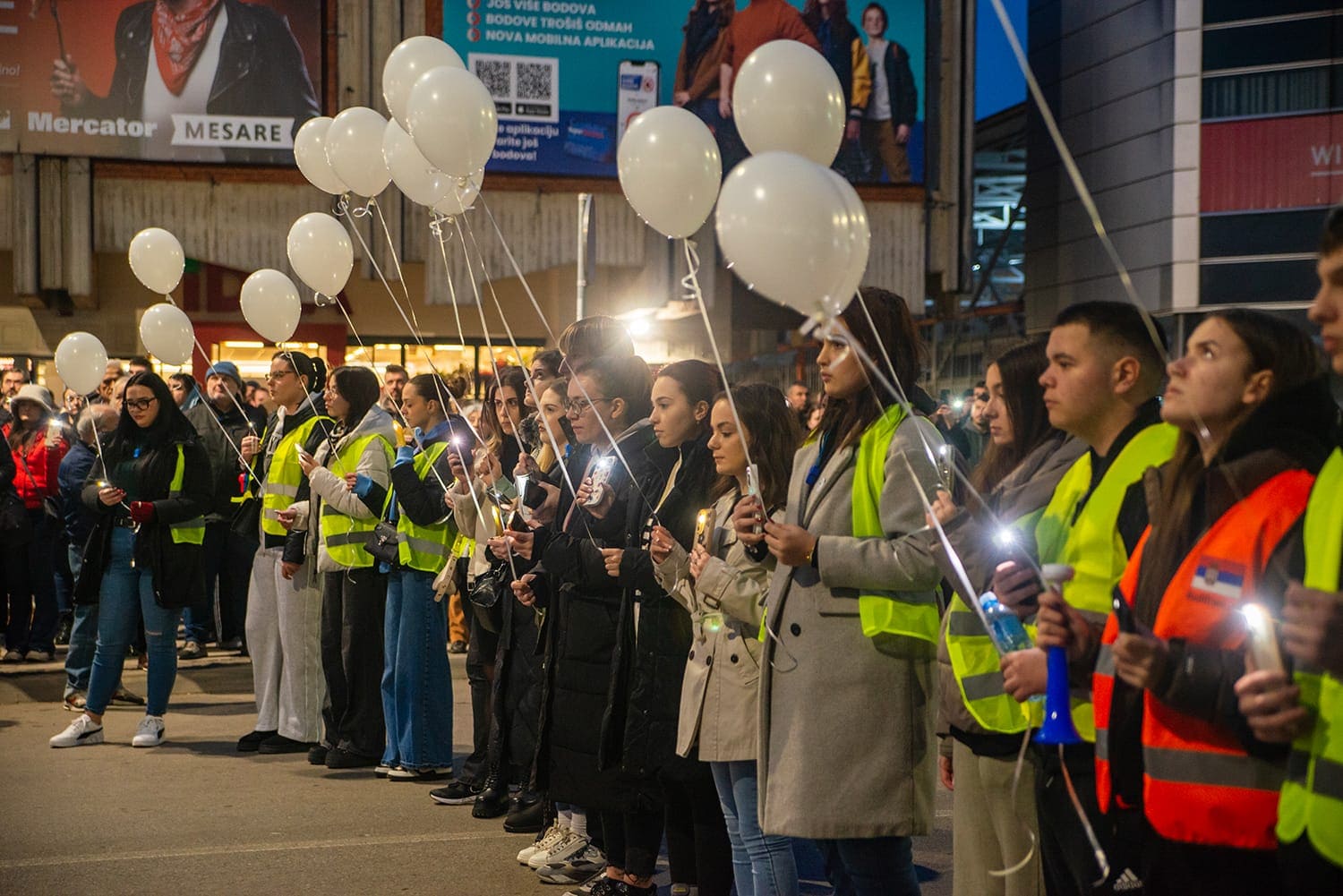
Compiled by Adriana Zaharijević & Jana Krstić In late 2024, a tragedy shook Serbia — the collapse of a newly renovated railway station in Novi Sad claimed 16 lives, exposing deep layers of state negligence for its citizens and soaring levels of corruption. What began as mourning soon transformed into one of the most widespread civic uprisings in Serbia’s recent history. Led by students, joined by educators, workers, and citizens across the country, the movement challenged not just a single government failure but the broader erosion of democratic institutions. This timeline offers a structured account of the unfolding events, focusing on the regime's violent retaliation against the Serbian educational system. Photo by Hristina Zdravkovic From Mourning to Mobilization Nov 22, 2024 – Silent vigils blocking the roads in honour of the Novi Sad victims. The vigils were announced to the authorities. In front of the Faculty of Dramatic Arts, those gathered were attacked by the passers-by, some of whom were identified as the officials of the ruling party, SNS. Nov 25, 2024 – The students of the Faculty of Dramatic Arts occupied the faculty building in protest, to be successively joined by four other faculties (University of Belgrade) and the Faculty of Philosophy (University of Novi Sad). Dec 25, 2024 – 84 public faculties and one private faculty are blocked (74% of all Serbian faculties). At the same time, 73 secondary schools, i.e. 14%, are occupied by their pupils. These numbers would grow. Mid-December – All public faculties (but one, Orthodox Theological Faculty) gave their public support to the four students’ demands. Dec 20, 2024 – The Ministry of Education abruptly shortened the first school semester in order to prevent the school teachers, already in legal strike, from joining the blockades. Pupils remained in schools until the end of term. Due to the Ministry’s executive order, the first semester was not graded. Student marshals at the protest, sourced from https://protesti.pics The Months of Uprising – January and February 2025 Jan 20, 2025 – The second school semester was supposed to begin. It didn’t. At the beginning of March, approximately 500 schools across Serbia were in blockade, while around 400 continued with legal strike (15,500 teachers in blockade, 9,000 in strike; 70–80% schools in some form of work stoppage). In parallel, various social sectors – medical and agricultural workers, the Bar Association and the Association of Engineers, post office workers, cab drivers, actors, and pensioners – joined the blockades or initiated strikes. Jan 21 – The Rector of the University of Belgrade addressed the parliamentary Committee for Education and Science and stated that "the University of Belgrade gives its full support to the students", citing the support of a huge majority of professors. Rebellious and Free University platforms of professors and researchers began to connect and organize. Teachers formed their informal associations – PULS, Udružena prosveta Srbije – and those platforms began to collaborate. Student marshals leading the protest, sourced from https://protesti.pics The Days Prior to the Sound Cannon (March 15) March 4 – The salary of education workers was reduced between 50 and 100 percent; in some cases, high school teachers were paid only 2,191 RSD (less than 20 EUR), in others 12,000 RSD. An informal group of IT experts invited citizens to join the "Solidarity for Education" network and donate to help educators. The network is still in operation. March 7 – A group of 30 young people, presenting themselves as ‘the students who want to study’ or ‘Students 2.0’, set up tents in front of the president’s office in Pioneers Park. In the following days leading to the major gathering on March 15, the ‘Students 2.0’ were joined by SNS members and affiliates, and then by suspicious characters, many of whom have an established criminal record. The park area was soon fully occupied, fenced, and additionally shielded by 150 tractors without licence plates. The encampment is still in place. March 9 – Commenting on the large protest scheduled for 15 March, the President said he expected the opposition to "organize great violence" at the rally in Belgrade and that "everyone who participates in it will be arrested". This marked the beginning of a long line of threats to participants and organizers – still labelled as the ‘opposition’ funded by foreign money, despite the fact that the students openly and consistently refrained from supporting opposition parties. March 13 – At a press conference two days earlier, the University of Belgrade rector emphasized that the students, who organized the gathering, want a peaceful and dignified protest, stressing that the conflicts, announced for days by government-controlled media, are not part of the students’ plans. March 15 – The largest gathering in the capital, with more than 300,000 people in the street. The gathering was interrupted by the alleged deployment of LRAD (long-range acoustic device) on peaceful protesters during 15 minutes of silence for the victims of the Novi Sad collapse. The Ministry of Internal Affairs denied the allegations despite footage of the incident, as did the President, who called for the prosecution of those ‘lying’ and ‘spreading disinformation’. Tractors in front of the National Assembly of the Republic of Serbia, positioned ahead of the announced student protest on March 15. Sourced from https://protesti.pics Serbian Academia at the Helm of the "Coloured Revolution" Since December, the regime unsuccessfully sought to single out the ‘leaders’ of the students protests. Before March 15, the opposition was still defined as the main culprit behind the blockades. March 18 – In a TV interview, the President commented: "Faculty professors who do nothing, except participate in blockades, will get potatoes. Tomorrow, I think… They will get nothing." March 24 – The Ministry of Education of the technical government, caretaker government issued regulation 5/35, which effectively reduced the professors’ salaries to 12.5% of what they earned before. March 25 – The Ministry of Education has launched inspection supervision of faculties across Serbia, widely seen as yet another form of pressure on higher education institutions. March 28 – The rector of the University of Belgrade was turned into state enemy no. 1, ‘the face of evil’ (Minister in the technical government). March 31 – The dean of the Faculty of Philosophy in Niš was stabbed by a passer-by at a protest. April 1 – The dean of the Faculty of Economy in Belgrade was summoned to the police. April 18 – The rector of the University of Belgrade was summoned to the police on charges of abuse of official authority (sued by the ‘Students 2.0’). The Dean of the Faculty of Philosophy welcomes students at the protest in Niš. Sourced from https://protesti.pics The Effects of Potato Regulation 5/35 University professors are no longer paid for 20 hours of teaching and 20 hours of research per week, since the ratio was changed to 35 to 5 in favour of teaching. As there are no classes, professors receive only 12.5 percent of their salary, or, according to some reports, about 20,000 dinars (170 EUR) per month. Financial Violence Against University Professors – The drastic cut in research hours has subjected university professors to severe financial hardship, endangering their basic livelihoods. Collapse of the Accreditation System – Scientific and artistic research is essential for accreditation and quality assurance of university programs. With the new decree, this capacity is undermined. Jeopardising Engagement in Projects – With only 5 hours allocated to research, professors are unable to participate in or apply for most European projects, severely limiting international academic cooperation. Weakening Career Prospects – The decree severely hinders career advancement, as promotions are based on research output now nearly impossible under these conditions. Student cyclists in France, sourced from https://protesti.pics (Unanswered) Appeals of the Serbian Academics March 4 – 80 researchers holding EU research grants in Serbia sent a joint letter to the European Commission calling on it to help tackle corruption in the country. The Commission acknowledged receiving the letter but has neither replied nor commented. March 20 – An Open Appeal for international academic support for Serbian students and professors was signed by around 4,500 academics in less than a week. March 26 – 470 deans, professors, assistants and other employees of the University of Belgrade submitted an initiative to the Constitutional Court to assess the constitutionality of the Regulation. March 31 – The Serbian Academy of Sciences and Arts demanded the withdrawal of the Regulation. April 17 – The academic community appealed to the new Prime Minister, a professor of medicine, to withdraw the Regulation. And many more... Protest in Niš on March 1, sourced from https://protesti.pics Where Are We Now? Students’ demands remain unmet. Primary and then secondary schools gradually resumed classes in late April and May. The government’s ambition appears to be to quell the blockades without a clear plan for how or when the school year will end. Many teachers are threatened with dismissal – or already dismissed. The new Ministry of Education is dubbed the "Ministry of Revenge". Several faculties have entered legal strike; most remain in blockade; a few now teach asynchronously online. All faculties are exposed to non-payment of funds for material costs, fines, inspections, and reduced budgets. The illegal reduction of professors' salaries has entered its third month. There are frequent threats to cancel the funding of state universities. Strategy: divide et impera. At a rally in Niš on May 17, the president claimed young people were misled by social media and manipulative professors, to whom he said: "they will not get money until they start doing their work." A new Bill on Higher Education, announced recently, has sparked fears that it will further repress universities and significantly reduce academic autonomy. Protest in Belgrade on March 15, sourced from https://protesti.pics What Should We Do? This is a moment for concrete solidarity. The Serbian academic community now stands as the last bulwark against a rising wave of authoritarian repression. Colleagues around the world must use every platform – from faculty senates to social media – to denounce the crackdown. Academic associations should call on European and global bodies to condition funding on respect for university autonomy. In classrooms and at conferences, professors should spotlight Serbia’s struggle and keep it in the global conversation. Most importantly, we must stand with the students and professors who have placed themselves on the front lines of this fight. Their call for transparency, accountability, and independent education is not just Serbia’s cause – it is a defense of values cherished by academics everywhere. The world’s scholars cannot look away. The protection of knowledge and democracy depends on it.