

Overcoming ethno-nationalism
Author: Vladimir Stojković Although I am someone who was very small when the breakup of Yugoslavia began, I became aware of the importance of the idea of such a federation. The very idea of such a community was significantly progressive and went beyond the primitive narrow ethnic views of a multicultural society. In the idea of Yugoslavia, I saw at least an attempt at the formation of nations that happened after the French Revolution throughout Europe. It meant connecting people from different regions and different cultures. Like say in France and Italy. People created and adopted their new common identity over time. This is how societies of free people were formed, who voluntarily took part in such a community. However, something like that in the Balkans, i.e. former Yugoslavia was not possible. In other words, Yugoslavia was an attempt to achieve something like this here as well, but the nationalism of the ethnic groups interrupted that good idea. Mostar, city in Bosnia and Herzegovina. Author: Marcel Dominic, pixabay.com This is the climate of societies that base their existence on mythology. This constant need for societies to compete in who has a "richer" national history, etc. they cannot lead to progress and the survival of a social community. The aim of such "histories" is to glorify ethnic virtues and to somehow develop a sense of uniqueness of a certain ethnic group and supremacy in relation to its neighbors in the region. It is especially interesting to see this in the area of the former Yugoslavia, where peoples who speak the same language live and who are much closer to each other in terms of mentality than, say, Italians from southern and northern Italy. The wars of the 1990s on the territory of the former Yugoslavia set a lot of things back. People argue over territories and drawing borders. The dominance of a certain ethnic group and the suppression of minority groups is one of the main characteristics of such societies. That way of functioning of a society has been absolutely surpassed and reminds of some medieval times and the age of feudalism. It is difficult to expect the restoration of Yugoslavia as we knew it in the near future, but the idea of association and federalism certainly exists and that is what we should strive for. Perhaps the peoples of this area can once again be in some form of a common federation. The political and security situation in Europe and the world is such that the entry of all the countries of the former Yugoslavia, and the Balkans as a whole, into the EU would be a rational step forward. In this way, the idea of uniting into one union would be realized. It would be a stimulating injection for the Balkan countries, which would definitely push our societies into much more progressive trends in order to try to cross paths with the ghosts of the past.
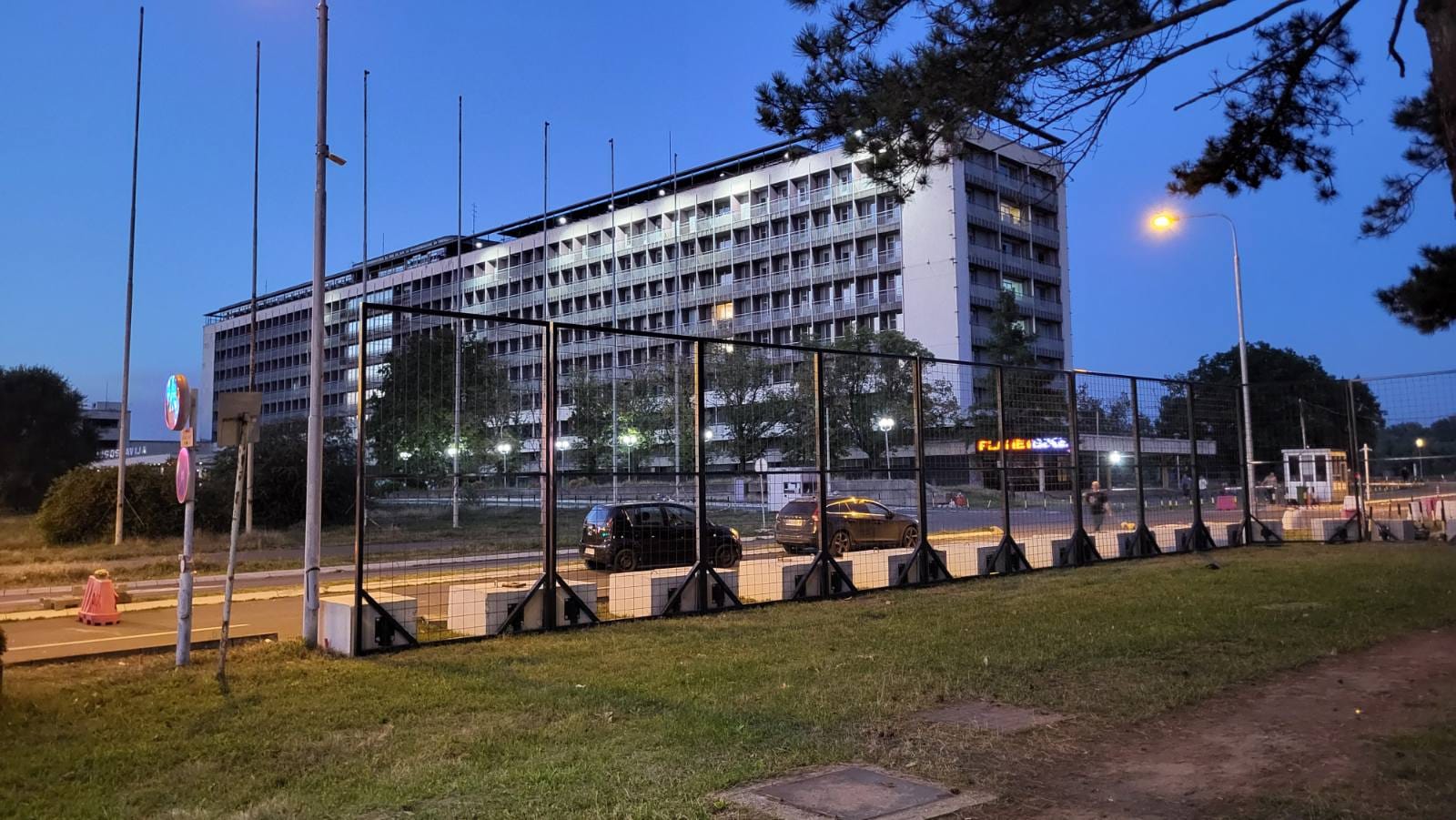
The fight to save Hotel Jugoslavija: activist Vasilije Brojčin against the city government’s bulldozing of history
This year, on October 20th, Belgrade celebrated the 80th anniversary of its liberation from the fascist regime in World War II. Or perhaps it would be more accurate to say, "Belgrade should have celebrated," as the local government of the capital of former Yugoslavia is actively promoting historical revisionism. Belgrade's Mayor Aleksandar Šapić has even discussed relocating the grave of Yugoslav President Josip Broz Tito from the city. His absurd proposals go so far that, ahead of this anniversary, he announced plans to repaint the city’s buses, which are in “socialist red” and “resemble a hot dog stand”, into blue, supposedly "the color of the Serbian Nemanjić dynasty". It's not just the graves and red buses that have come under fire from the city authorities, but also buildings that stand as symbols of this historical era. While factories and public enterprises were systematically privatized immediately after the fall of Yugoslavia, the buildings and bridges weren't demolished right away. They likely awaited some investors with good offers. Now, they are being systematically sold off at hefty discounts. Why "systematically"? Buildings of cultural significance from the Yugoslav era, such as the Beograđanka, the Genex Tower, and the Belgrade Fair, have been deliberately neglected for years. After being left uncared for, the passage of time has caused them to deteriorate, reducing their market value. Combine that with historical revisionism that denies their cultural importance, and these iconic structures are being handed over to investors who will tear them down in a matter of days and erect "fancy" luxury buildings, where apartments will be sold at exorbitant prices. A simple equation, really. Hotel Jugoslavija with a fence, photo by Vasilije Brojčin The latest target of the city authorities is the renowned Hotel Jugoslavija. In September 2024, the city government adopted a detailed regulation plan that anticipates the Hotel's demolition following its sale in March 2024 to Millennium Team, a company close to the ruling party. Although a demolition permit had not been issued at the time of writing, just days after the plan was approved, fences appeared around the Hotel, behind which bulldozers and machinery can be seen. However, one thing disrupted the city government's calculations—local activists. Led by an opposition party, the Green Left Front, they have gathered to resist not only the procedural violations but also the disregard for the Hotel's cultural and historical significance, as well as the potential environmental impact the construction of a new complex could have on residents of the Zemun and New Belgrade municipalities. Today, we speak with Vasilije Brojčin, activist who grew up in the neighborhood and have been actively involved in efforts to prevent the destruction of this landmark. They share their connection to the Hotel, the importance of preserving it, and the ongoing struggle to save it from demolition. Can you tell us about your connection to Hotel Jugoslavija and what that building means to you? Since I spent my whole childhood residing in this part of New Belgrade and Zemun, the Hotel reminds me of walks along the Danube quay with my parents and grandparents as a child, as it is a typical local milestone when going on a walk. "Are you going far? No, just to Jugoslavija and back" We still like to walk there; it's as relaxing as ever, but now, with the plans for demolition, that experience is in danger of being reduced to memories only. How did you first get involved in the fight to prevent the demolition of the Hotel? I began to participate in this cause as soon as the Green-Left Front (GLF) learned that the company that bought the Hotel plans to demolish it. I joined GLF back when it was Ne da(vi)mo Beograd (Do not let Belgrade d(r)own), a movement known for fighting capitalistic urbanism and gentrification, so it is already a niche of activism I have experience in. What is the historical and cultural significance of Hotel Jugoslavija for the local community and beyond? Its historical significance is undisputed, as it is a building that hosted many important people from many different backgrounds, from political figures to Hollywood actors and even astronauts from the Apollo 11 Moon landing mission. In the architectural sense, it's a prime example of socialist modernism. It fits in harmony with the architecture of neighboring housing blocks, so it never looked out of place, probably one of the reasons it was always accepted by the locals. Hotel Jugoslavija is a neighborhood landmark for the local community, including me. It symbolizes returning home after work or school, similar to the sight of Genex Tower when you're returning from a long trip. Photo: From the legacy of Stevan Kragujević (collection of the Museum of Yugoslavia) What are some of the critical arguments that activists have presented against the city's plan to demolish the Hotel? Aside from the building itself being of historical importance, we argue (and expert's opinions support) that its demolition and replacement with a complex consisting of a much bigger central building and the two 155m tall skyscrapers would have devastating consequences on its surroundings from putting additional pressure on traffic and parking infrastructure that would not be able to accommodate the influx of vehicles, to ecological destabilization of Danube river and protected ecosystem of its Great war island, home to many different species of birds. Of course, one of our major issues with this project, as leftists, is that it has precisely zero benefits to the local community and an average person. It includes no public amenities and is just another playground for the rich, one of the many popping up around Belgrade. How have the local authorities and city officials responded to the concerns raised by activists? Activists did not encounter understanding from the local or city officials; their reactions ranged from regularly denying all written complaints to being condescending to activists who attended the public debate at the Bureau of Urbanism. There have been reports of bulldozers arriving at the site despite the demolition permit not yet being issued. How did you and other activists react to this development? Yes, it's true. A fence has been built, and some construction equipment is on standby. We were outraged but not surprised as the company set to carry out the demolition and construction of the luxury complex is known to disregard laws regarding urban planning. What actions has the activist community taken so far to stop the demolition, and have any legal steps been initiated to prevent it? There were multiple campaigns to inform the locals about the plans for demolition, and a warning protest was also held with stands where attendees could sign a complaint form. Those complaints, the only legal procedure available, were labeled by city officials as unreasonable and driven solely by nostalgia, even though the experts in architecture and urbanism wrote those. What challenges have you faced during this campaign, and how do you and other activists stay motivated to continue fighting? The biggest challenge was and still is, to inform the public. Since all the biggest media companies are pro-ruling parties and won't report on any criticism of any of their projects, you have to do everything grassroots: hand out flyers, put up posters, go door to door, and talk to people in person. Previous successful local initiatives against capitalist urbanism and invasive construction projects motivate us to persist in our fight. We strive to replicate examples from New Belgrade's blocks 37 and 63, where the local community got together, defended their public spaces, and sent the investors back to where they came from. Many believe that the companies involved in the project are closely tied to Belgrade's political establishment. How does this influence the dynamics of the fight to save the Hotel? Yes, those same companies are involved in all of the construction projects of the current political establishment, from the notorious Belgrade Waterfront to Expo 2027, so there is no doubt that politicians in power have financial benefits from their operations. That doesn't affect the activists too much, except that disturbing knowledge that you are up against something potentially dangerous and much more significant than yourself, a mafia of sorts. Looking forward, what are your hopes for the future of Hotel Jugoslavija? What would be your ideal outcome for this building and the surrounding area? After the Hotel is defended, the most realistic outcome would be to become a hotel again since it's, unfortunately, private property. But if I'm talking ideally, like a dream outcome in the ideal society, it would be turned into student accommodation, and what a cool one it could be, considering its perfect location for recreational activities and good public transit connection to the rest of the city. Photo: From the legacy of Stevan Kragujević (collection of the Museum of Yugoslavia) For Vasilije and other residents of New Belgrade and Zemun, to continue to create memories within the public spaces surrounding the Hotel Jugoslavija, it is necessary that the local authorities once and for all hear their constituents and act in their best interest instead of only their own. It remains to be seen how much pressure from the activists and interested citizens will have to be directed towards the investors and local authorities in order to stop this kind of urban planning which neglect the public interest.