
Women’s function as change agents in nonviolent protests in Ukraine and the Balkan states
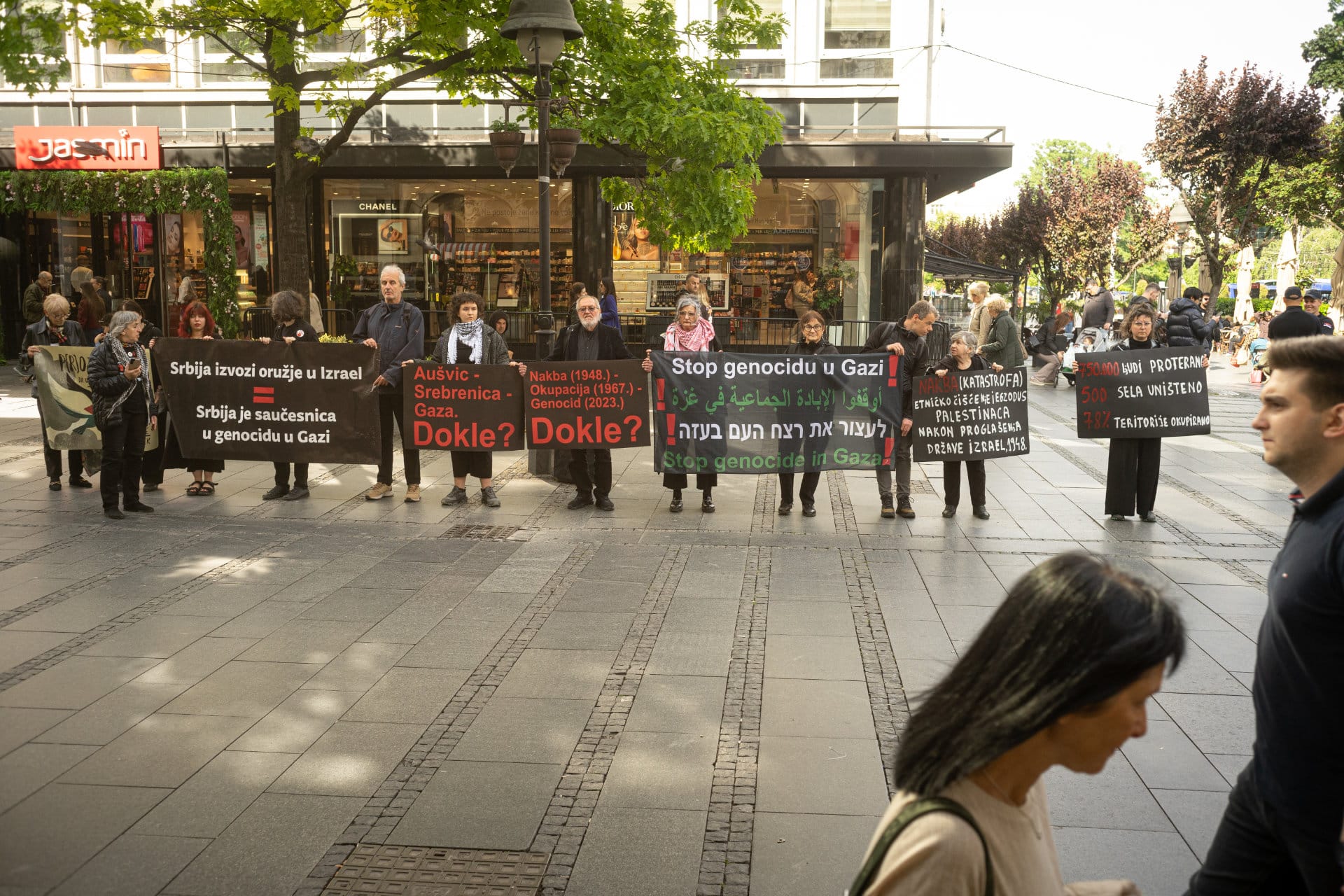
Author: Silvia Fabijanić Conflicts or rebellion against authority do not necessarily have to be violent. Nonviolent resistance does not seek victory over the enemy but the overcoming of injustice, thus a real solution and thereby the liberation of both those affected by the injustice and the opponents."1 It is about shaping actions that seek to stop wrong and harmful policies as they are being implemented, not an abstract idea that peace is "built" by the very act of resistance. Nonviolent movements throughout history have opened up space for reflection and the reshaping of social structures, often questioning relations between power, material inequalities, and dominant social norms. During the 1990s in Serbia, public space was dominated by fear, war propaganda, and the onset of armed conflicts. While much of society passively observed the events of the war, the organization Women in Black appeared on the streets of Belgrade. Their activism was based on the clear conviction that war is wrong and must be publicly and consistently opposed while it is happening. Women in Black had no institutional power or weapons, but they possessed a strong political stance and a visible, symbolically powerful presence in public spaces, which makes their activism particularly significant. This paper focuses on the work of Women in Black during the 1990s because of the specific historical and political context, marked by war, nationalism, and strong repression. Although armed conflicts did not take place on the territory of Serbia, the state was directly involved in the wars in the territory of the former Yugoslavia. A socio-political framework characterized by propaganda, militarization, and political control was established. Under such circumstances, nonviolent resistance takes on a special gravity and risk. Photograph from the Women in Black archive, documenting the “Stop the Genocide in Gaza” protest held in Belgrade in May 2026 Years later, during 2013 and 2014, in Ukraine, under conditions of peace and without armed conflict, the pro-democracy protest movement Euromaidan emerged. The protest movement began as a response by the people to the decision by the then-President of Ukraine not to sign an agreement with the European Union and to turn the country's policy toward Russia. The movement started as a peaceful protest but later escalated into a violent conflict. This paper focuses on the role of women during the nonviolent period of Euromaidan. During Euromaidan, women stepped out of socially imposed traditional roles and actively participated in political and social changes. Although the historical, political, and social contexts of the Women in Black and the women during Euromaidan differ, they are comparable in the way women enter the political sphere nonviolently through public activism during times of profound political and social change. Neither the Women in Black nor the women during the (nonviolent) part of Euromaidan were overshadowed by men; rather, they sought to be equal to men. We live in patriarchal social structures that systematically diminish or ignore women's overall contributions. Does women's activism in nonviolent movements serve as a corrective to social invisibility, rather than as an affirmation of difference? Based on this thesis, the paper focuses on the actions of Women in Black during the 1990s and on the participation of women in the nonviolent part of the Euromaidan protests. Although they operate in different historical and political contexts, this paper aims to present their nonviolent resistance, the motives that drive them to enter the public sphere, the risks they face, their level of visibility, and the contribution they have made to society through their nonviolent actions. This paper is based on a qualitative analysis of secondary sources. The analysis was conducted using thematic analysis of scientific, media, and audiovisual sources. NONVIOLENT RESISTANCE AND THE ROLE OF WOMEN IN SOCIAL MOVEMENT A passive attitude toward injustice in society is considered a greater problem than violence itself. Passivity represents implicit support for the violent structures of social power. Nonviolence is not a sign of weakness, but a conscious and deliberate abstention from violence while actively fighting against injustice. Nonviolent resistance does not seek victory over the enemy but the overcoming of injustice, thus a real solution and thereby the liberation of both those affected by the injustice and the opponents.2 It is useful to point out that nonviolent resistance is not the same as pacifism. Pacifism is a moral conviction, while nonviolent resistance is a strategic choice. People choose it because they think it will make it easier to win, not necessarily because they "love peace."3 Nonviolent movements offer various methods of action, from public protests and strikes, through boycotts and symbolic actions, to information campaigns. Their main characteristic is that they do not create moral constraints4 or other forms of obstacles.5 The accessibility for participation enables mass mobilization of citizens. Compared to violent methods, nonviolent resistance also demonstrates strategic effectiveness. Empirical data confirms that nonviolent campaigns are twice as likely to succeed (53%) compared to violent uprisings (26%), and they also leave behind more stable and democratic societies.6 The first key reason is the aforementioned mass participation, and the second is "political jiu-jitsu." It is a mechanism in which brutal repression of peaceful protesters backfires, destroying the authorities' reputation.7 It is precisely in these mechanisms of mass participation and strategic countereffect that women are a key strategic advantage. Since women make up approximately 50% of the total population, their active involvement in resistance movements is a crucial factor in achieving critical mass. Without women, a movement cannot reach the critical mass needed to exert effective pressure on the regime's "pillars of power." The presence of women on the front lines in 99% of cases directly undermines the regime's patriarchal authority and forces security forces to question their loyalties.8On the other hand, violence directed against unarmed women dramatically increases the moral and political cost of repression.9 That women's participation is not just a statistical figure but a reality is demonstrated by the Women in Black organization in Belgrade and the massive turnout of women at the Euromaidan in Ukraine. Although they may seem difficult to compare due to different political and social circumstances, the bridge connecting them is their entry into the public sphere through nonviolent resistance. WOMEN IN PEACE INITIATIVES IN THE BALKANS DURING THE 1990S: THE CASE OF SERBIA AND 'WOMEN IN BLACK' The political context of 1990s Serbia was marked by strong militarism and nationalist homogenization of society, as well as the breakup of SFRY10. Slobodan Milošević11used mass rallies to consolidate his power and create an atmosphere in which any voice of reason was branded "treasonous." Although the first multi-party elections were held, the system was not truly democratic. A strong retraditionalization of society occurred. The war discourse required men to be warriors and women to be "mothers of the nation" who would bear new soldiers and remain silent. 12 The political crisis of 1990 was merely a prelude to the armed conflicts that would follow on the territory of Croatia and Bosnia and Herzegovina. Serbia found itself in the paradoxical position of a state with no war on its own territory, yet simultaneously carrying out mass mobilization and sending resources to the battlefields. In such a specific context—where the war is waged 'in the name of the people,' but not on their territory—a strong internal resistance emerges in the form of the organization Women in Black. Women in Black is an activist group and network with a feminist-anti-militarist orientation, composed of women and men from different generations and ethnic backgrounds, with varying levels of education, social statuses, lifestyles, and sexual orientations. The organization grew out of earlier feminist initiatives, including Women's Studies and anti-war centers13, in response to the militaristic regime of Slobodan Milošević and the start of the war in Croatia and Bosnia. In Belgrade, on October 9, 1991, the organization began its weekly "vigil."14Every Wednesday on Republic Square in Belgrade, they stood in silence, dressed in black, holding banners. They used the traditional Eastern European/Christian custom of wearing black for the deceased, but gave it a new meaning: mourning the victims on "all three sides," which was a radical act because the regime only recognized Serbian victims. The silence served as a shield against the aggressive, male discourse of war. They chose silence as a rejection of speaking unnecessary words that prevent and hinder reflection on oneself and others. 15 They used black clothing as an "instrument of reason" and a method for their nonviolent entry into the social sphere. Through their engagement, they consciously distanced themselves from socially gender-imposed female roles and "sending sons to war," instead articulating their resistance as an independent political choice. This approach represented a radical critique of the very foundations of society, as they recognized militarism and war as direct extensions of patriarchal power structures. It was a direct blow to the very core of nationalist ideology. The members of the organization stated: We are a group of women who stand in silence and in black every week to express our disagreement with the war. We decided to show what the female side of this war is. Women in our countries wear black to express their sorrow for the deaths of their loved ones. We wear black for the deaths of all the victims of war. We wear black because people have been driven from their homes, because women have been raped, because towns and villages have been burned and destroyed."16 In addition to showing solidarity with the victims of war, the Women in Black also organized safe spaces for all men who refused military service. By practically protecting these men, they opposed the militaristic regime and shielded individuals from the state's repressive apparatus. "Women in Black also set up in a rented apartment that became a refuge for opponents of conscription and deserters. When the wars began, it is estimated that 300,000 Serb men of military age went into exile rather than fight. Providing emotional, moral, and political support to these men who refused to participate in the fighting was one of the practical ways the women acted on their feminist and anti-militarist ideas. Some of these men, in turn, became valued members of the organization." 17 Because of their views, Women in Black were subjected to various forms of attacks. The attacks included verbal and physical assaults on the streets, both during and outside of street actions, destruction of the organization's property, death threats against members, organized witch hunts and calls for lynching, and sexist outbursts. The use of sexist insults served to reduce their political message to "female hysteria" or moral depravity. Regime media called them "traitors," "foreign mercenaries," and other derogatory names and conducted media campaigns against the members. Almost no street action by Women in Black went by without physical and/or verbal attacks.18The attacks were not spontaneous actions or random incidents but were organized and systemic acts aimed at discrediting, isolating, and intimidating the members. In addition to random passersby, they were often attacked by organized groups such as members of paramilitary formations or far-right extremists. The sources of repression were society and the state apparatus. They were "traitors" because they rejected national homogenization and spoke publicly about the crimes being committed at the time by their own nation. One of the members stated: "We protested in the street and exposed our bodies [using the body as an integral part of the political message] against the regime…people would come up to us who spat on us, pushed us, pulled our hair, and yelled that we were traitors.." 19 Police officers would often stand by while passersbys attacked the women, intervening only when the situation escalated. Sometimes, the police officers themselves would hurl insults at the activists. The police's lack of reaction to these events indicated how complicit state authorities were in restricting the right to freedom of assembly.20 By standing in black, remaining silent, showing courage, and engaging in nonviolent action, they became highly visible in the public sphere of Serbian society in the 1990s. Women in Black were the first to show that it was possible to "take to the streets" in a strictly controlled regime. Their concept of long-term persistence (standing every week for years) is proof of the "possibility of nonviolent resistance" even under the harshest conditions. In doing so, they proved that a 'minority' movement can become the 'moral compass' of a society, ensuring that a critical voice is heard even in moments of greatest silence. They created a recipe for nonviolent resistance and perseverance. After the end of all the armed conflicts in which Serbia was involved, Women in Black did not stop their work. They shifted their focus to confronting the past, being in solidarity with all victims of war, honoring the victims by visiting war crime sites, and insisting that the crimes not be forgotten and that Serbia's institutions confront what was done.21 From the 1990s to today, the government in Serbia has changed, but the deep-seated mechanisms of the system have remained the same. After the collapse of the overhang at the Novi Sad train station (November 1, 2024), which killed 16 people, a new turning point was reached in Serbian society. A new wave of nonviolent resistance has begun, initiated by students demanding accountability for the deaths of 16 people and a change in political leadership. At the time of writing, the protests are still ongoing. The organization Women in Black has offered its full support to the students. In the new nonviolent resistance on the streets across Serbia, female students are not just participants; they actively take part in the blockades and are also targeted by police intimidation and physical and verbal attacks by the authorities. WOMEN AS AGENTS OF NONVIOLENT RESISTANCE DURING EUROMAIDAN On November 21, 2013, in Ukraine, protesters gathered on the main square in Kyiv to protest President Viktor Yanukovych.22 At that time, Ukraine was at a deeply divided crossroads between European integration and a renewed strong bond with Russia. Uncertainty about the country's future direction was caused by President Yanukovych's sudden withdrawal from Ukraine's Association Agreement with the European Union. For some Ukrainian citizens, membership in the European Union represented the only hope of bringing prosperity to Ukraine.23Aside from the latter reason, discontent among Ukrainian citizens had been smoldering for years. The causes lay in the oligarchic-clan system of power, corruption that permeated every sphere of society, and distrust in state institutions.24All of these were key drivers that brought the people of Ukraine onto the streets and sparked the Revolution of Dignity, better known as Euromaidan. Depending on the authors, the uprising can be divided into two phases: the first phase, which began in 2013 with peaceful student protests in Kyiv, and the second phase in 2014 when the protests spread across the entire country, and police repression turned them from peaceful demonstrations into mass violent protests.25This paper is based on the nonviolent part of Euromaidan and at a time when there is no immediate danger of war. Although Ukraine has experienced earlier revolutions, during Euromaidan women nonetheless transitioned from the role of "helpers" to that of "creators" of the revolution. "Women of Euromaidan" do not operate as an organization, like Women in Black, and therefore cannot be precisely defined. They are a generation of women who simultaneously navigated imposed traditional roles and actively participated in other protest roles, thereby permanently redefining public space in Ukraine. Their presence was multifaceted, and they occupied a space that was often under the strict supervision and regulation of male protesters. Although the media often emphasized the male aspects, women made up a huge part of the movement. At the very beginning of the protests, women made up as much as 44% of all participants.26According to the research, the motives for participating in the protest were multiple and often overlapping. The most common motive was opposition to corruption and human rights violations (60%), solidarity with the protesters (32%), the fight for a better future for their children (27%), and a sense of civic duty and helping society (24%).27 Many women embraced traditional female roles and were often seen by fellow protesters, as well as the broader public, as aides to the male protesters rather than as revolutionaries in their own right.28Their reproductive work—such as cooking, cleaning, laundry, and logistics—was often undervalued and considered less important than the "real" fighting on the barricades.29 In the post-Soviet context of Ukraine, such work in the private sphere (associated with women) is considered less prestigious and rarely receives public recognition compared to "real" work in the public sphere. However, although at the start of the protests women were pushed into traditional roles, they took on the roles which marked the beginning of their growing visibility within the patriarchal environment. Women began offering legal aid to protesters, organizing public lectures and documentary film screenings within the camp, patrolling barricades, distributing food and providing medical assistance, participating in negotiations, providing informational support, and handling logistics.30Ukrainian women thus fought for and occupied spaces traditionally reserved for men in the public sphere of a patriarchal society. Thanks to their participation in the Euromaidan protests, they became equal partners who shaped the protest and occupied male public spaces, unlike in earlier revolutions.31 The most prominent example of their organization was the founding of the Euromaidan SOS initiative.32The leaders of the initiative were women, most of whom were human rights activists.33Within the framework of the initiative, they coordinated activities, monitored cases of abuse, and ensured access to legal protection, thereby shielding individuals from the state's repressive apparatus. In addition to their involvement in mixed-gender collectives, they also operated through independently organized initiatives. They founded independent Women's Battalions ("Women's Sotnya") with the aim of making women's contributions visible and as a direct initiative by feminists appalled by the revolution's sexism. The most famous was the "Olga Kobylianska" Women's Battalion.34Although it was called a "battalion," it was not a military or violent formation, but rather an independent women's initiative focused on self-defense, guard duty, and organizational support within the nonviolent protest movement. The activists organized special actions like "Women's Solidarity Night" to draw attention to their contributions, marching through Euromaidan with instruments and chanting "Freedom, equality, women's solidarity!". Their actions provoked hostile reactions from some protesters; they were told, "You're provocateurs! What are you doing?" and their banners were torn down.35Examples of sexism and misogyny were common. In the kitchens, you could find signs like: "Dear women, if you see trash - clean it up, [male] revolutionaries will be pleased," and there were also ads looking for "young women to create a positive atmosphere."36There was also strong rhetoric among the male protesters and their "concern for women" that aimed to keep women away from "danger zones," not viewing them as capable of making decisions on their own.37 One of the more creative nonviolent actions by the protesters was the "Mirror Action." It was a powerful tactic in which protesters held torso-sized mirrors with the message "God, is that me!" as a counter-response to the police shields. The idea was for the police to see their reflections in the mirrors and confront their own actions. In addition, the protesters offered tea to the police officers, played their national anthem, and attached flowers to the officers' shields.38 Unfortunately, clashes with the police soon broke out, and Euromaidan became a violent protest. The police's violent crackdown on the protesters led to a large number of injuries and deaths, the radicalization of the protesters, and ultimately the flight of President Yanukovych. "I realized that this was serious, that the state had now turned against its own people."39It was precisely this realization of a state attacking its own citizens that was key to mobilizing women who had not previously considered themselves politically active. However, during Euromaidan, women in Ukraine had already shown how important they are in the public sphere through nonviolent engagement and participation, and how they can stand on equal footing with men. After Euromaidan in 2014, there was the Russian annexation of Crimea40and the war in Donbas.41Tensions continued over the following years, until the end of February 2022, when Russia launched a full-scale invasion of Ukraine, which remains an ongoing conflict. Unlike the Women in Black who were active in Serbia in the 1990s, a territory where no war was taking place, the women of Ukraine find themselves in a situation where an armed conflict is currently being waged on their territory. Thus, due to the newly emerged political and social circumstances, Ukrainian women have developed the view that defending the country is a prerequisite for preserving women's rights. They believe that a Russian victory means the end of human rights and feminist achievements in Ukraine, and therefore, defense (which includes both men and women) is necessary.42