
Propaganda in Mostar graffiti
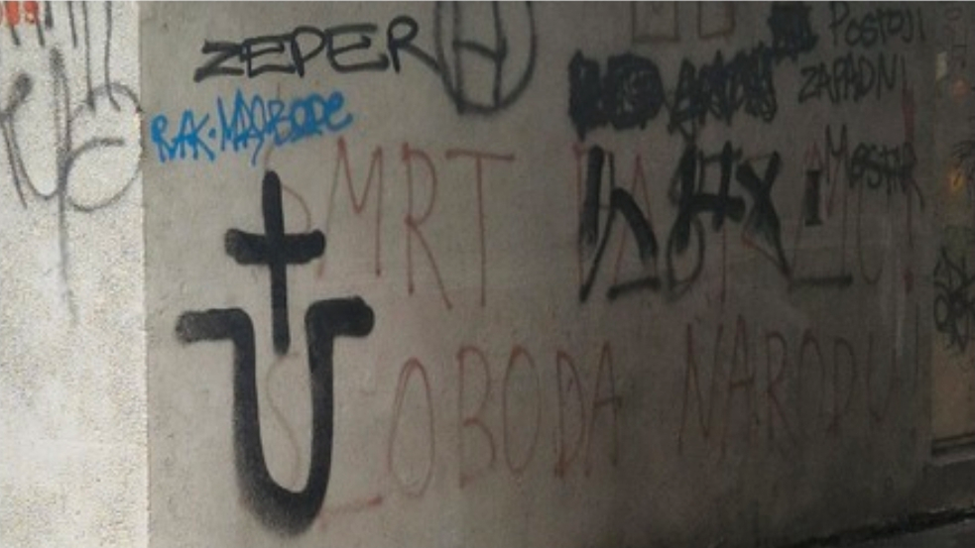
Author: Almin Šemić Ovaj članak možete pročitati na naškom ovde. On the wall of a building near the Glass Bank in Mostar, behind the Croatian National Theatre, in Knez Domagoj Street, there is a graffiti piece shown in the cover photograph that testifies to the long-standing presence of various messages in Mostar’s public space. Photo sourced from the Bljesak.info news portal As can be observed, the wall surface had previously been used for different inscriptions, including football supporter markings and other messages, indicating that this space functions as an open surface for informal visual communication. At the centre of attention is the graffiti bearing the message “Death to Fascism, Freedom to the People,” over which the symbol of the Ustasha “U” has been drawn. This creates a direct and clear ideological contrast within the same visual field between the anti-fascist slogan and a symbol that carries an opposing historical and political meaning. Furthermore, the message represents both a contrast and a reflection of Mostar’s society, where individuals express their affiliation with one ideology or multiple ideologies through such graffiti. On the same wall, there is also the inscription “There Is a Western Mostar,” which can be interpreted as a form of narrative concerning the division of Mostar. Such messages do not function merely as individual expressions but as recurring discourses that shape perceptions of the city and its boundaries in a symbolic sense. As Joseph Goebbels once stated, “A lie repeated a hundred times becomes the truth.” Just imagine how many times such a message, along with similar messages, had to be repeated in order to become normalized. In the context of children and propaganda, within ten years, sustained propagandistic influence may result in people no longer knowing whether Mostar was an anti-fascist city. Consider also how many times the phrase “Mostar Gymnasium” had to be repeated in order to erase the name of Aleksa Šantić. On a road in the suburban Mostar settlement of Vrapčići, near Mikulića Mahala, a graffiti inscription containing a message directed at a particular ethnic group was written. The inscription was sprayed in black paint directly onto the asphalt, without any additional visual elements, suggesting a rapid and informal intervention in public space. This is characteristic of graffiti intended to communicate a message quickly and directly. Photo sourced from the Večernji list news portal According to media reports, specifically from Raport and Večernji List, the graffiti was noticed in the early morning hours, after which the case was reported to the competent authorities, who conducted an investigation. Available information further suggests that similar inscriptions had previously been recorded in this area, indicating a continuity in the use of public surfaces for messages carrying political and identity-related connotations. Unlike graffiti that relies on symbolism or indirect messages, this inscription is characterized by its explicit and unambiguous formulation. What distinguishes it from the graffiti discussed in the previous section of this article is precisely the directness and explicitness of its message, which does not rely on symbolic conflict but instead communicates its content openly and unequivocally. Whereas the previous graffiti functioned through the overlapping of signs and the creation of ideological conflict within the same visual space, this one relies on a clear verbal formulation that requires no additional interpretation. From an analytical perspective, as previously noted, the message of the graffiti is clearly directed toward a specific ethnic group, as evidenced by the wording itself. Its structure and choice of words indicate an attempt at direct communication with a clearly defined “other,” while public space is used as a channel for transmitting such a message. At the same time, although it is impossible to determine with certainty who was responsible for creating the graffiti, the manner in which it is formulated points to a pattern characteristic of anonymous actors operating outside institutional frameworks. It is precisely this anonymity that allows the message to exist without the assumption of responsibility, while its public visibility ensures the dissemination of the message without intermediaries. In this context, the graffiti may be interpreted as a form of expression that does not seek dialogue but rather a one-sided assertion of presence and attitude within a particular space. Its function is not informative but performative: it does not merely communicate content, but also establishes a particular relationship toward the space and the community in which it appears. It is also possible to identify elements of propaganda within this graffiti, although it does not operate through an organized or institutional form. The message is formulated directly and without symbolic complexity, which is one of the fundamental characteristics of propaganda: clarity and ease of understanding without the need for additional interpretation. It is directed toward a specific group and employs emotionally charged language, thereby attracting attention and potentially influencing both the perceptions and emotions of passers-by. Although the identity of the author remains unknown, the manner in which the graffiti was created suggests an attempt to transmit a particular viewpoint through public space and reinforce the presence of that narrative, placing it within the broader framework of informal and decentralized propaganda. One may therefore consider how many times such a propagandistic message would need to be repeated before it becomes perceived as reality. On the wall of a residential building in Mostar, a graffiti inscription containing multiple messages written in black and red spray paint can be observed. The upper section consists of a sentence referring to territorial expansion and a historical context, accompanied by a symbol and a year, while the lower section contains the inscription “Ustaše Mostar: Fascism Lives!”. Photo sourced from the Mostarski.ba news portal The use of different colours and the arrangement of the messages suggest that the graffiti was not created at a single moment but rather represents a layered intervention produced by multiple authors or during different stages. The inclusion of geographical references and ideological terminology indicates an attempt to symbolically define the space and connect it with particular historical interpretations. The upper section of the graffiti, referring to historical context and territorial boundaries, demonstrates an awareness of historical narratives and their role in contemporary public discourse. From the perspective of propaganda studies, this graffiti illustrates how public space can become a site of competing messages that seek to influence the perceptions of passers-by. The upper inscription employs historical references and territorial allusions to suggest a particular political and identity-based framework, relying on recognizable symbols and narratives that already possess emotional and ideological significance within Mostar. Such an approach corresponds to several basic principles of propaganda, including the simplification of messages, reliance on familiar symbols, and attempts to associate a specific space with a particular collective identity. Furthermore, repetition represents one of the fundamental mechanisms of propaganda. Through the repeated appearance of similar messages and symbols in public space, certain narratives may gradually become normalized and integrated into collective perceptions. This raises broader questions regarding institutional responses to such messages and the extent to which public authorities address their presence within the urban environment. If viewed alongside recent incidents, such as attempts to remove graffiti depicting Slobodan Praljak in Ortiješ, as well as acts involving the placement of Ustaša stickers and symbols on monuments in Baćevići, the graffiti may be interpreted within a wider pattern of symbolic and ideological contestation in public space. In the context of propaganda, the graffiti can also be understood as an affirmation of a particular ideological narrative that relies on historical references and symbols associated with the legacy of fascism. Such messages do not operate in isolation. Rather, they often build upon existing social and political tensions, particularly in communities such as Mostar, where public space continues to bear the legacy of the conflicts of the 1990s. In this sense, the graffiti may be connected to narratives emerging from the war in Bosnia and Herzegovina, including the conflict between Bosniaks and Croats, with symbols and messages serving as mechanisms for the reinterpretation or preservation of specific forms of collective memory. Although the territorial divisions established during the war may no longer exist in a formal sense, symbolic boundaries continue to shape public discourse and spatial perceptions within the city. The repeated appearance of ideologically charged symbols, attacks on memorial sites, and disputes over historical narratives demonstrate how public space remains a field in which competing interpretations of the past are expressed and contested. The emotional dimension of propaganda is also evident in such messages, as they seek not only to communicate information but also to provoke emotional responses and influence attitudes toward coexistence, identity, and collective belonging. On an information board located in front of a building associated with the religious and cultural institutions of the Serbian community in Mostar, specifically in front of the Bishop’s Residence, a graffiti inscription was written in purple spray paint containing the markings “1981” and “4th Corps.” Photo sourced from the Top Portal news portal These references may be linked to local identity-based and historical contexts. The number “1981” is commonly associated with the Red Army (Football club Velež Mostar) supporters’ group, while “4th Corps” refers to a formation of the Army of the Republic of Bosnia and Herzegovina that operated in this area during the Bosnian War. The choice of location itself—an information board identifying a museum and religious site—further emphasizes the symbolic dimension of the intervention within this space. From an analytical perspective, the graffiti can be understood as a form of symbolic marking of space, through which a particular identity framework is communicated by means of brief and recognizable references. Such messages do not necessarily require explicit verbal formulations in order to be understood by the local community, as their meaning is constructed through existing social and historical references. In this context, the graffiti may function as a signal of the presence of a particular group or narrative within a given space, especially when it is displayed at a location associated with another community. Consequently, the message may be recognizable not only to members of the local community but also to a wider audience familiar with the historical and social significance of these references. Within the framework of propaganda studies, this graffiti may be viewed as a form of symbolic and identity-based territorial marking that relies not on direct statements but on recognizable signs embedded within the local context. The inscriptions “4th Corps” and “1981” evoke wartime and supporter-group symbolism, and through the combination of these references communicate a particular identity narrative. Their meaning is further shaped by the location, given that the graffiti appears on a board situated in front of a building associated with institutions of the Serbian community in Mostar, thereby giving the message a more specific and targeted dimension. In this sense, the graffiti may be interpreted as a signal of the presence of a particular social or ideological group within a space symbolically associated with another community. Similar inscriptions containing the same references have previously been documented at this and related locations, suggesting a pattern of repetition and the use of public space for the transmission of coded messages, a characteristic feature of informal forms of propagandistic communication. At first glance, the graffiti reading “KILL THE BALIJA” at the Bunica picnic site may appear to be just another act of vandalism in public space. However, its message extends beyond ordinary graffiti and enters the sphere of hate propaganda, ethnic intolerance, and symbolic violence. The location itself further amplifies the significance of the message. A natural recreational area, which should represent a space of leisure, social interaction, and escape from societal tensions, is transformed into a site of intimidation and a reminder of wartime narratives that have not completely disappeared from the public sphere of Bosnia and Herzegovina, even decades after the conflict. Photo sourced from the Blagaj Info Facebook page The message of the graffiti is direct, aggressive, and leaves little room for interpretation. The use of the term “balija,” which is employed within nationalist discourse as a derogatory label for Bosniaks, demonstrates a clear intention to dehumanize a particular ethnic group. Dehumanization has historically been one of the central elements of hate propaganda, involving the portrayal of the “other” as inferior, dangerous, or undesirable. When such language is combined with the imperative “kill,” the graffiti moves beyond hate speech and becomes an explicit call for violence. Visually, the graffiti is not artistically complex, yet its propagandistic power lies precisely in its brutal simplicity. The black lettering, roughly painted on a concrete surface, conveys a sense of urgency and raw aggression. There is no aesthetic ambition and no symbolism intended to obscure its meaning; the objective is not artistic expression but rather the dissemination of fear and the provocation of a reaction. Graffiti of this kind often functions as a territorial marker, representing an attempt to symbolically claim space through a nationalist message. It is particularly important to consider the context of Mostar and Herzegovina, regions that continue to bear the legacy of wartime divisions. Within such an environment, graffiti can serve as a means of prolonging conflict in symbolic form. Their impact extends beyond the individual reader, influencing the broader social atmosphere by creating feelings of insecurity and reinforcing distrust between communities. In this case, the propaganda does not seek to persuade through rational argumentation but through emotions, primarily hatred, fear, and anger. Such graffiti also performs a function of normalizing extremist discourse. When messages that advocate violence remain visible in public space for extended periods without a response from institutions or the wider community, they may create the impression of social tolerance toward such expressions. In this way, the graffiti becomes more than an isolated incident; it becomes part of a broader culture of silence and passivity regarding nationalist violence. From a propaganda perspective, the graffiti employs several key mechanisms: simplification of the message, identification of an “enemy,” emotional manipulation, and public visibility. For this reason, its influence can be particularly significant among younger generations who grow up surrounded by symbols of division. Rather than encouraging dialogue and shared public space, messages of this kind contribute to an atmosphere of conflict and serve as a reminder that public space in Bosnia and Herzegovina continues to function as a site of political and identity-based struggle.
Analiza propagande na Mostarskim zidovima
Autor: Almin Šemić Na zidu zgrade u blizini Staklene banke u Mostaru, iza Hrvatskog narodnog kazališta, u ulici Kneza Domagoja, nalazi se grafit iz naslovne fotografije koji svjedoči o dugotrajnoj prisutnosti različitih poruka u javnom prostoru Mostara. Fotografija preuzeta sa portala Bljesak.info Kako uočavamo, površina zida već je ranije korištena za ispisivanje raznih natpisa, uključujući navijačke oznake i druge poruke, što ukazuje na to da ovaj prostor funkcionira kao otvorena površina za neformalnu vizualnu komunikaciju. U središtu pažnje nalazi se grafit sa porukom „Smrt fašizmu, sloboda narodu“, preko koje je iscrtana simbolika ustaškog U. Time se unutar istog vizualnog polja uspostavlja direktan i jasan ideološki kontrast između antifašističke parole i simbola koji nosi suprotno historijsko i političko značenje. Osim toga, poruka je svojevrsni kontrast ali i ogledalo mostarskog društva, koje putem ovakvih grafita, izražavaju pripadnost jednoj ideologiji ili ideologijama. Na istom zidu nalazi se i natpis „Postoji zapadni Mostar“, koji se može čitati kao oblik narativa o podijeljenosti Mostara. Ovakve poruke ne funkcionišu samo kao individualni izrazi, već kao ponavljajući diskursi koji oblikuju percepciju grada i njegovih granica u simboličkom smislu. Kako i Joseph Goebbels kaže “svaka laž ponovljena stotinu puta, postaje istina”. Zamislite samo, koliko se puta morala ponoviti ovakva poruka kao i njoj slične poruke da postane normalna. U kontekstu djece i propagande, za desetak godina, propagandnim djelovanjem se više neće znati ni je li Mostar bio antifašistički grad. Zamislite i koliko se puta morala ponoviti začkoljica Gimnazija Mostar, kako bi se iskorijenilo ime Alekse Šantića. Na cesti u mostarskom prigradskom naselju Vrapčići, u blizini Mikulića mahale ispisan je grafit koji sadrži poruku usmjerenu prema jednoj etničkoj grupi. Natpis je napisan crnim sprejem direktno na asfaltu, bez dodatnih vizualnih elemenata, što upućuje na brzu neformalnu intervenciju u javnom prostoru. Kao što je to slučaj i kod svakog grafita kojim se želi nešto brzo poručiti. Fotografija preuzeta sa portala Večernji list Prema medijskim navodima, konkretno Raporta i Večernjeg lista, grafit je primijećen u jutarnjim satima, nakon čega je slučaj prijavljen nadležnim institucijama koje su izvršile uviđaj. Iz dostupnih informacija proizlazi da su slični natpisi i ranije zabilježeni na ovom području, što ukazuje na kontinuitet korištenja javnih površina za ispisivanje poruka sa političkim i identitetskim konotacijama. Za razliku od grafita koji koriste simboliku ili indirektne poruke, ovaj natpis karakterizira eksplicitna i nedvosmislena formulacija. Ono što ga razdvaja od grafita iz prethodne analize jeste direktnost i eksplicitnost poruke, koja ne koristi simbolički sukob već otvoreno i nedvosmisleno komunicira sadržaj. Dok je prethodni grafit funkcionirao kroz preklapanje znakova i stvaranje ideološkog konflikta unutar istog vizualnog prostora, ovaj se oslanja na jasnu verbalnu formulaciju bez potrebe za dodatnim tumačenjem. U analitičkom smislu, kao što smo već pomenuli, poruka grafita je jasno usmjerena prema konkretnoj etničkoj grupi, što proizlazi iz same formulacije teksta. Njena struktura i izbor riječi ukazuju na pokušaj direktne komunikacije sa jasno definiranim drugim i drugačijim, pri čemu se javni prostor koristi kao kanal za prenošenje takve poruke. Istovremeno, iako nije moguće sa sigurnošću utvrditi tko stoji iza ispisivanja grafita, način na koji je formuliran upućuje na obrazac karakterističan za anonimne aktere koji djeluju izvan institucionalnih okvira. Upravo ta anonimnost omogućava poruci da postoji bez preuzimanja bilo kakve odgovornosti, dok njena javna vidljivost osigurava širenje poruke bez posrednika. U navedenom kontekstu, grafit se može interpretirati kao oblik poruke koja ne teži dijalogu već jednostranom iskazu prisutnosti i stava u prostoru. Da prostite, kao kad lav izmokri teritoriju da je označi, tako slično možemo posmatrati i ovaj grafit. Njegova funkcija nije informativna, već performativna, on ne samo da prenosi sadržaj, nego i uspostavlja određeni odnos prema prostoru i zajednici u kojoj se pojavljuje. U ovom grafitu moguće je prepoznati i elemente propagandnog djelovanja, iako on ne djeluje kroz organiziranu ili institucionalnu formu. Poruka je formulirana direktno i bez simboličke složenosti, što je jedna od osnovnih karakteristika propagande, jasnoća i lakoća razumijevanja bez potrebe za dodatnim tumačenjem. Usmjerena je prema konkretnoj grupi i koristi snažan, emocionalno nabijen jezik čime se postiže efekt privlačenja pažnje i potencijalnog uticaja na percepciju prolaznika, ali i na samu emociju. Iako nije poznato tko stoji iza pisanja ovakvog grafita, način na koji je izvedena ukazuje na pokušaj da se kroz javni prostor prenese određeni stav i učvrsti prisutnost tog narativa, što grafit svrstava u širi okvir neformalne, decentralizirane propagande. A zamislite samo, koliko se puta ovakva propagandna poruka morala ponoviti da bi postala stvarnost. Na zidu stambene zgrade u Mostaru, ispisan je grafit koji sadrži više poruka pisanih crnim i crvenim sprejem. Gornji dio čini rečenica koja referira na teritorijalno širenje i historijski kontekst, uz dodatak simbola i godine, dok se u donjem dijelu nalazi natpis “Ustaše Mostar: fašizam živi!”. Fotografija preuzeta sa portala Mostarski.ba Različite boje i raspored sugeriraju da grafit nije nastao u jednom trenutku, već kao slojevita intervencija više autora ili u različitim fazama. Svakako da, spominjanje geografskih referenci i ideoloških termina ukazuje na pokušaj da se prostor simbolički definira i poveže sa određenim historijskim interpretacijama. Gornji dio grafita, onaj o povijenom kontekstu odnosno granicama, jasno prikazuje svijest okoline o proučavanju povijesti. Sto puta ponovljena laž je istina, a upravo tim putem se nastoji ići kroz pisanje ovakvih grafita, alaudirajući da je NDH tekovina još uvijek prisutna u Mostaru. Ona ista NDH koja svojata granice do Drine i zaziva crna odijela. Ako posmatramo kroz prizmu propagande, ovaj grafit pokazuje kako javni prostor može postati mjesto konkurentskih poruka koje nastoje oblikovati percepciju prolaznika. Gornji natpis koristi povijesne reference i teritorijalne aluzije kako bi sugerirao određeni politički i identitetski okvir, oslanjajući se na prepoznatljive simbole i narative koji već imaju emocionalno i ideološko značenje u Mostaru. Takav pristup odgovara osnovnim principima propagande, pojednostavljivanje poruke, oslanjanje na poznate simbole i pokušaj povezivanja prostora sa određenim kolektivnim identitetom. Nadalje, jedan od osnovnih principa propagande jest ponavljanje poruke, u ovom primjeru, poruke fašizma koja zapravo i već dugo odzvanja Mostarom. Pitanje ostaje, kako ovakve poruke ne bude akciju u predstavnicima vlasti u Mostaru? Da li su i oni taoci ovakvih politika? Ukoliko posmatramo nedavni pokušaj brisanja grafita Slobodana Praljka iz naselja Ortiješ, te upade u mjesto Baćevići gdje živi pretežno srpsko stanovništvo (slučaj lijepljenja ustaških stikera i pisanje ustaških simbola na spomeniku NOBa), onda dolazimo do svjesnog propagandnog djelovanja koje svoje utemeljenje pronalazi duboko u prošlosti. U kontekstu propagande, ovaj grafit može se i interpretirati kao oblik afirmacije ideološkog narativa koji se oslanja na historijske reference i simbole povezane s fašističkim nasljeđem. Odnosno, prihvatanje jedne ideologije. Takve poruke ne djeluju izolirano, već se često nadovezuju na postojeće društvene i političke tenzije, posebno u sredinama poput Mostara gdje je javni prostor i dalje obilježen posljedicama ratnih sukoba iz 1990ih. U tom smislu, grafit se može povezati s narativima koji proizlaze iz rata u Bosni i Hercegovini, uključujući i sukobe između Bošnjaka i Hrvata, pri čemu simboli i poruke služe kao način reinterpretacije ili održavanja određenih kolektivnih sjećanja. Drugim riječima, ratne granice su možda i pobrisane, no one teritorijalne nisu. Danas se u Mostaru fašizam slavi kao Nova godina. Svjedočili smo skrnavljenju Partizanskog spomen groblja i lupanju ploča. Osim toga, prisutan je i emocionalni princip djelovanja, pogotovo u dijelu suživota, gdje se emocionalnim putem nastoji postići akcija. Na informativnoj tabli ispred objekta povezanog sa vjerskim i kulturnim institucijama srpske zajednice u Mostaru, točnije ispred Vladičanskog dvora, ispisan je grafit ljubičastim sprejem koji uključuje oznake “1981” i “4. Korpus”. Fotografija preuzeta sa portala Top Portal Ove reference mogu se dovesti u vezu sa lokalnim identitetskim i historijskim kontekstom, “1981” se često povezuje sa navijačkom grupom Red Army, dok “4. Korpus” upućuje na formaciju Armije BiH koja je djelovala na ovom području tokom rata u Bosni i Hercegovini. Sam izbor lokacije, tabla koja označava muzej i vjerski objekt, dodatno naglašava simboličku dimenziju intervencije u ovom prostoru. U analitičkom smislu, grafit se može posmatrati kao oblik simboličkog označavanja prostora, gdje se kroz kratke i prepoznatljive oznake prenosi određeni identitetski okvir. Takve poruke ne moraju nužno imati eksplicitnu verbalnu formulaciju da bi bile razumljive lokalnoj zajednici, jer se njihovo značenje gradi kroz postojeće društvene i historijske reference. U tom kontekstu, grafit može djelovati kao signal prisutnosti jedne grupe ili narativa u prostoru, posebno kada je ispisan na mjestu koje se povezuje s drugom zajednicom. Dakle, poruka može biti poznata samo lokalnoj ili široj zajednici, a u ovom kontekstu poznata je i široj i lokalnoj zajednici. U okviru propagande, ovaj grafit može se posmatrati kao oblik simboličkog i identitetskog označavanja prostora, koji ne koristi direktne poruke, već prepoznatljive oznake unutar lokalnog konteksta. Natpisi “4. Korpus” i “1981” upućuju na ratnu i navijačku simboliku, čime se kroz kombinaciju tih referenci prenosi određeni identitetski okvir. Njegovo značenje dodatno se oblikuje kroz lokaciju, s obzirom na to da je ispisan na tabli ispred objekta povezanog s institucijama srpske zajednice u Mostar, čime poruka dobija konkretnu ciljanu dimenziju. U tom smislu, grafit se može interpretirati kao signal prisutnosti jedne društvene ili ideološke skupine u prostoru koji se simbolički povezuje s drugom. Slični natpisi sa istim oznakama već su ranije zabilježeni na ovom i srodnim lokalitetima, što ukazuje na obrazac ponavljanja i korištenja javnog prostora za prenošenje kodiranih poruka, karakterističan za neformalne oblike propagandnog djelovanja. Na prvi pogled, grafit “UBIJ BALIJU” na izletištu u Bunica djeluje kao još jedan čin vandalizma u javnom prostoru. Međutim, njegova poruka prevazilazi obični grafit i ulazi u sferu propagande mržnje, etničke netrpeljivosti i simboličkog nasilja. Sama lokacija dodatno pojačava težinu poruke – prirodno izletište koje bi trebalo predstavljati prostor odmora, zajedništva i bijega od društvenih tenzija pretvara se u mjesto zastrašivanja i podsjećanja na ratne narative koji ni decenijama nakon sukoba nisu u potpunosti nestali iz javnog prostora Bosne i Hercegovine. Fotografija preuzeta sa Facebook stranice Blagaj Info Poruka grafita je direktna, agresivna i ne ostavlja prostor za interpretaciju. Korištenje riječi “balija”, koja se u nacionalističkom diskursu koristi kao pogrdan naziv za Bošnjake, pokazuje jasnu namjeru dehumanizacije određene etničke skupine. Upravo je dehumanizacija jedan od ključnih elemenata propagande mržnje kroz historiju – stvaranje slike “drugog” kao manje vrijednog, opasnog ili nepoželjnog. Kada se takva poruka spoji s imperativom “ubij”, grafit prelazi iz govora mržnje u otvoreni poziv na nasilje. Vizualno, grafit nije umjetnički kompleksan, ali njegova propagandna snaga leži upravo u brutalnoj jednostavnosti. Crna boja slova, grubo ispisana na betonskoj površini, ostavlja dojam hitnosti i sirove agresije. Nema estetske ambicije, nema simbolike koja bi prikrivala značenje – cilj nije umjetnički izraz nego širenje straha i provociranje reakcije. Takvi grafiti često služe kao teritorijalne oznake, odnosno pokušaj simboličkog “prisvajanja” prostora kroz nacionalističku poruku. Posebno je značajno analizirati kontekst Mostara i Hercegovine, prostora koji i dalje nose snažno naslijeđe ratnih podjela. U takvom ambijentu grafiti postaju sredstvo produžavanja konflikta u simboličkoj formi. Oni ne djeluju samo na pojedinca koji ih pročita, već utiču i na kolektivnu atmosferu, stvarajući osjećaj nesigurnosti i produbljujući nepovjerenje među zajednicama. Propaganda u ovom slučaju ne pokušava uvjeriti argumentima, nego emocijama – prvenstveno mržnjom, strahom i bijesom. Ovakvi grafiti također imaju funkciju normalizacije ekstremnog govora. Kada poruke koje pozivaju na nasilje ostaju dugo prisutne u javnom prostoru bez reakcije institucija ili zajednice, stvara se utisak društvene tolerancije prema njima. Time grafit postaje više od pojedinačnog ispada; on postaje dio šire kulture šutnje i pasivnosti prema nacionalističkom nasilju. U propagandnom smislu, grafit koristi nekoliko ključnih mehanizama: pojednostavljivanje poruke, identifikaciju “neprijatelja”, emocionalnu manipulaciju i javnu vidljivost. Upravo zbog toga njegov uticaj može biti snažan, posebno među mlađim generacijama koje svakodnevno odrastaju okružene simbolima podjela. Umjesto dijaloga i zajedničkog prostora, ovakve poruke proizvode atmosferu konflikta i podsjećaju koliko je javni prostor u Bosni i Hercegovini i dalje mjesto političke i identitetske borbe.
Roma in Bosnia and the Unfinished Violence of the 1990s
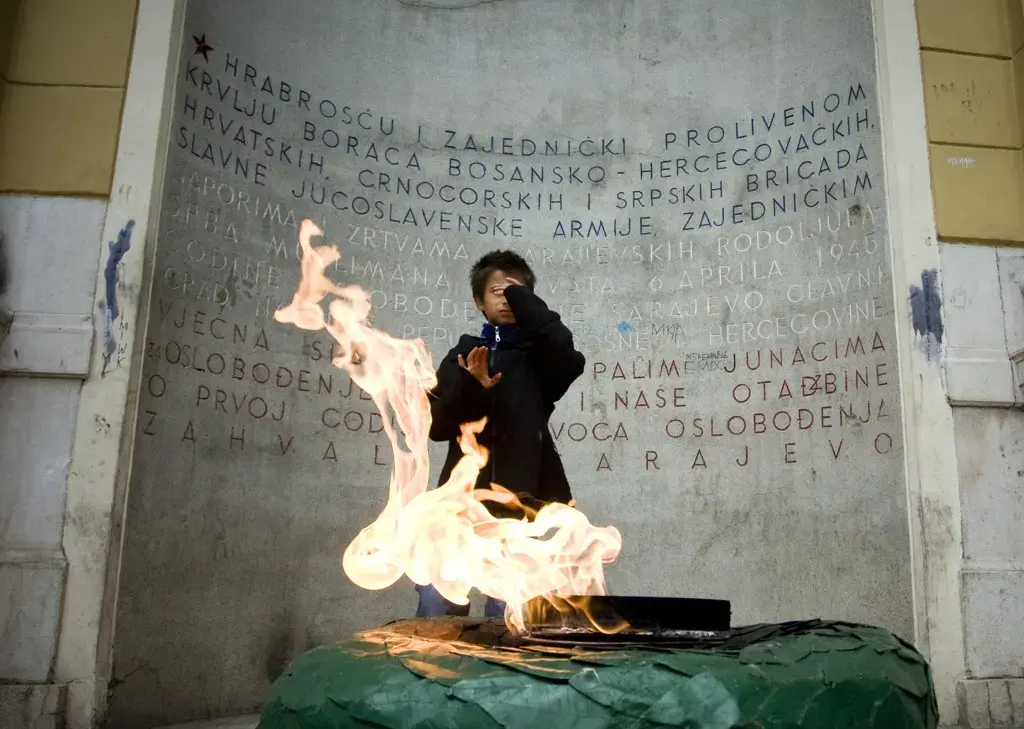
Historically speaking, the Roma population has been one of the most marginalised and discriminated groups in the Western Balkans. During the middle and new ages, Roma people were slaves to the other nations in the Balkans, with Roma slavery being officially abolished only in 1856 in Romania. Estimates say that up to half a million Roma people were killed during the Second World War by Nazi Germany and its fascist collaborators. According to data from the United States Holocaust Memorial Museum, tens of thousands of Roma in the territory of the former Yugoslavia under German occupation were sent to concentration camps such as Sajmište and Jasenovac. The Roma population in Croatia and Bosnia and Herzegovina was nearly decimated (Post-conflict Research Center, 2018, 4). A Roma child stands in front of the "Eternal Flame" in downtown Sarajevo. The plaque does not mention the casualties of Sarajevan minorities. Image by Jasmin Brutos. Bosnia, July 2008. Taken from: https://pulitzercenter.org According to the last available population census from 2013, Roma population in B&H amounts to 12,583 or 0,36% of the total population (Agency for Statistics of Bosnia and Herzegovina, 2019, 27), which makes them the biggest national minority in B&H an the fourth nationality. However, these figures do not depict the real situation for many reasons, two of them most important in the regard of this article. (1) Data collection like population census is carried out from door to door of households and this is the main obstacle since Roma people very often do not have a household in a usual sense of the word and reside in informal settlements where it is very challenging to keep track of the recorded households and their members. (2) Those who do take part in the data collection are hesitant to declare themselves as Roma due to the systemic and individual discrimination they have been experiencing for their whole lives. Instead, they either use their constitutionally guaranteed right not to declare their ethnicity/nationality or say that they are Bosniacs, Serbs or Croats. According to the report by the Institution of Human Rights Ombudsman of Bosnia and Herzegovina the estimation of the real number of Roma population in B&H is around 50.000 in total (Institution of Human Rights Ombudsman of Bosnia and Herzegovina, 2014, 23). Data shows that 71% of Roma households in Eastern Europe live in absolute poverty, a concept used to describe the living conditions in which people do not have enough resources to meet basic needs such as food, water, clothing and shelter (Singer, 1993, 218). The Institution of Human Rights Ombudsman claims that the Roma people do not exercise their human rights. Between 50% and 70% of Roma in B&H live in substandard housing, most often consisting of one room and no sanitary facilities. As far as 30% of Roma who participated in UNICEF research did not have a kitchen, while 17% lived without electricity (UNICEF, 2013, 24). When it comes to the legislative of the B&H, it is important to stress that “the Constitution of B&H does not recognize Roma and other minority groups as citizens with rights equal to those of their Bosniak, Croat, and Serb counterparts” (Post-conflict Research Center, 2018, 6-7). This gradually enables institutional discrimination and exclusion of Roma people, despite the ratification of international agreements that oblige B&H to fight against this kind of discrimination. Socio-economic status of Roma in B&H (Employment, healthcare, and education) Comprehensive, detailed and up to date data on socio-economic status of Roma in B&H is missing, but different reports and research results show that Roma in B&H is an especially vulnerable population. According to these findings, Roma people in Bosnia and Herzegovina face the highest level of discrimination in terms of employment opportunities and are almost completely absent from the workforce, which means that they have little choice but to find unregistered work in the informal sector (“grey economy”) or remain without an income. The unemployment rate among Roma is 56%, which is among the highest in the Western Balkan region and twice as high as that of non-Roma (European Commission, 2019, 55). Roma youth from Kakanj, a town 40 km northwest of Sarajevo, pose for a portrait. Image by Jasmin Brutos. Bosnia, September 2009. Taken from: https://pulitzercenter.org Main cause for the high unemployment rate among Roma is the inaccessibility of the labour market. This comes as a consequence of either being undocumented, living in informal settlements away and separated from the urban areas where the job offer rate is higher or the sheer lack of education, skills and required work experience (Civil Rights Defenders, 2018, 10-11). These deep systemic problems require intervention from the government, on all institutional levels. Qualitative analysis of the public policies which should result in a more satisfactory level of inclusion of Roma in B&H shows that the strategies only mention Roma briefly as one of the vulnerable groups and only few envisage Roma specific activities (Sarajlic, 2020). Most recent report of the European Commission points out that there is no significant progress in this area. Roma children are particularly vulnerable to the worst forms of child labour (European Commission, 2024, 41). Although Bosnia and Herzegovina’s healthcare system is formally based on principles of solidarity, inclusiveness, and accessibility, significant disparities between declared aspirations and real life persist. Unequal access to healthcare, poor service quality, financial opacity, outdated technology, and insufficient investment in new equipment remain key challenges. Vulnerable groups are often treated as homogeneous in policy documents, overlooking their diverse needs. Roma, in particular, face persistent barriers to healthcare, primarily due to a lack of personal identification documents and residence registration. Without these, they cannot access services like healthcare, social security, or education. The situation is even more challenging for those in rural areas, where healthcare services are less accessible (Sarajlic, 2020, 29-31). According to the results of the 2013 Multiple Indicator Cluster Survey, more than 30% of Roma children of school age in Bosnia and Herzegovina do not attend primary school. Additionally, less than half complete primary education on time - 46% of boys and only 34% of girls (CAHROM, 2016, 17-19). Since the end of the war in 1995, 294 Roma children have dropped out of primary school in the Federation of Bosnia and Herzegovina alone, despite support measures implemented by the relevant ministries (Civil Rights Defenders, 2018, 14). Given the importance of education, especially for children from vulnerable families, it is alarming that only 1.5% of Roma children attend preschool. In addition to the poor living conditions faced by the Roma population in Bosnia and Herzegovina, another contributing factor to high dropout rates and low preschool attendance may be the lack of recognition of Roma culture within the education system. The European Commission's 2016 Progress Report on Bosnia and Herzegovina highlights that the Roma language is not offered as an optional subject in any school in the country, nor are there alternative opportunities to learn it. Not only is education in the Roma language nonexistent, but it is also neither mentioned as a requirement nor considered a possibility in any official reports (European Commission, 2016). Roma in the Wars of the 1990s and as Refugees in Bosnia and Herzegovina As a result of the wars in the former Yugoslavia, tens of thousands of Roma from Bosnia and Herzegovina, Macedonia and Serbia were forced to leave their homes. In Bosnia and Herzegovina, hundreds of Roma were killed, but Roma were never recognised as victims of the war (Rorke, 2016). There is very little information about the exact number of Roma victims during these wars. Additionally, there is a lack of information about war crimes committed against Roma. According to a 2021 study by the Forum of Roma in Serbia, Roma over the age of 65 in Serbia testified that every twelfth elderly person had lost someone in the wars of the 1990s, and nearly the same proportion reported that a close family member had been wounded (Autonomija, 2024). Addressing war crimes is a problem that exists at the national level in BiH. War crimes researchers from non-governmental organizations have stated that Roma people were victims of all sides during the war, despite not being involved in starting the conflict. On top of that, unlike other ethnic groups, there were no paramilitary groups to protect Roma people. (DWP, 2024). To this day, only one case involving crimes against Roma has been prosecuted. The Skočić case involves members of the Simini Chetniks unit, who in July 1992 destroyed a mosque in the village of Skočić near Zvornik and killed 27 Roma civilians. They raped three Roma women, then took all the captured individuals in a truck to the village of Malešić, where the three women were singled out and taken to a house, where they were detained for several months. They were kept as slaves, raped, beaten, and forced to serve the members of the unit. One of them was 13 years old, and the other was 15. The remaining Roma men were taken to a pit in the village of Hamzići, where they were individually pulled out of the vehicle, killed with knives or firearms, and their bodies thrown into the pit. A bomb was then thrown into the pit. For these crimes, two members of the unit were sentenced to eight years, and one to five years, for the following acts: inhumane treatment, bodily harm, sexual humiliation, and rape. For example, one of the two sentenced to eight years, Zoran Djurdjević, committed the crime of raping a Bosniak woman a month before this crime, for which he was sentenced to 13 years (Nikolic, 2010). The Humanitarian Law Center points out that no one has been convicted for the murder of 27 Roma men, and that sentences for the prolonged sexual violence and rape of Roma women were significantly lighter than those for similar crimes against women of other nationalities. Based on this, the Center believes that Serbian institutions responsible for prosecuting war crimes are indifferent to investigating and prosecuting crimes against Roma during the conflicts in the former Yugoslavia. This lack of action, coupled with a clear absence of empathy for the victims, reveals a discriminatory attitude toward Roma within these institutions. (Humanitarian Law Center, 2019). The fact that cases of war crimes committed against Roma are rarely even initiated, and when they are, they result in lenient sentences, is alarming enough. Even more concerning is the fact that many accused and even convicted war criminals move freely and work across the former Yugoslavia, making the region highly unsafe for vulnerable groups such as the Roma people. As we have already noted, a large number of proceedings have yet to be initiated or are still in their early stages, and the Humanitarian Law Center has repeatedly warned about the potential dangers posed by the absence of lustration for war criminals. For example, a war criminal who was sentenced to 22 years in prison for the most serious crimes against the Muslim population was, with the approval of a primary school principal and the support of the mayor, allowed to give a lecture to children in a school in Novi Sad last year - on the topic of "heroism" (Bursać, 2023). Similarly, in the most recent elections held in Serbia, Vojislav Šešelj, who was convicted by the Hague Tribunal for hate speech, participated in the elections and is currently part of the ruling coalition in the country's capital (N1, 2023). Thus, individuals who participated in or supported war crimes remain embedded in the structures of power today. Given that Bosnia and Herzegovina has a three-member presidency, with each member representing one of the three constituent peoples, it is also worth noting that the party representing Serbs was founded by Radovan Karadžić, a convicted war criminal sentenced to life imprisonment by the International Criminal Tribunal for the former Yugoslavia (United Nations, 2016). The circumstances are even more challenging for Roma who left for foreign countries during the war and returned to Bosnia and Herzegovina afterward. The post-war political and social structures often excluded them, leaving many without access to housing, healthcare, or education. A large number of Roma lack proper identification documents, preventing them from obtaining refugee status or state assistance. Furthermore, the destruction of their homes and displacement disrupted their traditional ways of life, pushing many into extreme poverty. Reports from organizations such as the United Nations and Human Rights Watch have documented cases of discrimination against Roma in the post-war period. The United Nations even declared Roma as a Category of Persons from Bosnia and Herzegovina who are in Continued Need of International Protection after the war (UNHCR, 1999). Many Roma settlements were destroyed during the conflict, and those who attempted to return often faced hostility from local communities. For these reasons, the EU signed an agreement with Bosnia and Herzegovina, obligating the country to reintegrate all Roma who were deported from the European Union back to Bosnia and Herzegovina (Efendic & Ferré, 2023). To achieve this goal, national governments developed “reintegration policies.” However, these policies do not always take into account the specific situation of Romani returnees, particularly the discrimination and other forms of anti-Gypsyism they face. More concretely, they fail to address the lack of adequate housing and the limited access to the labor market that Roma experience due to their ethnicity. Moreover, the “reintegration policies” do not always acknowledge the different circumstances of returnees. For instance, Roma banished in the aftermath of the war in Kosovo who spent more than 15 years in Western Europe face a different situation upon return compared to Roma who left their home countries only a few years ago. Additionally, the measures outlined in these “reintegration policies” are not fully implemented, primarily due to a lack of financial resources (Civil Rights Defenders, 2018, 26). Thus, even when bound by an agreement, Bosnia and Herzegovina fails to provide adequate protection for returning Roma. The situation is significantly worse when Roma return from countries that are not EU members, as there is no regulation obligating Bosnia and Herzegovina to reintegrate them into society. Exclusion as a post-war reality The Roma population in Bosnia and Herzegovina faces deep-rooted systemic discrimination, socio-economic exclusion, and political marginalization. Despite being the largest national minority, Roma remain largely invisible in official policies, lacking fundamental rights such as access to education, employment, healthcare, and legal recognition. Their historical and contemporary suffering, including the atrocities committed against them during the wars of the 1990s, remains unacknowledged, perpetuating cycles of marginalization. The lack of institutional commitment to justice and inclusion, coupled with rising nationalist rhetoric, further exacerbates their vulnerability. Non-governmental organizations in Bosnia and Herzegovina, as well as international human rights organizations, often describe the position of Roma in BiH as a "vicious cycle." There is no doubt that Roma are excluded from society, and their integration requires a chain reaction that the government and institutions of Bosnia and Herzegovina show no willingness to initiate. Roma in Bosnia and Herzegovina are, above all, unsafe, exposed to violence that goes unpunished, and their frequent lack of access to healthcare makes them even more vulnerable. References Agency for Statistics of Bosnia and Herzegovina. (2019). Census of Population, Households and Dwellings in Bosnia and Herzegovina. Agency for Statistics of Bosnia and Herzegovina. https://www.popis.gov.ba/popis2013/doc/Knjiga2/K2_S_E.pdf Autonomija. (2024, August 31). MARKO MILOSAVLJEVIĆ: Romske žrtve jugoslovenskih ratova ostale marginalizovane i nepriznate. Portal građanske Vojvodine, Autonomija. https://autonomija.info/marko-milosavljevic-romske-zrtve-jugoslovenskih-ratova-ostale-marginalizovane-i-nepriznate/ Bursać, D. (2023, May 17). Bursać: Tišina tamo, ratni zločinac djeci drži čas! ALJAZEERA. https://balkans.aljazeera.net/opinions/2023/5/17/bursac-tisina-tamo-ratni-zlocinac-djeci-drzi-cas CAHROM. (2016). THEMATIC REPORT BY THE GROUP OF EXPERTS ON VOCATIONAL EDUCATION AND TRAINING FOR ROMA. Ad Hoc Committee of Experts on Roma and Traveller Issues. https://rm.coe.int/16806a9332 Chileva, A., Clarke-Habib, S., & Kut, G. (2021). A Manual for Trainers in the Western Balkans: Youth peer education for peacebuilding and conflict transformation. Regional Youth Cooperation Office. https://www.rycowb.org/wp-content/uploads/2022/03/Y-Peer_PB_Manual_English_web.pdf Civil Rights Defenders. (2018). The Wall of Anti-Gypsyism: Roma in Bosnia and Herzegovina. Civil Rights Defenders. https://crd.org/wp-content/uploads/2018/02/The-Wall-of-Anti-Gypsyism-–-Roma-in-Bosnia-and-Herzegovina-BiH.pdf DWP. (2024, Jun 22). Zločini nad Romima na području bivše Jugoslavije nikad nisu procesuirani. Dealing with the past. https://dwp-balkan.org/bs/zlocini-nad-romima-na-podrucju-bivse-jugoslavije-nikad-nisu-procesuirani/ Efendic, A., & Ferré, C. (2023). ASSESSMENT OF POLICY, INSTITUTIONAL AND SERVICE GAPS RELATED TO SUSTAINABLE SOCIO-ECONOMIC REINTEGRATION OF RETURNEES IN BOSNIA AND HERZEGOVINA. UNDP. https://www.undp.org/sites/g/files/zskgke326/files/2024-10/returnee_assessment_bih_report_final.pdf European Commission. (2016). Bosnia and Herzegovina 2016 Report. Europian Commission. European Commission. (2019). Commission Opinion on Bosnia and Herzegovina’s application for membership of the European Union. European Commission. https://eur-lex.europa.eu/legal-content/EN/TXT/PDF/?uri=CELEX:52019SC0222 European Commission. (2024). Bosnia and Herzegovina 2024 Report. European Commission. https://enlargement.ec.europa.eu/document/download/451db011-6779-40ea-b34b-a0eeda451746_en?filename=Bosnia%20and%20Herzegovina%20Report%202024.pdf Humanitarian Law Center. (2019, March 11). Sentences for rape of Roma women from Skočić too mild. Humanitarian Law Center. http://www.hlc-rdc.org/?p=36418&lang=de Institution of Human Rights Ombudsman of Bosnia and Herzegovina. (2014). Special report on the status of Roma in Bosnia and Herzegovina. OSCE Office for Democratic Institutions and Human Rights. https://www.osce.org/files/f/documents/2/a/110495.pdf International Criminal Tribunal for the former Yugoslavia, United Nations. (2023, September 23). THE ICTY INDICTED 161 INDIVIDUALS for serious violations of international humanitarian law committed in the territory of the former Yugoslavia. ICTY. https://www.icty.org/en/cases/key-figures-cases Kulkova, M. (2019). From Negative to Positive Peace in Western Balkans. Central European Journal of International and Security Studies, 13(3), 26-47. https://cejiss.org/images/issue_articles/2019-volume-13-issue-3/02-kulkova.pdf N1. (2023, November 1). Šešelj: Radikali u koaliciji sa SNS na beogradskim i lokalnim izborima. Danas. https://www.danas.rs/vesti/politika/seselj-radikali-u-koaliciji-sa-sns-na-beogradskim-i-lokalnim-izborima/ Nikolic, M. (2010, February 1). Prvi proces za zločine nad Romima. Radio Slobodna Evropa. https://www.slobodnaevropa.org/a/skocic_romi_zlocin/1944992.html Perviz, I. (2023, April 16). Dosije Stava: Sud BiH osudio najviše ratnih zločinaca u historiji. stav.ba. https://stav.ba/vijest/dosje-stava-sud-bih-osudio-najvise-ratnih-zlocinaca-u-historiji/ Post-conflict Research Center. (2018). Roma on the Margins. OSCE Mission to BiH. https://www.osce.org/files/f/documents/8/2/406001.pdf Rorke, B. (2016, July 20). 25 Years after Yugoslavia: Roma Exclusion (Part 1). European Roma Rights Centre. https://www.errc.org/news/25-years-after-yugoslavia-roma-exclusion-part-1 Sarajlic, A. (2020). Analysis of mainstream policies targeting Roma integration in Bosnia and Herzegovina. Regional Cooperation Council Roma Integration Action team. https://www.rcc.int/romaintegration2020/files/admin/docs/246777234263684e42c5e9739dfcbdab.pdf Singer, P. (1993). Practical ethics (2nd ed.). Cambridge University Press. Tokača, M. (2012). The Bosnian Book of the Dead. Istraživačko dokumentacioni centar. https://exyugenealogy.net/wp-content/uploads/2019/12/bosanska-knjiga-mrtvih_tom-i.pdf Trepanic, A. (2023, January 11). U BiH 172 potjernice za licima koja izbjegavaju pravdu u vezi ratnih zločina. BIRN. https://balkaninsight.com/sr/2023/01/11/u-bih-172-potjernice-za-licima-koja-izbjegavaju-pravdu-u-vezi-ratnih-zlocina/ UNHCR. (1999, May 1). Update of UNHCR's Position on Categories of Persons from Bosnia and Herzegovina who are in Continued Need of International Protection. UNHCR. https://www.unhcr.org/news/update-unhcrs-position-categories-persons-bosnia-and-herzegovina-who-are-continued-need UNICEF. (2013). Položaj Romske djece i porodica u Bosni i Hercegovini. UNICEF. https://www.unicef.org/bih/media/436/file/Položaj%20romske%20djece%20i%20porodica%20u%20Bosni%20i%20Hercegovini.pdf United Nations. (2016, March 24). Karadžić (IT-95-5/18). International Criminal Tribunal for the former Yugoslavia. https://www.icty.org/en/case/karadzic War Crimes Database. (n.d.). WAR CRIMES TRIALS DATABASE AT A GLANCE. Retrieved February 2, 2025, from https://www.warcrimesdatabase.net Zatega, E. (2025, January 28). Hiljade ratnih zločina u BiH vjerovatno nikad neće biti sudski procesuirano. Slobodna Evropa. https://www.slobodnaevropa.org/a/ratni-zlocini-bih-sudovi/33290353.html
From Kyiv to the Balkans: How a Museum Opened My Eyes to Shared Wartime Childhoods
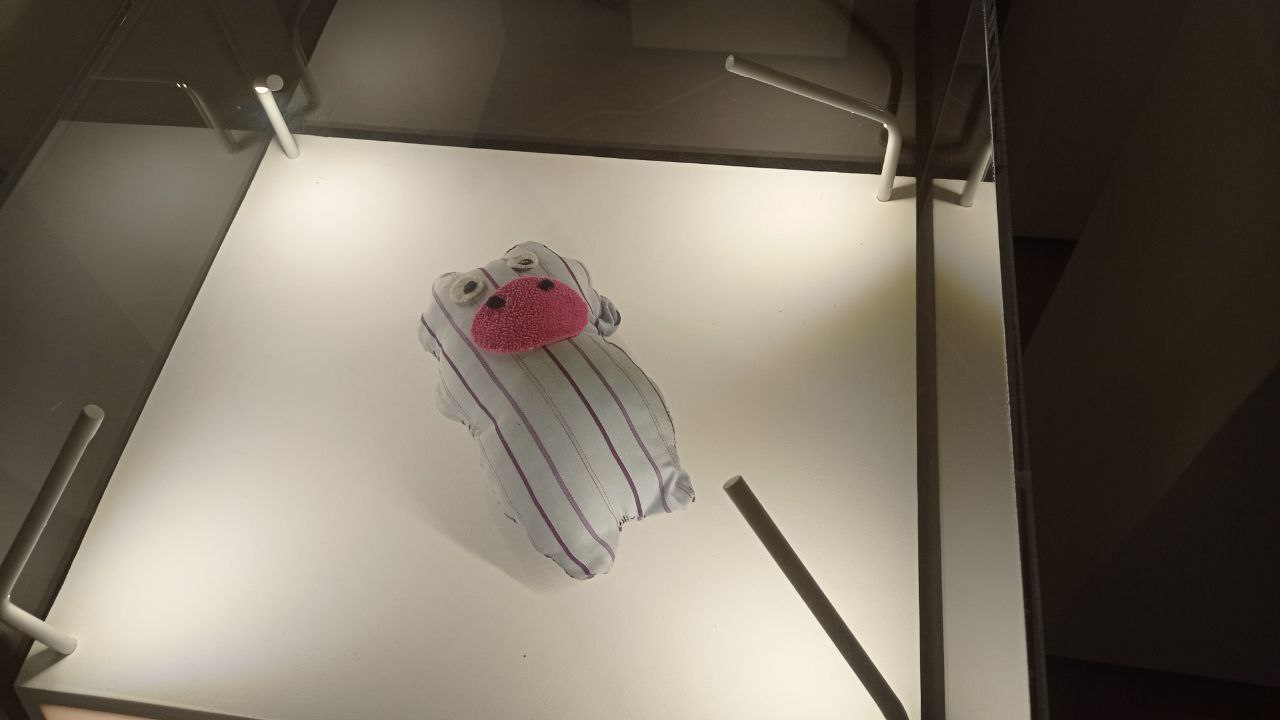
Author: Vladyslava Oliinyk What do a child in Sarajevo in the 1990s and a child in Ukraine today have in common? A historian and student shares how moderating an exhibition at the War Childhood Museum in Kyiv sparked a personal and academic journey into Balkan history, empathy, and the power of cultural memory. This blog reflects on how museums can connect past and present across borders—and how stories of childhood in wartime can bring people and nations closer together. Last summer, I had the unique opportunity to moderate a temporary exhibition at the War Childhood Museum in Kyiv. Although the exhibition was managed by the museum’s Ukrainian branch, moderators like myself had to familiarize ourselves with the institution’s origins in Sarajevo, Bosnia and Herzegovina. The War Childhood Museum is a relatively young institution—its permanent exhibition opened only in 2017—but its conceptual depth is striking. The idea behind the museum lies in the tension between the uniqueness and universality of growing up during wartime, as first explored in the book War Childhood by Bosnian entrepreneur and author Jasminko Halilović. Halilović transformed his personal experiences as a child during the Bosnian War (1992–1995) into a literary work and, eventually, a cultural institution. Photo by Oliinyk Vladyslava As a historian, I was familiar with the basic chronology and causes of the Bosnian War, but I had never examined the conflict on a micro level. During my undergraduate studies, my focus was on the history of visual art in Victorian Britain, and I gave little attention to Central or Eastern Europe. It wasn’t until Russia’s full-scale invasion of Ukraine that I felt a personal urgency to understand the region’s post-Soviet transitions and the independence movements of neighboring countries. The complex and often painful recent history of the Balkans earned my deep respect, but at first, I struggled to see how our experiences were connected. Encountering the War Childhood Museum changed that. I began to recognize parallels between the Russian-Ukrainian war and the Bosnian conflict—especially in how children navigate trauma, displacement, and interrupted childhoods during wartime. The museum made these connections tangible, offering a space where individual stories speak across national and temporal boundaries. Photo by Oliinyk Vladyslava In my growing curiosity about the Balkans, I chose to join a Central European University specifically because it offered a course on Balkan Studies. Ukrainian universities also offer Central and Eastern European studies, but I realized that to truly understand the region, I needed to learn from the people who live there. Who can speak more vividly about the intricacies of student protests in Serbia than those participating in them? Who can reflect more truthfully on the Bosnian war than those who lived through it? Through my studies and encounters, these questions are finding meaningful answers. My experience taught me how cultural institutions, like museums, can provide powerful tools for rethinking war, trauma, and identity. Today’s museums can connect the histories of different nations, revealing shared tragedies and common challenges—particularly for children navigating the chaos of war. This renewed focus on the experiences of minors has led me to new research interests and opened a new chapter of European history I had never expected to engage with so deeply. Museums, I’ve learned, can simultaneously build bridges and highlight difference—and in doing so, they provide a space where empathy, inquiry, and healing can coexist. Photo by Oliinyk Vladyslava Photo by Oliinyk Vladyslava