
Author: Almin Šemić
Ovaj članak možete pročitati na naškom ovde.
On the wall of a building near the Glass Bank in Mostar, behind the Croatian National Theatre, in Knez Domagoj Street, there is a graffiti piece shown in the cover photograph that testifies to the long-standing presence of various messages in Mostar’s public space.
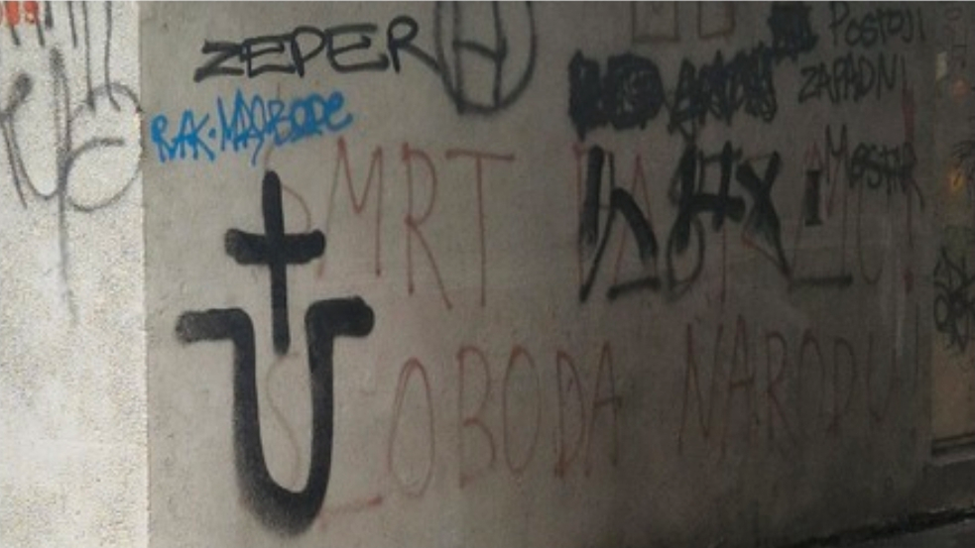
As can be observed, the wall surface had previously been used for different inscriptions, including football supporter markings and other messages, indicating that this space functions as an open surface for informal visual communication.
At the centre of attention is the graffiti bearing the message “Death to Fascism, Freedom to the People,” over which the symbol of the Ustasha “U” has been drawn.
This creates a direct and clear ideological contrast within the same visual field between the anti-fascist slogan and a symbol that carries an opposing historical and political meaning.
Furthermore, the message represents both a contrast and a reflection of Mostar’s society, where individuals express their affiliation with one ideology or multiple ideologies through such graffiti.
On the same wall, there is also the inscription “There Is a Western Mostar,” which can be interpreted as a form of narrative concerning the division of Mostar. Such messages do not function merely as individual expressions but as recurring discourses that shape perceptions of the city and its boundaries in a symbolic sense.
As Joseph Goebbels once stated, “A lie repeated a hundred times becomes the truth.”
Just imagine how many times such a message, along with similar messages, had to be repeated in order to become normalized.
In the context of children and propaganda, within ten years, sustained propagandistic influence may result in people no longer knowing whether Mostar was an anti-fascist city.
Consider also how many times the phrase “Mostar Gymnasium” had to be repeated in order to erase the name of Aleksa Šantić.
On a road in the suburban Mostar settlement of Vrapčići, near Mikulića Mahala, a graffiti inscription containing a message directed at a particular ethnic group was written. The inscription was sprayed in black paint directly onto the asphalt, without any additional visual elements, suggesting a rapid and informal intervention in public space. This is characteristic of graffiti intended to communicate a message quickly and directly.
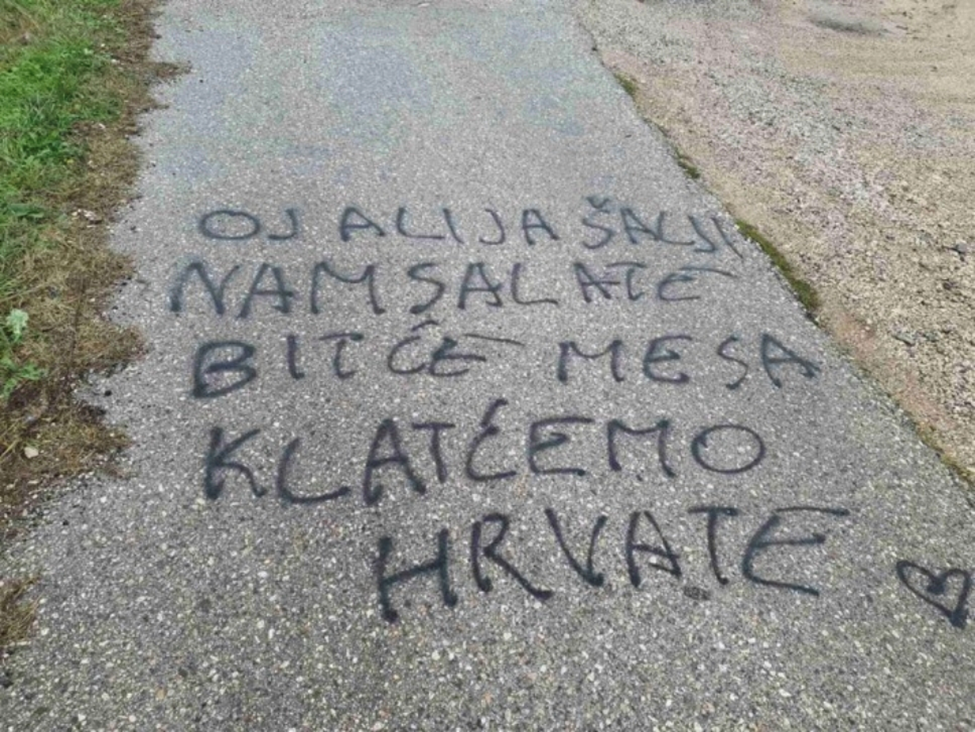
According to media reports, specifically from Raport and Večernji List, the graffiti was noticed in the early morning hours, after which the case was reported to the competent authorities, who conducted an investigation. Available information further suggests that similar inscriptions had previously been recorded in this area, indicating a continuity in the use of public surfaces for messages carrying political and identity-related connotations.
Unlike graffiti that relies on symbolism or indirect messages, this inscription is characterized by its explicit and unambiguous formulation. What distinguishes it from the graffiti discussed in the previous section of this article is precisely the directness and explicitness of its message, which does not rely on symbolic conflict but instead communicates its content openly and unequivocally.
Whereas the previous graffiti functioned through the overlapping of signs and the creation of ideological conflict within the same visual space, this one relies on a clear verbal formulation that requires no additional interpretation.
From an analytical perspective, as previously noted, the message of the graffiti is clearly directed toward a specific ethnic group, as evidenced by the wording itself. Its structure and choice of words indicate an attempt at direct communication with a clearly defined “other,” while public space is used as a channel for transmitting such a message.
At the same time, although it is impossible to determine with certainty who was responsible for creating the graffiti, the manner in which it is formulated points to a pattern characteristic of anonymous actors operating outside institutional frameworks. It is precisely this anonymity that allows the message to exist without the assumption of responsibility, while its public visibility ensures the dissemination of the message without intermediaries.
In this context, the graffiti may be interpreted as a form of expression that does not seek dialogue but rather a one-sided assertion of presence and attitude within a particular space. Its function is not informative but performative: it does not merely communicate content, but also establishes a particular relationship toward the space and the community in which it appears.
It is also possible to identify elements of propaganda within this graffiti, although it does not operate through an organized or institutional form. The message is formulated directly and without symbolic complexity, which is one of the fundamental characteristics of propaganda: clarity and ease of understanding without the need for additional interpretation. It is directed toward a specific group and employs emotionally charged language, thereby attracting attention and potentially influencing both the perceptions and emotions of passers-by.
Although the identity of the author remains unknown, the manner in which the graffiti was created suggests an attempt to transmit a particular viewpoint through public space and reinforce the presence of that narrative, placing it within the broader framework of informal and decentralized propaganda.
One may therefore consider how many times such a propagandistic message would need to be repeated before it becomes perceived as reality.
On the wall of a residential building in Mostar, a graffiti inscription containing multiple messages written in black and red spray paint can be observed. The upper section consists of a sentence referring to territorial expansion and a historical context, accompanied by a symbol and a year, while the lower section contains the inscription “Ustaše Mostar: Fascism Lives!”.
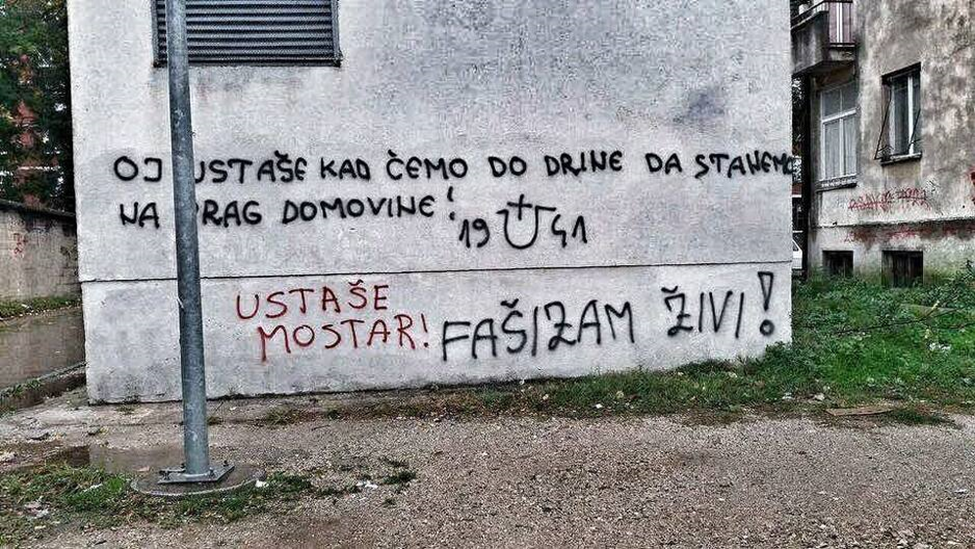
The use of different colours and the arrangement of the messages suggest that the graffiti was not created at a single moment but rather represents a layered intervention produced by multiple authors or during different stages. The inclusion of geographical references and ideological terminology indicates an attempt to symbolically define the space and connect it with particular historical interpretations.
The upper section of the graffiti, referring to historical context and territorial boundaries, demonstrates an awareness of historical narratives and their role in contemporary public discourse. From the perspective of propaganda studies, this graffiti illustrates how public space can become a site of competing messages that seek to influence the perceptions of passers-by.
The upper inscription employs historical references and territorial allusions to suggest a particular political and identity-based framework, relying on recognizable symbols and narratives that already possess emotional and ideological significance within Mostar.
Such an approach corresponds to several basic principles of propaganda, including the simplification of messages, reliance on familiar symbols, and attempts to associate a specific space with a particular collective identity.
Furthermore, repetition represents one of the fundamental mechanisms of propaganda. Through the repeated appearance of similar messages and symbols in public space, certain narratives may gradually become normalized and integrated into collective perceptions.
This raises broader questions regarding institutional responses to such messages and the extent to which public authorities address their presence within the urban environment.
If viewed alongside recent incidents, such as attempts to remove graffiti depicting Slobodan Praljak in Ortiješ, as well as acts involving the placement of Ustaša stickers and symbols on monuments in Baćevići, the graffiti may be interpreted within a wider pattern of symbolic and ideological contestation in public space.
In the context of propaganda, the graffiti can also be understood as an affirmation of a particular ideological narrative that relies on historical references and symbols associated with the legacy of fascism. Such messages do not operate in isolation. Rather, they often build upon existing social and political tensions, particularly in communities such as Mostar, where public space continues to bear the legacy of the conflicts of the 1990s.
In this sense, the graffiti may be connected to narratives emerging from the war in Bosnia and Herzegovina, including the conflict between Bosniaks and Croats, with symbols and messages serving as mechanisms for the reinterpretation or preservation of specific forms of collective memory. Although the territorial divisions established during the war may no longer exist in a formal sense, symbolic boundaries continue to shape public discourse and spatial perceptions within the city.
The repeated appearance of ideologically charged symbols, attacks on memorial sites, and disputes over historical narratives demonstrate how public space remains a field in which competing interpretations of the past are expressed and contested.
The emotional dimension of propaganda is also evident in such messages, as they seek not only to communicate information but also to provoke emotional responses and influence attitudes toward coexistence, identity, and collective belonging.
On an information board located in front of a building associated with the religious and cultural institutions of the Serbian community in Mostar, specifically in front of the Bishop’s Residence, a graffiti inscription was written in purple spray paint containing the markings “1981” and “4th Corps.”
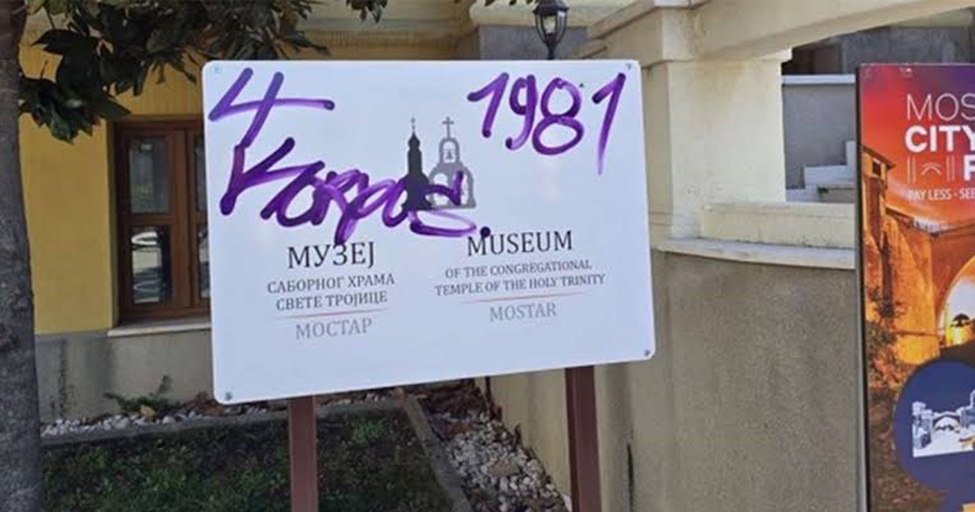
These references may be linked to local identity-based and historical contexts. The number “1981” is commonly associated with the Red Army (Football club Velež Mostar) supporters’ group, while “4th Corps” refers to a formation of the Army of the Republic of Bosnia and Herzegovina that operated in this area during the Bosnian War. The choice of location itself—an information board identifying a museum and religious site—further emphasizes the symbolic dimension of the intervention within this space.
From an analytical perspective, the graffiti can be understood as a form of symbolic marking of space, through which a particular identity framework is communicated by means of brief and recognizable references.
Such messages do not necessarily require explicit verbal formulations in order to be understood by the local community, as their meaning is constructed through existing social and historical references. In this context, the graffiti may function as a signal of the presence of a particular group or narrative within a given space, especially when it is displayed at a location associated with another community. Consequently, the message may be recognizable not only to members of the local community but also to a wider audience familiar with the historical and social significance of these references.
Within the framework of propaganda studies, this graffiti may be viewed as a form of symbolic and identity-based territorial marking that relies not on direct statements but on recognizable signs embedded within the local context.
The inscriptions “4th Corps” and “1981” evoke wartime and supporter-group symbolism, and through the combination of these references communicate a particular identity narrative. Their meaning is further shaped by the location, given that the graffiti appears on a board situated in front of a building associated with institutions of the Serbian community in Mostar, thereby giving the message a more specific and targeted dimension. In this sense, the graffiti may be interpreted as a signal of the presence of a particular social or ideological group within a space symbolically associated with another community.
Similar inscriptions containing the same references have previously been documented at this and related locations, suggesting a pattern of repetition and the use of public space for the transmission of coded messages, a characteristic feature of informal forms of propagandistic communication.
At first glance, the graffiti reading “KILL THE BALIJA” at the Bunica picnic site may appear to be just another act of vandalism in public space. However, its message extends beyond ordinary graffiti and enters the sphere of hate propaganda, ethnic intolerance, and symbolic violence. The location itself further amplifies the significance of the message. A natural recreational area, which should represent a space of leisure, social interaction, and escape from societal tensions, is transformed into a site of intimidation and a reminder of wartime narratives that have not completely disappeared from the public sphere of Bosnia and Herzegovina, even decades after the conflict.
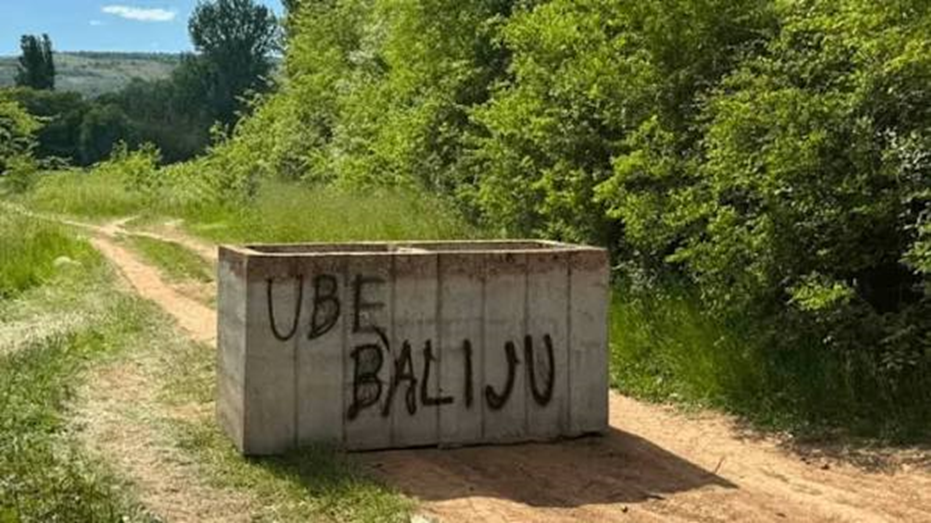
The message of the graffiti is direct, aggressive, and leaves little room for interpretation. The use of the term “balija,” which is employed within nationalist discourse as a derogatory label for Bosniaks, demonstrates a clear intention to dehumanize a particular ethnic group. Dehumanization has historically been one of the central elements of hate propaganda, involving the portrayal of the “other” as inferior, dangerous, or undesirable. When such language is combined with the imperative “kill,” the graffiti moves beyond hate speech and becomes an explicit call for violence.
Visually, the graffiti is not artistically complex, yet its propagandistic power lies precisely in its brutal simplicity. The black lettering, roughly painted on a concrete surface, conveys a sense of urgency and raw aggression. There is no aesthetic ambition and no symbolism intended to obscure its meaning; the objective is not artistic expression but rather the dissemination of fear and the provocation of a reaction. Graffiti of this kind often functions as a territorial marker, representing an attempt to symbolically claim space through a nationalist message.
It is particularly important to consider the context of Mostar and Herzegovina, regions that continue to bear the legacy of wartime divisions. Within such an environment, graffiti can serve as a means of prolonging conflict in symbolic form. Their impact extends beyond the individual reader, influencing the broader social atmosphere by creating feelings of insecurity and reinforcing distrust between communities. In this case, the propaganda does not seek to persuade through rational argumentation but through emotions, primarily hatred, fear, and anger.
Such graffiti also performs a function of normalizing extremist discourse. When messages that advocate violence remain visible in public space for extended periods without a response from institutions or the wider community, they may create the impression of social tolerance toward such expressions. In this way, the graffiti becomes more than an isolated incident; it becomes part of a broader culture of silence and passivity regarding nationalist violence.
From a propaganda perspective, the graffiti employs several key mechanisms: simplification of the message, identification of an “enemy,” emotional manipulation, and public visibility. For this reason, its influence can be particularly significant among younger generations who grow up surrounded by symbols of division. Rather than encouraging dialogue and shared public space, messages of this kind contribute to an atmosphere of conflict and serve as a reminder that public space in Bosnia and Herzegovina continues to function as a site of political and identity-based struggle.