
This is a stories category
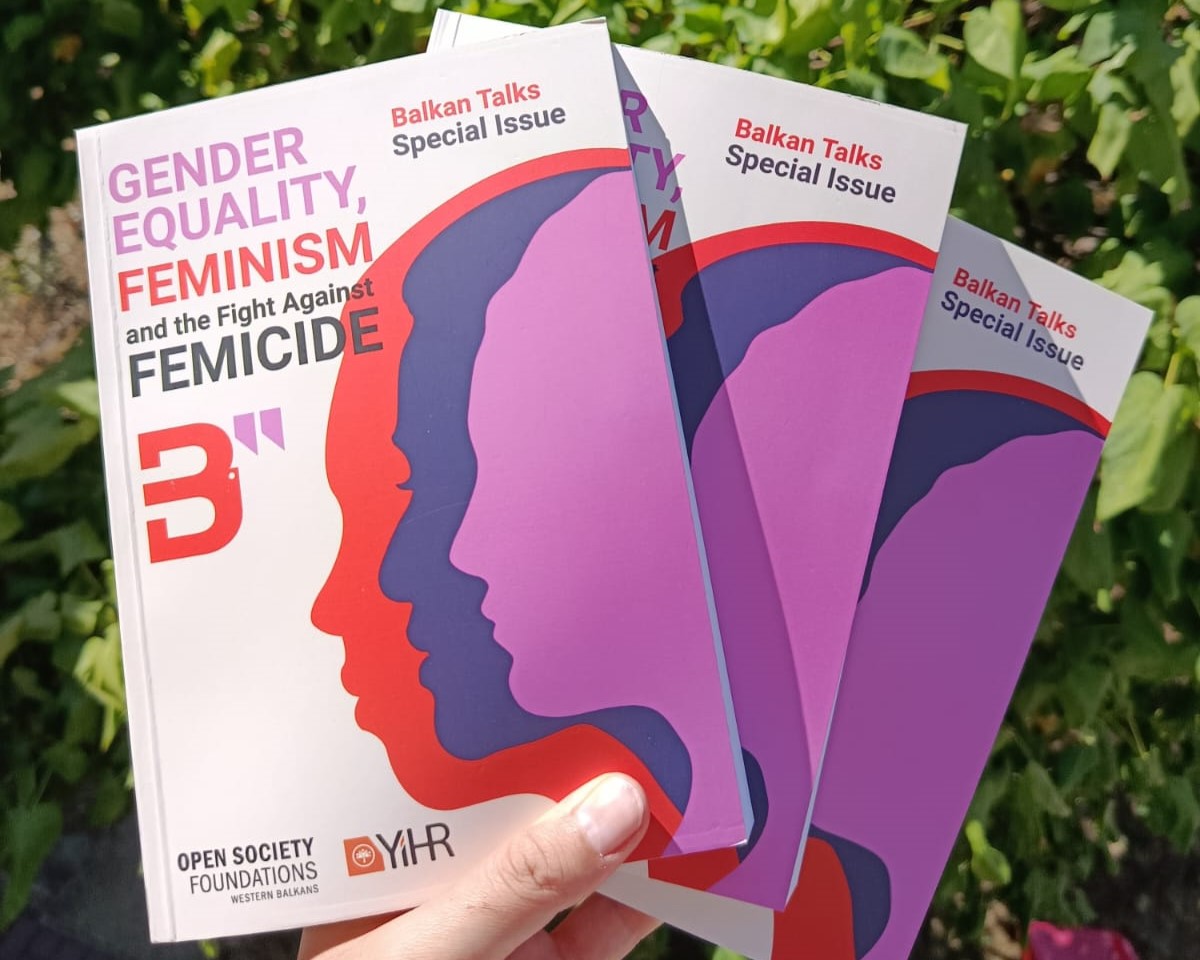
Balkan Talks Special Issue Is Here!
After more than a year of writing, researching, editing, discussing and working across borders, we are happy to share the Balkan Talks Special Issue: Gender Equality, Feminism and the Fight Against Femicide. Across more than 250 pages, the issue brings together 20 authors from 10 countries: Albania, Bosnia and Herzegovina, Bulgaria, Croatia, France, Greece, Montenegro, North Macedonia, Serbia and Slovenia. They are high school students, university students and young researchers, coming from different disciplines and experiences, but sharing a willingness to ask difficult questions about the societies in which we live. This publication grew from something that has been at the heart of Balkan Talks since its beginning: the conviction that young people across the Balkans should have a space to speak in their own voices and to speak to one another. That matters particularly in a region that is still so often described through its divisions. We come from different countries, speak different languages and carry different historical experiences. We do not need to erase those differences in order to work together. Balkan Talks has shown us that crossing them allows us to recognise how many questions we share about equality, safety, memory, discrimination, democracy and the institutions that shape our lives. The message coming from these pages is remarkably clear: young people across the Balkans do not want division to determine the limits of our conversations. Balkan Talks Special Issue Gender Equality, Feminism and the Fight Against FemicideDownload From research to the institutional arena Gender equality, feminism and femicide are the central concerns of this Special Issue, but they open the door to a much broader conversation. The texts address feminist anti-war activism, wartime sexual violence and its aftermath, motherhood and media pressure, sex-selective abortion, women in politics, LGBTQ+ solidarity, Roma women’s empowerment, artificial intelligence and misogyny, cultural representation and women’s resistance. And we wanted different forms of knowledge to have a place here. The issue therefore moves between policy work, research essays, opinion pieces, interviews, poetry and reviews. Some contributions are academic, others are personal. Some investigate institutions, while others turn to literature, film or lived experience. This diversity is deliberate: Balkan Talks gives young authors the freedom to decide which questions are urgent and how they want to approach them. There is, however, a reason why the first major chapter after the foreword is called “Balkan Talkers in the Institutional Arena.” At its centre is Recognising Femicide as a Standalone Crime: Policy and Advocacy Recommendations from Albania, North Macedonia and Serbia, written by Edit Babameto, Angela Dimovska and Jana Krstić. The paper examines legal and institutional responses to femicide in the three countries and develops country-specific recommendations intended for advocacy towards institutions, authorities and the wider public. Its place at the beginning of the publication reflects something important about how we understand Balkan Talks. Our texts are also part of our struggle. Our voices are a form of participation. Research can help us understand the societies around us, but understanding them is not where our responsibility ends. When young people document institutional failure, challenge the language through which violence is normalised, formulate policy recommendations or bring neglected experiences into public discussion, they are already intervening in the world they study. The policy paper itself emerged from the conclusion that another accumulation of data is insufficient when existing research already documents the problem: young researchers and youth leaders also need to bring that knowledge into visible, cross-border advocacy. That is what we mean by entering the institutional arena. We want our work to reach beyond our own pages. 20 authors, many forms, one conversation The Special Issue begins with the policy work of Edit Babameto, Angela Dimovska and Jana Krstić. In Balkan Talkers and the Socially Engaged Academia of the Future, Silvia Fabijanić examines women as agents of change in nonviolent protests in Ukraine and the Balkans; Ema Selimović explores feminist transnational counter-discourse through epistolary exchange during the dissolution of Yugoslavia; and Teodora Milovanović analyses media pressure surrounding motherhood in Serbia. The opinion section brings together Jana Krstić, Dunja Stojanović, Lora Zaharievska, Milica Marković, Almin Šemić, Nina Anžić, Tao Romevo, Stamena Kozić, Jovana Petković and Bojana Vuletić, writing from across the region about wartime sexual violence, sex-selective abortion, femicide and institutional responsibility, women in politics, gender and smoking, the erasure of women through seemingly positive stereotypes, generative AI and LGBTQ+ solidarity. Mary Drosopoulos speaks with Balkan women authors about solidarity with Palestine, while Orida Dajko tells the story of Brisilda Taço and Roma women’s empowerment in Albania. Poetry by Aleksandra Đorđević and Jana Krstić makes room for another language through which gender and lived experience can be expressed. Finally, Milica Jovanov, Almin Šemić and Eirini Tsordia turn to books, theatre and film, asking what culture can tell us about women’s lives and resistance. Together, these contributions refuse the idea that young people are simply waiting for their turn to participate. They are already researching injustice, creating knowledge, questioning inherited assumptions and building relationships across borders. Thank you, Balkan Talkers Above all, this publication belongs to the people who filled its pages. Our deepest thanks go to all of its authors: Edit Babameto, Angela Dimovska, Silvia Fabijanić, Ema Selimović, Teodora Milovanović, Dunja Stojanović, Lora Zaharievska, Milica Marković, Nina Anžić, Almin Šemić, Tao Romevo, Stamena Kozić, Bojana Vuletić, Jovana Petković, Mary Drosopoulos, Aleksandra Đorđević, Eirini Tsordia, Milica Jovanov, Orida Dajko and Jana Krstić. Special thanks go to Milica Jovanov, who created the illustrations and layout for this Special Issue, and Bojana Vuletić, responsible for proofreading and copy editing. The publication was edited by Jana Krstić and published by the Critical Education Centre (CKO), with a print run of 200 copies. Our gratitude also goes to the Balkan Talks editorial board: Jana Krstić, Bojana Vuletić, Eirini Tsordia and Tao Romevo, and to the people whose volunteer work keeps Balkan Talks alive throughout the year: Antonio Nojić, who maintains our website; Jelena Jaćimović and Emilija Krstić, for their design contributions; and Jovana Petković, whose social media work helps our authors and ideas reach young people across the region. We are also grateful to the professors of the CEU's Global Invisible University programme, within whose Balkan courses many of these texts, and Balkan Talks itself, first began to take shape. Balkan Talks remains a volunteer-driven initiative. Behind its articles, illustrations, website, social media and this publication are people who have decided that a regional space for young voices is worth their time and work. Now we want to hear your voice Publishing this Special Issue is a milestone, but it makes sense only if the conversation continues. We want more young people from across the Balkans to enter it. We want voices we have not heard yet, questions we have overlooked and disagreements that force us to think again. We want Balkan Talks to keep growing as a community where education and regional exchange meet. So read the Special Issue. Question it. Disagree with us. Continue an argument that one of our authors has started. Send us your research, essay, poem, review or an idea that does not fit neatly into any of those categories. Become a Balkan Talker. Because every time a young person from Sarajevo reads someone from Skopje, someone from Belgrade works with someone from Tirana, or a conversation begins between people who were taught to think of one another primarily through borders, something important happens. We do not become the same. We become better able to stand together while remaining different. And perhaps that is one of the clearest messages these 260 pages send: the young people of the Balkans are capable of crossing the divisions we inherited and speaking together about the societies we want to build. Follow our web journal and @talksbalkan to find upcoming calls, educational programmes and new opportunities to become part of the community. These are our voices. These are our struggles. And this is a community we are building across borders. Let’s keep Balkan talking! The publication of the Balkan Talks Special Issue and our advocacy for the recognition of femicide as a distinct criminal offence were made possible with the support of the Open Society Foundations (OSF) and the Youth Initiative for Human Rights Serbia (YIHR).

Call for Applications: Invisible University for Southeastern Europe
Central European University’s Global Invisible University Project Central European University has officially launched the Invisible University for Southeastern Europe (IUSEE) within its Global Invisible University program. This initiative builds upon decades of educational tradition established by the Flying Universities and the Alternative Academic Network, which historically aimed to fill formal education gaps in the region. The program is open to BA, MA, and PhD students residing in the Balkans, as well as those with a strong academic interest in the region. Starting in September 2026, IUSEE will offer two interdisciplinary courses: Introducing the Balkans (Dr Aleksandar Pavlovic and Dr Marija Mandic) and Wars for the Yugoslav Succession and their Contemporary Legacy in the Balkans and Beyond (Dr Vladimir Petrovic and Dr Sven Milekic). Introducing the Balkans focuses on the issue of perception and self-perception of this peninsula, and should be equally appealing to students from the region and those interested in it. Wars for the Yugoslav Succession and their Contemporary Legacy aims at examining not only the atrocious decade of warfare, but the way it shaped postwar realities in the region. We are aiming for advanced BA and ambitious MA students, primarily from universities in Southeastern Europe, but also beyond. Our courses are offered online, and the lecturers are coming from different academic disciplines and surroundings. Besides the courses on Southeastern Europe, the students can also enroll into an impressive range of courses offered by GIU’s Ukrainian and Georgian cluster. Full course descriptions are available here. The attendance is free of charge, and it offers additional opportunities: Student Benefits and Opportunities ECTS Certification: Participants can enroll in Balkan and other ECTS-certified courses offered by the Global Invisible University. Skill Development: The program provides intensive academic English training to enhance research proficiency. Financial Support: Students are eligible to apply for research grants valued up to 800 EUR. Academic Collaboration: Selected participants will contribute to the project's official website, Balkan Talks. In-Person Networking: Students are eligible to apply for a week-long, fully immersive winter school. Application Information Interested students are invited to submit their applications through the Global Invisible University Application Form. Application Deadline: September 9, 2026 For any question, you can contact us at [email protected]
Flamingo Revolution Chronicles – The protest versus Rama’s “algorithm”: voices from the square speak out
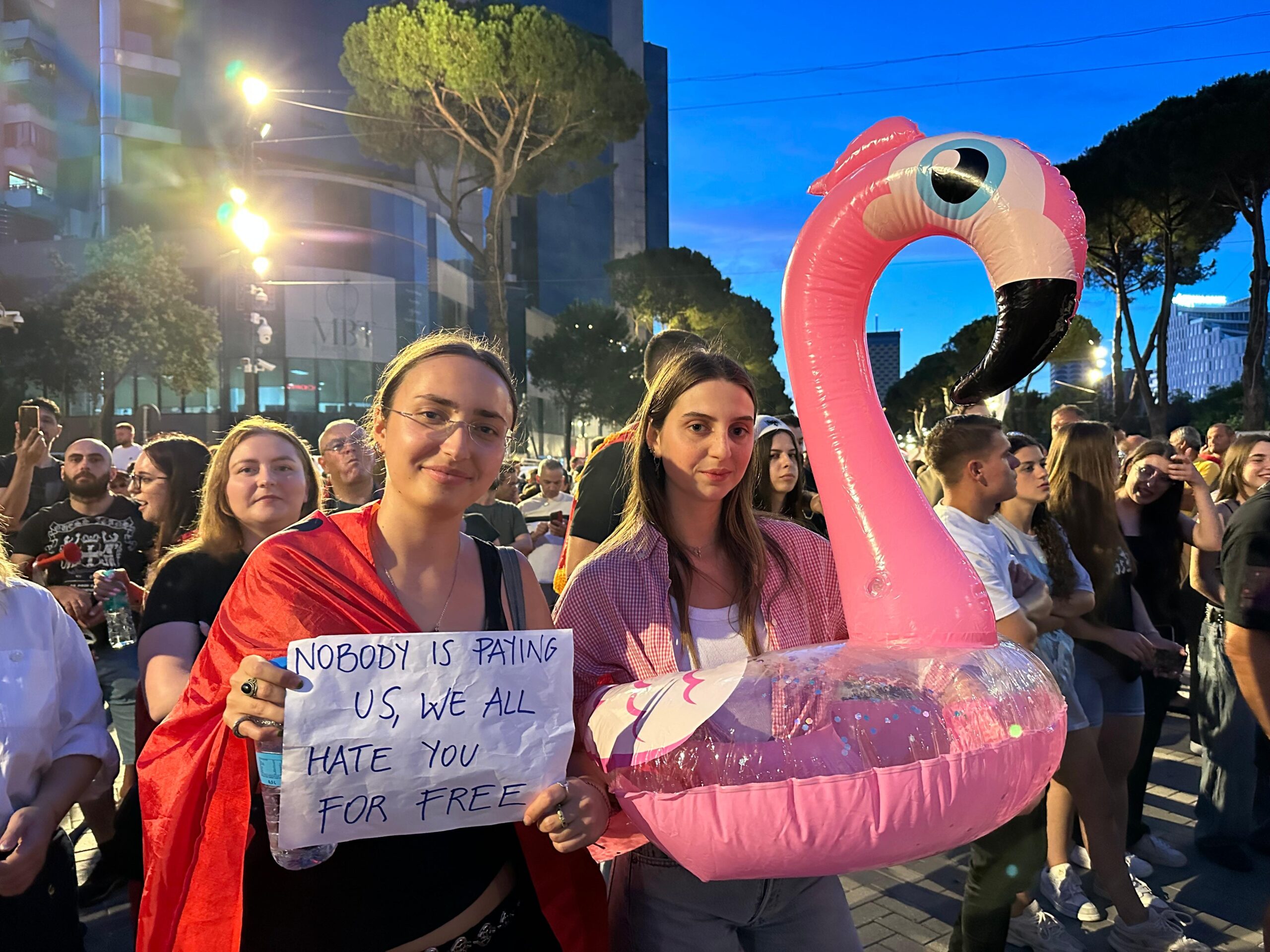
Rama described the square as a “television studio for the algorithm.” Eight voices involved in the protest tell Faktoje how work is divided on the ground, where different approaches clash, and what may come after day 51. Author: Jona Cenameri The original article was published on Faktoje, you can read it here. Photo: Jona Cenameri “The square is simply a television studio for the algorithm. It is the place where material is filmed to feed the algorithm and justify it,” Prime Minister Edi Rama said on June 20 during a meeting of the Socialist Party Parliamentary Group. Rama argued that the algorithm rewards conflict, outrage and intimidation, while describing the protest in these terms: “A protest is no longer a protest. It is a stage, a marketplace, a marketplace of emotions, clicks, morality, and even careers.” On July 11, during a conversation with young people in Jalë, the prime minister added nuance to this position. “I did not say that the algorithm was the reason for the protest,” Rama said. He acknowledged that the protest had causes rooted in citizens’ everyday lives, but argued that the algorithm amplified noise, dissatisfaction, manipulated videos and fake news, which, according to him, “pour fuel on a fire that was not started by the algorithm, but by people.” Rama added that the algorithm was not the organiser of the protest and that a distinction had to be made between “where the protesters’ genuine motivation ends” and where manipulation by other actors begins. On July 19, protesters gathered in Tirana for the 50th consecutive day to demand Prime Minister Rama’s resignation. The nightly protest in the capital, which began as a reaction to violence and in defence of Zvërnec, has continued without interruption since May 31, 2026. What is happening? To understand what is happening beyond the content circulating on social media, Faktoje interviewed eight people involved in the protest in different ways. Their accounts do not represent the entire protest and do not claim to summarise the views of every participant. They are some voices among the many voices, groups and currents that coexist in the square. Nevertheless, they help shed light on the origins of the discontent, the way the protest is organised, the role of digital platforms and the debates over how it should continue. Zvërnec For environmental expert Olsi Nika, the events in Zvërnec were “the last straw,” though not necessarily the only event that could have triggered such a reaction. According to him, the spark could just as easily have come from the dragging of a woman in Rrjoll, the protest by mussel farmers in Butrint, or an issue such as the treatment of cancer patients, among others. “The glass has to fill before it overflows. This was the drop that made it overflow,” Nika says. He considers it significant that the spark this time was environmental, since interventions in the territory and protected areas had long generated dissatisfaction but had never before provoked such a broad reaction. For Nika, Zvërnec should not be seen only as the place where the episode that triggered the protest occurred. He describes it as “one of the most representative images” of the problems created during Albania’s transition. In his view, “Zvërnec brought together unresolved property disputes, the dominance of private interests, the role of private security and the lack of an immediate institutional response.” He sees the fence and the violence against the protester as “symbols of a relationship in which the citizen is confronted not by institutions, but by private interests operating on the ground.” Nika also criticises the way part of the media covered the event and the protest. According to him, the incident in Zvërnec initially did not receive the attention it deserved, while later coverage focused mainly on the microphone and the speakers outside the Prime Minister’s Office, leaving out other voices from the square. “Zvërnec is a mirror that showed how things are done in Albania,” he says. According to Nika, the protest quickly moved beyond its initial environmental cause. Photo: Jona Cenameri The leadership Those interviewed generally agree that the protest is not being directed by a single hand. “Is there one central organiser? No. Are there groups coordinating in order to contribute? Yes, and there are several of them,” says Migen Qiraxhiu, activist and co-founder of Civic Resistance. According to him, one of the reasons the protest has maintained participation is the belief among citizens that they are not being used to serve a single individual or political force. Within the protest, Qiraxhiu says, there are young people who take care of the children’s area, students who create installations and placards, the drum and flamingo group, people who manage the sound area, and young people who organise the march after the formal part of the protest outside the Prime Minister’s Office ends. “The protest has many voices, many groups and many forms of contribution, and that is precisely one of its greatest strengths,” Qiraxhiu says. Natasha Paja, a designer and member of the Trivet Art group, describes the organisation through the concrete division of tasks. “Someone makes sure the microphone runs smoothly, someone takes care of the children’s creative corner, someone handles the rhythm of resistance, someone else the chants. There are people who contribute to communication with the diaspora and a group that takes care of the evening march,” she says. According to Paja, the organisation is horizontal: people become involved wherever they are able to contribute, without a leader who has the legitimacy to make decisions on behalf of the entire protest. Entela Ndrevataj, a feminist activist and member of the Feminist Collective, a voluntary and autonomous community, also says the protest does not have a classical structure, but that this is precisely what has created space for different groups. “The square is a shared space and, as such, no group has imposed itself over another,” she says. For Ndrevataj, corruption is also “intertwined with an authoritarian and patriarchal way of exercising power, where decisions are made from above and public wealth is treated as private property.” The flamingos Sokol Çunga, an activist, historian and translator, participates as an individual rather than as part of an organisational structure. He describes the protest as sincere and articulated not only through the microphone, but also through placards and the flamingos. When it comes to the level of coordination, Çunga is more sceptical. “The only coordination I see is the time and place, and ‘who is going to transport the flamingos?’” he says. According to him, the crowd changes every day in form, size and composition and does not come to the square under direction or with a completely unified goal. For this reason, Çunga does not believe that the protest, as a single body, can draft detailed political or institutional plans. “The next steps remain simpler and more tangible: every day on the boulevard!” The organising group Unlike participants who see only dispersed coordination, Ilir Xhemalaj, activist and founder of the National Union of Telephone Operators, says that from the first day there has been a group of activists responsible for the smooth running of the formal part of the protest. According to him, the group is made up of environmental activists, trade unionists, oil workers and people from other fields. They take care of the sound system, the speakers and the organisation of the gathering outside the Prime Minister’s Office. “The sound system comes at a cost, which all of us activists have paid out of our own pockets,” Xhemalaj says. He explains that, apart from several intellectuals who were invited at the beginning, the other speakers wait their turn to take the microphone. “The only criterion for speakers is to wait your turn. One person comes off, another goes on, and everyone speaks about their own views and concerns,” he says. According to Xhemalaj, the group’s responsibility ends when the speeches finish. The march that follows and other actions may be organised by different people and are not automatically decisions made by the same group. For Xhemalaj, the importance of digital platforms has been undeniable. “It is precisely social media that has made it possible for this protest to function, develop and grow in size. Gen Z has managed to use social media very effectively to call on people to come out into the square,” he says. Photo: Jona Cenameri The algorithm Migen Qiraxhiu turns the prime minister’s argument about the algorithm in the opposite direction. According to him, Rama had no problem with the algorithm when digital communication kept attention focused on the government and on Rama himself. “The problem begins when the algorithm is no longer on his side. The algorithm does not create events by itself; it follows the interest, reaction and attention generated by a real event,” Qiraxhiu says. In his view, the protest “has taken not only the square and the public debate, but the algorithm as well.” Arnen Sula clarifies that the organisation he leads is not part of the protest’s organisational structure and that he participates as a citizen and activist. “Every protest is measured by the people who take part in it, not by algorithms,” Sula says. “Digital platforms can help with organisation and communication, but they cannot replace the physical presence of citizens.” According to him, when citizens continue to come to the square for weeks, it shows that there is a concern that cannot be reduced to a social media phenomenon. Olsi Nika interprets Rama’s focus on the algorithm as an attempt to avoid responsibility for the causes that produced the protest. “To deny that there is a protest when people are in the square, when the protest is being covered across the media and when there is an extraordinary outpouring of anger online as well, and to call all of this simply an algorithm, is a tactic belonging to a failed strategy,” he says. The microphone The very element that Xhemalaj presents as organisational work, the sound system and the speaking order, is viewed sceptically by Olsi Nika. Nika says that the people around the microphone represent only one part of the protest. “Both technically and physically, there is another protest where the microphone can no longer be heard,” he says. According to him, the cameras’ focus on the improvised podium creates the impression that the speakers represent the entire square, while leaving out participants standing farther away and their reasons for protesting. Nika also sees the microphone as carrying the risk of personal protagonism and the controlled release of revolt. “I consider the microphone to be the instrument that kills the protest and kills the revolt,” he says. For Xhemalaj, the sound system is necessary infrastructure for giving different groups and citizens a voice. For Nika, focusing on the microphone can create a hierarchy of visibility within a protest that presents itself as horizontal. Politics There are also activists and representatives in the square with political affiliations. Emiljando Kita, an activist with Together Movement (Lëvizja Bashkë), says he supports the demands articulated by protesters, from the repeal of the contested laws to the resignation of the prime minister. “When people take to the streets, coordination happens naturally because the objective is shared,” he says. The protest has also brought representatives and activists from other political forces into the square, including the Opportunity Party (Partia Mundësia), the Albania Becomes Movement Party (Partia "Lëvizja Shqipëria Bëhet") and the Democratic Party (Partia Demokratike), the latter mainly through its youth members. Migen Qiraxhiu argues that one reason the protest has not become fully identified with any single political force is that its messages have been critical of the two main political figures of Albania’s transition, Edi Rama and Sali Berisha. The “National Assembly” The clearest disagreement over the future of the protest concerns the idea of creating a “National Assembly” or citizens’ assembly. Ilir Xhemalaj says the initiative is not intended to speak on behalf of the protest or to establish parallel institutions. It is meant to serve as a space where citizens and intellectuals can offer ideas about how the protest should continue. Xhemalaj clarifies that the Assembly has not yet been created; only a few meetings of the working group for its formation have taken place. “We are preparing for a marathon, we are preparing for a long battle, and naturally we need everyone’s ideas,” he says. Other protesters view the initiative with reservations. Migen Qiraxhiu says he had joined a WhatsApp group where the idea was being presented, but left after reading the materials. He considers it legitimate to create new initiatives, including organisations or political parties, but opposes any claim to speak on behalf of the entire protest without a clear mandate. “Every initiative has the right to organise and propose ideas, but it must be clear that it represents only its founders and supporters, not automatically all protesters,” he says. Arnen Sula also believes that a National Assembly could create the perception that one group is assuming representation of a square that has no centralised structure. Natasha Paja calls the initiative “an old method for an old concept,” while Entela Ndrevataj says that, at this stage, the square should remain the main space and that one group should not place itself above the majority. For Sokol Çunga, the information circulated about the initiative was unclear and gave the impression of a chaotic process. He does not believe that such an assembly could confront the existing political forces and sees mass, peaceful protest as the main instrument. Olsi Nika is more critical. He regards such structures as parallel ones and argues that change should come through existing mechanisms: the vote, parliament, the justice system and the media. According to him, the energy of the square should exert pressure on these mechanisms to function, rather than replacing them with a structure that has no mandate from all protesters. Photo: Jona Cenameri What comes next After 51 days of protest, those interviewed do not present a single strategy. Their positions can broadly be divided between continuing pressure in the square, moving towards institutional action, and the need for more structured organisation. Sokol Çunga calls for a continued daily presence on the boulevard. Natasha Paja also sees the square as the priority, but says that work should continue in parallel on legal aspects, communication with European institutions and actions in other parts of the country. Entela Ndrevataj believes it is still too early to create a movement with a leadership and formal representation. She proposes closer cooperation among legal, media and environmental experts while preserving transparency and the horizontal character of the protest. Arnen Sula places emphasis on sustainability and on linking public pressure with justice institutions. “The protest cannot replace justice, but it can support it by demanding accountability and by not allowing issues to be forgotten,” he says, mentioning SPAK and other responsible bodies. Migen Qiraxhiu proposes legal initiatives, institutional requests, monitoring, documented reports of wrongdoing and stronger mechanisms of civic oversight. “The wounds of 36 years of transition cannot be healed in 43 days,” he says. For Qiraxhiu, one of the most important outcomes of the protest could be a change in the relationship between citizens and those in power: from citizens asking politicians for photographs to citizens filming them and demanding accountability. Ilir Xhemalaj calls for broader organisation, stronger links with regions outside Tirana and with the diaspora, and preparation for continuing through the summer. “The protest will continue without stopping until September,” he said during the interview, describing the summer as the main challenge to maintaining participation. Emiljando Kita sees the way forward as a combination of pressure in the square, political action and legal complaints. Olsi Nika offers the most critical assessment of the stage the movement has reached. According to him, the protest clearly knows what it does not want, the government and the current way in which power is exercised, but has not yet managed to articulate with equal clarity the political and institutional model it wants to build. “The protest is dead; long live the protest,” Nika says. He calls for lawyers, economists, journalists, analysts and experts to reorganise so that the energy of the protest can be transformed into argument, institutional pressure and concrete action. According to him, the protest could enter a phase in which it is “smaller in numbers, but much stronger in argument,” a process he believes could take shape in September. Social media Social media has played an important role in the mobilisation, growth and visibility of the protest. None of the voices interviewed denies this. But behind the online content there is also real organisation, even if it remains dispersed and without a single centre of leadership.
Flamingo Revolution Chronicles – How Rama’s position on protected areas changed
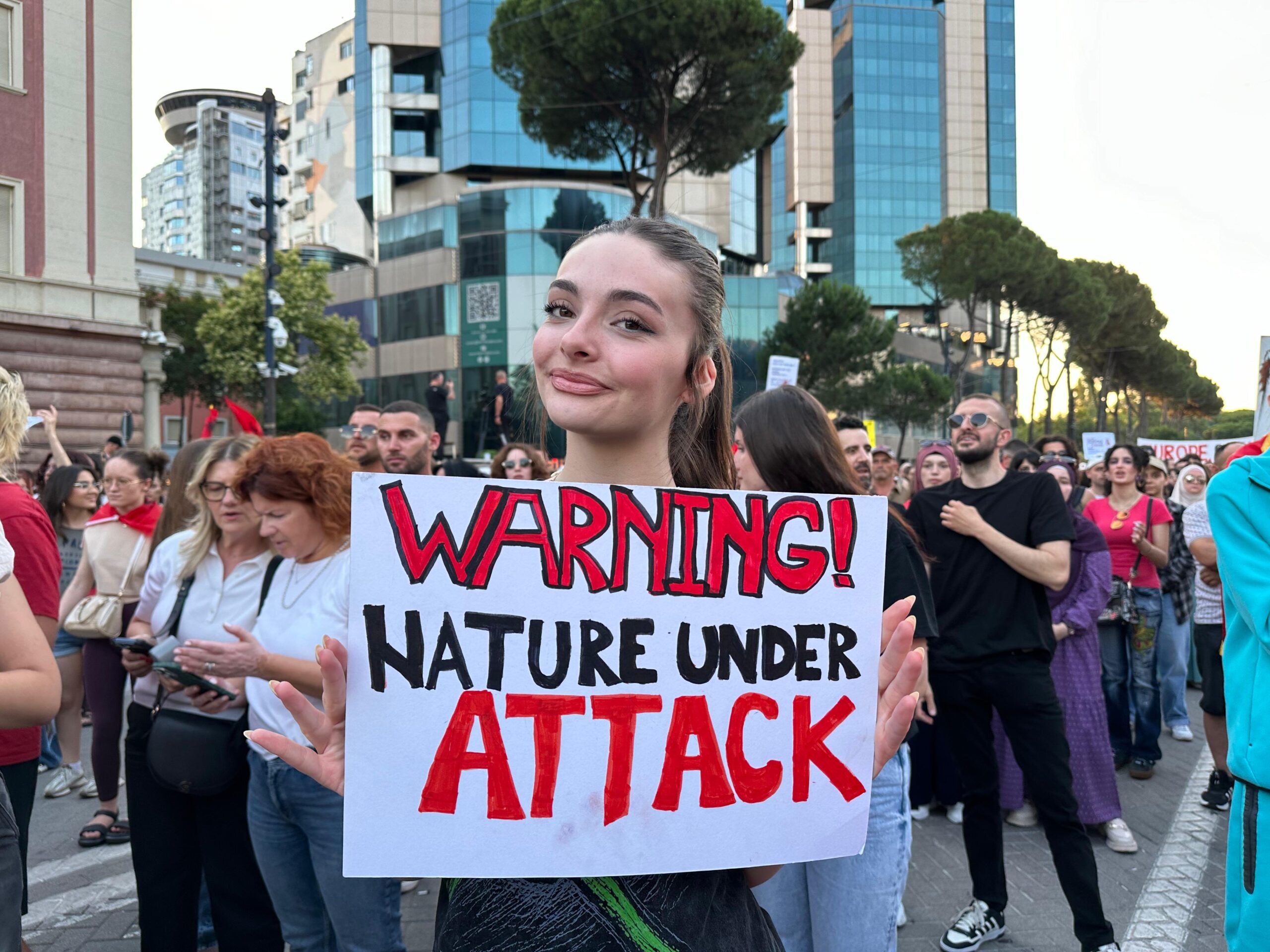
After the adoption of Law No. 21/2024, Rama said the amendments were “100% aligned with the European Union.” Today, his position has changed. Author: Jona Cenameri This article was originally posted on Faktoje, you can read it here. Photo: Jona Cenameri The Law on Protected Areas, which Prime Minister Edi Rama has defended for more than two years as an instrument for balancing nature conservation with economic development, will now be revised to bring it into line with European Union standards. The announcement was made on July 14 in Brussels, during the ninth Albania-EU Intergovernmental Conference, at a time when the repeal of the 2024 amendments had already been included among the five formalised demands of the protest that began on May 31. European Commissioner for Enlargement Marta Kos said that, before the protests began, the European Commission and the Albanian government had agreed that the 2024 amendments to the Law on Protected Areas would be repealed during 2026, along with the Law on Strategic Investments. According to Kos, the changes are necessary for the closure of negotiations on Chapter 27, which covers the environment and climate change. Rama intervened to draw a distinction between repealing the Law on Strategic Investments and revising the Law on Protected Areas. Regarding the latter, he insisted that there was “nothing to repeal,” describing it as one of the government’s best laws. At the same time, however, the prime minister acknowledged that anything within the law that does not comply with European standards would be changed, and that the law would be adjusted until it reached “100%” compliance with those standards. This wording contrasts with the statements made by Rama and then Minister of Tourism and Environment Mirela Kumbaro when the legal amendments were proposed and adopted. “We do not accept moral lectures” Rama’s defence of the amendments was already evident in December 2023, when the initiative was still under discussion. During an event dedicated to the Vjosa National Park in December 2023, Rama explained that the revision of the legal framework had been driven by requests from municipalities and by pressure for economic development. According to him, a “harmonious balance” had to be found between nature conservation and development. The prime minister also said that Albania needed luxury tourism, saying that such investments would generate higher revenues that would also benefit ordinary citizens. Faced with criticism from environmental experts, Rama said the government would not accept “moral lectures” on how it should treat nature. He repeated this position in March 2024, just weeks after the amendments had been adopted. Rama said that, considering what the government had done over the previous 10 years for nature and cultural heritage, no one was in a position to lecture it. He presented high-end tourism as a way to increase revenues without relying solely on a higher number of tourists, arguing that success depended on achieving a balance between protection and development. The law was “100% aligned with the EU” The amendments were adopted by Parliament on February 22, 2024, through Law No. 21/2024. Following a reaction from the Delegation of the European Union, which said it would closely monitor the implementation of the new provisions, Rama stated that the government was “100% aligned with the European Union.” According to him, the amendments strengthened the path towards sustainable development and would help Albania become a high-end tourism destination while simultaneously protecting biodiversity. Then Minister Mirela Kumbaro also defended the law. She said the amendments did not harm the environment and did not violate EU directives. According to her, there were “red lines” that would not be crossed, while any interventions allowed under the law would be ecological, environmentally friendly and controlled through strict rules. The official position in 2024 was, in essence, that the amendments did not weaken territorial protection and were in line with European obligations. Photo: Jona Cenameri The protest and the defence of the law The protest that began on May 31, 2026 brought the law back to the centre of public debate. Alongside opposition to the tourism project in the Pishë Poro-Nartë area, one of the first demands was the repeal of the amendments adopted in 2024. In his first reaction following the protest, Rama gave no indication that the government intended to step back from the law. On June 1, he said the government had not removed any territory from protected areas and that the protection categories had been brought into line with the highest international standards. According to him, Pishë Poro was a Category V protected landscape, where nature protection did not exclude development. His position became even firmer on June 9, during a meeting with journalists and media representatives from EU countries. Rama said that no one could lecture the government on the environment and described as a “lie” the claim that the law had been amended in order to pave the way for the project linked to Jared Kushner. According to him, the 2024 amendments were intended to clearly define the activities permitted within the different categories of protected areas. The prime minister insisted that, under European standards as well, a protected landscape is an area where construction may be permitted. He said the aim was for the project to serve as proof that nature and development could coexist. Rama did not present the law as an act that needed correction in order to comply with EU standards. On the contrary, he argued that both the amendments and the classification of the area were based on European standards, while dismissing as a “lie” the claim that the law had been changed specifically for the project. The Revision The first change in the language used by Rama appeared on June 18, following the adoption of a resolution by the European Parliament. Rama rejected the claim that the resolution represented the protest’s first victory. He said protesters had already had their “victory in their pocket” before the demonstrations began, because environmental protection was already a government priority. At the same time, however, he acknowledged that the amendments to the Law on Protected Areas were part of the EU negotiation agenda and that, during the analytical process with the European Commission, any provision that did not comply with European criteria and standards would be identified. The July 14 statement took this acknowledgement further. Rama publicly said that the law would be adjusted until it achieved full compliance with European standards. “As for the Law on Protected Areas, we have nothing to repeal, even though there has been a resolution in the European Parliament calling for this. In fact, we will revise this law on the basis of all European standards and we will change anything within it that is not in line with European standards…” Rama said. Rama continues to defend the law as one of the government’s best and rejects the term “repeal.” However, his acknowledgement that the law may contain provisions that are not compliant with EU standards marks a shift from the unequivocal defence he offered in 2024 and during the first days of the protest. The case of the Law on Strategic Investments is different. As early as February 2026, before the protest began, it had been announced that the current law would expire on December 31, 2026, and that the government was preparing a new legal framework.
Srebrenica in the 90s, Gaza Today: How imperialism weaponizes humanitarian language to justify atrocity
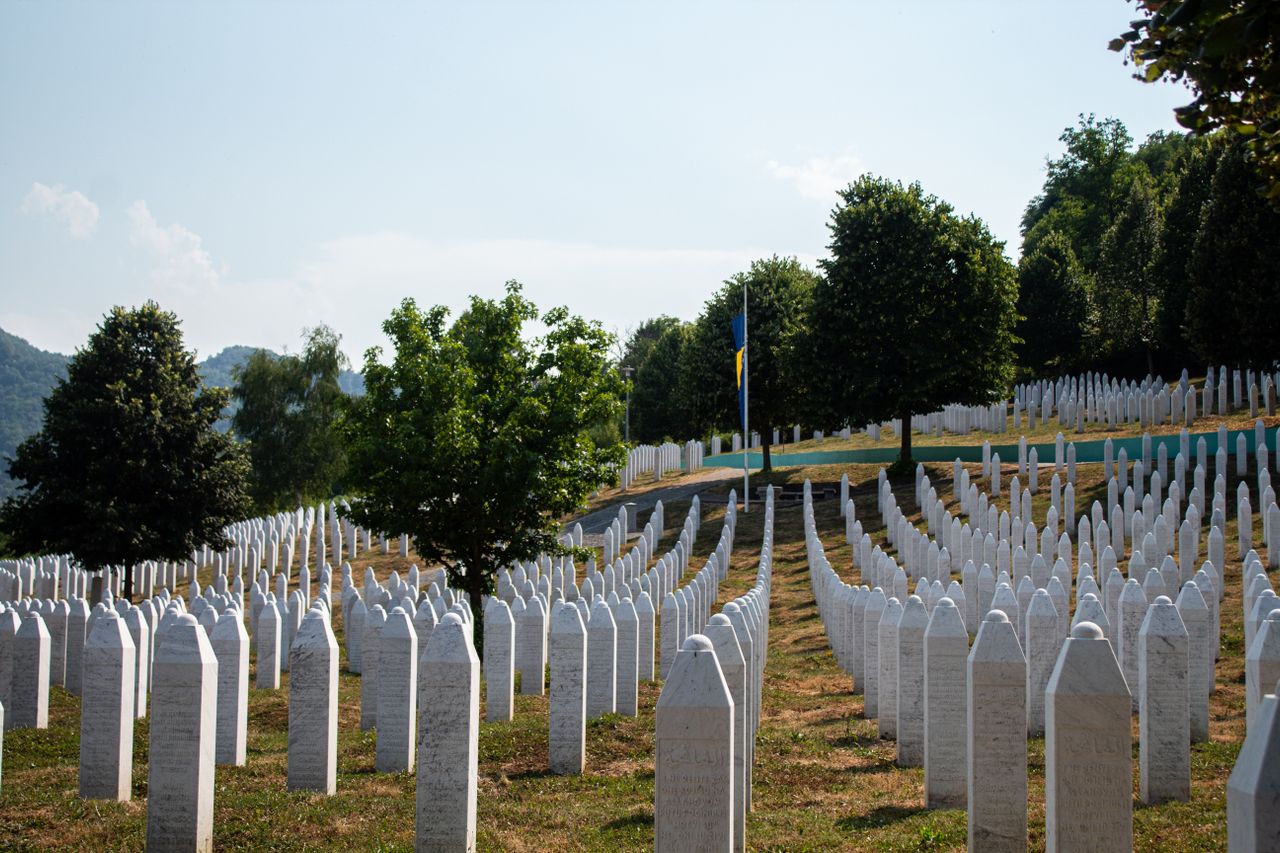
Authors: Ana Milosavljević Every year on July 11, Western ambassadors and dignitaries alike flock to the Potočari memorial center in eastern Bosnia to commemorate the Srebrenica genocide of 1995. 31 years ago, Bosnian Serb paramilitaries murdered more than 8,000 Bosniak men and boys en masse over the course of eight to ten days. In May 2024, the United Nations declared a day of remembrance for the victims of the Srebrenica genocide. But this year, more than any, the emptiness of the West’s “condemnation” of the Bosnian genocide was on full display, given its current support of Israel’s genocide of Palestinians in Gaza. However, the West’s hypocrisy regarding the Srebrenica genocide is much deeper than meets the eye. In fact, it was the US, Britain, and France that handed over the Srebrenica “safe zone” to its Bosnian Serb butchers in order to justify further intervention in the Balkan region. White gravestones at Srebrenica Memorial Cemetery, symbolizing remembrance and history. Photo by: Fatih Kopcal In 2005, the American diplomat Richard Holbrooke, who brokered the Dayton Accords to officially end the war, told Bosnian Hayat TV: “I was under initial instructions to sacrifice Srebrenica, Goražde and Žepa.” And that’s exactly what he did. Over the course of the three-year-long war, Bosniaks were ethnically cleansed from their villages by predominantly Serb paramilitaries but also Croat ones, to a lesser extent. Serbian President Milošević and Croatian President Tudjman had met before the war to devise a plan to partition the country for themselves. Bosniak refugees were funneled into what were assured to be the so-called “safe zones” of Srebrenica, Goražde, and Žepa. Once they arrived, they were disarmed completely and left with a meager Dutch peacekeeping force that was recently found guilty of willingly handing over many Bosniaks to their death. The US itself had intelligence and satellite imagery monitoring not only Serb troop movements in the lead-up to July 11 but throughout the duration of the massacre itself. Satellite imagery showed the bodies piling up in the killing fields, but no one did anything. But this year, more than any, the emptiness of the West’s “condemnation” of the Bosnian genocide was on full display, given its current support of Israel’s genocide of Palestinians in Gaza. In the wake of the massacre, the US garnered international support for its campaign to bomb Serb positions in Bosnia and lead the post-war process. This was the first time the so-called “defensive” North Atlantic Treaty Organization (NATO) launched an aggressive military campaign. As part of the so-called peace process, the Dayton Accords partitioned the country according to ethnicity: the Serb autonomous Republika Srpska and the Bosniak and Croat majority Federation of Bosnia and Herzegovina. Within that agreement, NATO troops were to be deployed to Bosnia, the first ever troop deployment outside of NATO member states. What was previously a nominally socialist, multi-ethnic country has since turned into a cesspool of neoliberalism, including austerity cuts, privatization of state-owned assets, environmental degradation, and misery for the masses of people. Now, Bosnia and all Balkan countries are encircled by the vultures of the world, including the US, China, and Russia, who are happy to profit from the bloodshed. That’s not to say that the Bosnian war was solely a Western creation, far from it. Yugoslavia’s internal divisions and inequality between nations laid the groundwork for armed conflict that was fostered, promoted, and waged by the ruling elite from the wealthiest republics. Yugoslavia’s History of Unity and Divisions In the decades since the wars related to the break-up of Yugoslavia ended, many have asked, perplexed: how could a country where various nations lived in relative peace end in such bloodshed—a country that was formed in the wake of and due to multi-national resistance to the Nazi occupation during World War II? The answer lies at the crossroads of economics and history. As Serbian forces took Srebrenica, the war criminal Ratko Mladić told cameras that “the time has come to take revenge on the Turks in this region.” The Turks he was supposedly referring to were Bosniaks, who he was intent on exterminating from the area to support Serbia’s territorial claims in Bosnia. During the 500+ year-long rule of the Ottoman Empire in the Balkans, both voluntary and involuntary conversion of the native populations to Islam was facilitated, including Christians, Catholics, and the Bogomils. Due to this history, Serbs and Croats both claim Bosniaks as belonging to their respective nation. Along this line of reasoning, many insist that Bosniaks simply do not exist as a separate nation. However, this logic ignores the historical development of nations and how they evolved over the transitory period between feudalism and capitalism. It is true that during Ottoman rule, Muslims enjoyed greater privileges than non-Muslims. Bosniak landowners were part and parcel of the Ottoman’s crushing rule in Bosnia, which oppressed not only poor Serb and Croat peasants but also Bosniaks. Multiple times, peasants of all these backgrounds rebelled against the empire of the day. From 1831 until 1875, poor peasants of all religions and backgrounds launched five different armed uprisings against the Ottoman Empire. With each rebellion, Bosniaks separated their national identity more and more from the ruling Turkish elite. In 1882, Serbs and Bosniaks also rebelled against the Habsburg military recruitment law, which would have conscripted young men. While Bosniak landowners were generally loyal to the Ottomans, peasants of all stripes had more in common with one another than the landowners. During the Habsburg rule in Bosnia, Bosniak landowners lost the political and economic power they had during the Ottoman Empire. Catholic and Orthodox landowners were seen as more reliable bulwarks against the Ottomans; thus, the feudal power dynamic was flipped on its head. The development of the Serbian nation was nurtured by the Russian Tsar, using Pan-Slavism as a smokescreen to extend its own influence in the region while the Catholic Habsburg empire coopted the Croatian national movement in an effort to defeat Hungarian pro-independence forces. In doing so, these powers helped develop the capitalist classes of both the Serbian and Croatian nations which both sought to convert and claim Bosniaks as their own. The oppression of Bosniaks further solidified under the First Yugoslavia from 1918 until 1941. At the beginning of the Yugoslavia monarchy, 2,000 Bosniaks were killed by Serb and Croatian paramilitaries in just two years. In 1919, land reforms nationalized eight million acres of Bosniak land, leaving 10% of Bosniak peasants without any means of production. Capitalist Yugoslavia with Socialist Trimmings Nazi Germany took advantage of this division in 1943 and promised Bosniaks a Muslim state if they cooperated. As such, a battalion of 21,000 Bosniak soldiers was formed to fortify the German occupation. The battalion was commanded by the SS officer, Himmler. Despite German support, the Bosniaks were still under attack from the other fascist forces of the region, including Serbian Chetniks and Croatian Ustasha. This caused many Bosniaks to join the multi-national Partisans led by the Communist Party of Yugoslavia. Under the motto of “Brotherhood and Unity,” Yugoslavia made some surface-level efforts to address the national oppression of Bosniaks. In 1963, the Socialist Federal Republic of Yugoslavia recognized a “Muslim nation” (referring to Bosniaks) as a constituent nation. Secularism was widely promoted; however, there was not a concerted campaign to break down reactionary ideologies that claimed Bosniaks as “merely” Islamized Serbs or Croats. In particular, chauvinism reigned supreme and reinforced economic inequalities between the wealthier nations (Serbs, Croats, and Slovenians) as compared with the poorer ones, including the Muslim Bosniak and Kosovar-Albanian populations. During the lifespan of Yugoslavia, there was an economic inequality between republics and nations that ultimately helped bring about the country’s demise. From 1953 to 1989, Bosnia’s gross domestic product (GDP) per capita decreased by 20 percent while GDP either remained the same or grew in the three wealthiest republics: Serbia, Slovenia, and Croatia. Statistical Yearbook, Belgrade, 1991. Institute of Economics – Zagreb, Center for Economic Informatics and Statistics. The impoverishment of oppressed nationalities like Bosniaks was further facilitated through the divisions in production. Raw materials were largely extracted from poorer republics and transported to wealthier ones to be refined. While many on the left still laud “Tito’s socialism,” a few additional facts illuminate the fact that Yugoslavia was simply a state-capitalist society with more social welfare programs. Over the lifetime of Yugoslavia, wage inequality increased instead of decreased; early on, wages between managers and workers were 1:3.5. By 1967, the ratio was 1:20. This was facilitated by so-called workers self-management councils, which bestowed managers, engineers, and white-collar workers with more power than the workers performing manual labor. As such, the Yugoslav “socialist” system, in effect, reproduced capitalist relations. Between 1972 and 1982, Yugoslavia’s foreign debt increased ninefold from $2.4 billion to $20.3 billion. In the 1980s, the World Bank and International Monetary Fund (IMF) used this debt to propose structural adjustment loans meant to privatize as much of Yugoslavia’s economy as possible. The austerity program was initially struggled against by a movement that crossed ethnic lines but was ultimately exploited by the reactionary nationalist elite. Throughout the late eighties and early nineties, half a million people took part in labor strikes against wage freezes, layoffs, increases in food and fuel prices, and the decadence of the ruling class. Reports about a strike in Slovenia noted that in addition to the economic demands, “The workers also demanded that the government slash the number of factory administrators, limit the number of limousines used by factory executives, and restrict their business travel.” Due to the corruption of the self-management committees and the bankruptcy of the Communist Party, workers became disillusioned with the establishment leadership. And thus, an opportunity emerged for reactionary nationalist groups to pit various ethnic groups against each other instead of blaming the multi-national, capitalist elite. For example, the right-wing Croatian Democratic Union political party blamed Serbs for the strikes in Croatia. The local party chapter said of one CEO that “he and other Serbs were to blame for the bad condition the company is in.” The Serbian elite claimed the “Serbs wanted to work, while the Croats didn’t.” At a session of the workers’ council, a female worker ominously warned against the strategy of the ruling elite, asking, “Will we swallow the bait of such tricks and misguided information, used by the most lazy among us to create divisions, when all of us will be equally hungry tomorrow: Croats, Serbs and Muslims alike!” Foreign Involvement in Bosnia Such was the reactionary nationalism that ultimately led to the state-supported Serb forces pillaging, looting, and exterminating Bosniak villages in Bosnia. Such was the reactionary nationalism that led to the Croatian government forcibly displacing its Serbian population at gunpoint, leading to the ethnic cleansing of 200,000 Serbs from eastern Croatia. The main reason why the West did not support Serbia’s attempts to keep the union together at will was to expel Russian influence from the region. It would be easier for the US to counter Russian influence if it was sequestered to Serbia as opposed to spread across six republics. In addition to representing the Ottoman Empire, the Serbian and Croat ruling classes justified their territorial ambitions as fighting “radical Islam.” They characterize Bosniaks as Islamic fundamentalists who sought to implement sharia law and oppress non-Muslims in an Islamic state. Bosniaks are generally secular, but there were members of their own ruling elite who promoted such ideology. For example, Alia Izetbegović, who became a member of the Presidency of Bosnia, had in the 1970s written an Islamic Declaration with hopes for Bosnia’s future as an Islamic state, which stated, “There can be neither peace nor coexistence between the Islamic religion and non-Islamic social and political institutions.” During the war in Bosnia, Saudi Arabia and Iran both sent mujahideen to fight on behalf of Bosniaks. While Serb and Croat-led paramilitaries did most of the plunder of Bosnia, it is reported that these fighters and Bosniak war criminals participated in ethnically cleansing Serbs and Croats in central Bosnia as well. In addition, Saudi-funded Wahhabi groups have funded mosques throughout the country and recruited members of the poor working-class youth to advance Wahhabism. In short, as the US Army War College paper says: “Bosnian Serbs and Croats may exaggerate the threat of Islamism or potential Islamic dominance, but the Bosniak leadership certainly provides them with plenty of ammunition.” In addition to Saudi Arabian Wahhabi forces, Turkey uses its historical and religious ties with Bosniaks to disguise its own self-interest in the region. In the 1990s, Turkey became part of the UN wartime peacekeeping mission. After the end of the war, it joined the NATO occupation of the country and had the second-largest number of troops in Bosnia. Turkey’s economic ambitions in the country became clear in a speech by Turkish politician Davutoğlu in Sarajevo in 2009. At an event titled “Ottoman Heritage and Muslim Communities in the Balkans Today,” he proclaimed, “Now is the time for reunification” by “reestablishing ownership in the region, through reestablishing multicultural coexistence, and through establishing a new economic zone.” Since then, Turkey has steadily increased its influence in Bosnia via investments in telecommunication, energy, transportation, health, tourism, construction, and banking. Today, Bosniaks see Turkey as their most significant and reliable ally. The most surprising player during the Bosnian war, however, is Israel. During the wars of the 1990s, Israel exported arms to the Serbian army, which were almost certainly used in the Bosnian genocide. In 2016, Israel’s State Attorney deemed that disclosure of Israel’s role in the Bosnian genocide posed a threat to Israel’s national security and foreign relations: a de facto admission of guilt. The butcher of Srebrenica and Bosnia, Ratko Mladić, wrote in his journal, “From Israel – they proposed joint struggle against Islamist extremists. They offered to train our men in Greece and a free supply of sniper rifles.” More recently, Israel abstained from a United Nations vote designating July 11 as the International Day of Reflection and Commemoration of the 1995 Genocide in Srebrenica. Bosnian War Repercussions When all was said and done, more than 200,000 people were killed in Bosnia, the vast majority (160,000) Bosniaks, 30,000 Croats, and 25,000 Serbs. 20,000 Bosniak women and children were raped in concentration camps while villages were looted and plundered by Serb and Croat forces. Two million people, mostly Bosniaks, were driven from their ancestral homes, and the economic cost of the war is estimated to be approximately $80 billion. Today, Bosnia and Herzegovina (along with other Balkan countries) ranks amongst the highest in terms of poverty and emigration in Europe. While the war has ended, the ideas and tensions that gave rise to it live on. Most Serbs do not recognize the systematic killing in Srebrenica as a genocide, as they are convinced by their own ruling elite that admission of this massacre makes Serbs a “genocidal nation.” In this way, the ruling elites of the Balkan countries continue the tradition of masking class differences with reactionary nationalist fervor. They do this skillfully to avoid scrutiny of their own exploitation of the masses and to divert attention from their culpability in war crimes of the 1990s. Such is the case with Serbian President Aleksandar Vučić, who in the 1990s famously proclaimed, “For every Serb you kill, we will kill 100 Muslims.” In the West, US intervention in Bosnia is widely seen as a successful “humanitarian mission.” For those on the left, it can be regarded as an effective way to bring a disobedient country to its knees. As soon as the Soviet Union collapsed, the US used its position as the most powerful imperialist to allow for and then coopt the massacre of Bosniaks for its own geopolitical interests. The US was happy to carve up the region for itself. However, it cannot be seen as the sole reason for Yugoslavia’s demise. In order to divide and conquer, there must be divisions to exploit. Until the people of the Balkans come to terms with this, the US, Turkey, Russia, and now China will continue to steal the wealth of the masses of each and every country in the Balkans, paying no mind to their religion or ethnicity.This article written by Ana Milosavljevic was first published in July 22, 2024 on red.media.
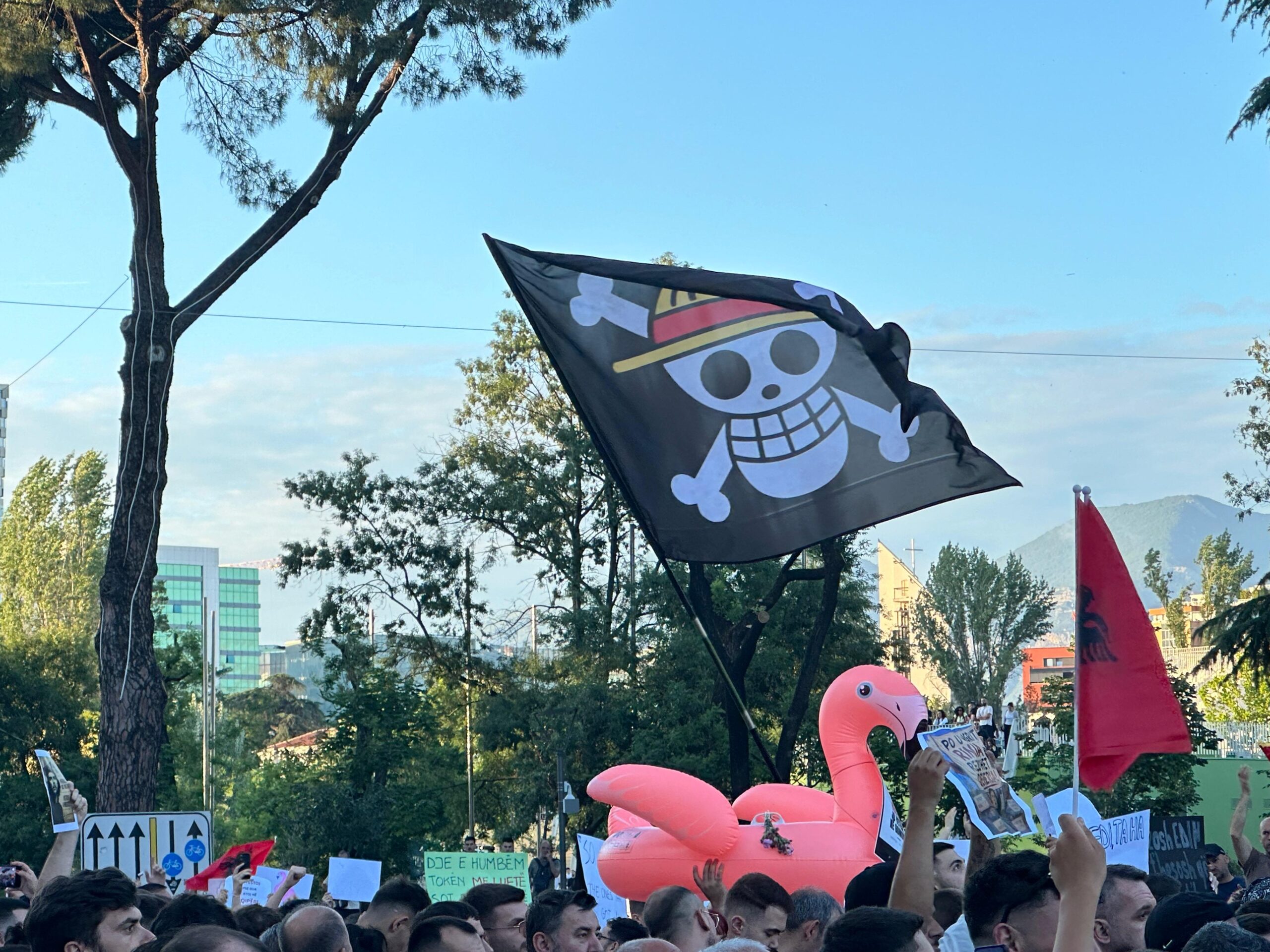
Flamingo Revolution Chronicles – Week 6: How the protest is changing, from flamingos to a fatigue that refuses to give in
In its sixth week, the protest against the project in Pishë Poro-Nartë has entered a more fatigued, but also more hard-edged phase: participation fluctuates, political demands are becoming more visible, the issue has returned to the European Parliament, while tensions with the police and disagreements over how the movement should continue have made the protest more fragile, but it is still there. Author: Jona Cenameri This article was originally posted on Faktoje, you can read it here. Photo: Jona Cenameri In the sixth week of the protest, two young people who have been there since the first days happen to catch each other’s eye and smile. Without saying much, like people who know they are tired, but also know they have not given up. Because after 38 days, the protest against plans for a tourist resort in the protected Pishë Poro-Nartë area is no longer measured only by the number of people in the square. It is also measured by those who arrive late after work, those who stay for only a few minutes, those who ask each other, “Were you here yesterday?”, and those who have left the country but continue to support the protest through social media. When the protest began on May 31, no one could have predicted that July, instead of finding Albanians on the beaches, would still find them in the square. But by its sixth week, what began as a rebellion against a project in Zvërnec that had yet to receive final approval had evolved into a broader revolt against the way public decisions are made, the way common property is treated, the way the state treats its citizens, and the way those in power respond when challenged. “It has changed a lot,” says a middle-aged man, summing up the protest in one sentence: “From resistance to a single project, it has become a determined protest against a distorted model of governance.” At first, it was Zvërnec. It was the images of the fence and the bulldozers, the confrontations with residents and activists, and the sight of a Zvërnec resident being dragged away by private security personnel in front of the State Police. It was the debate over the protected area, the legal amendments, the lack of transparency and the fear that one of the country’s most important ecosystems was being opened up to intensive construction. Then the revolt moved to Tirana. Tirana It began on May 31, while on June 1, International Children’s Day, the crowd initially appeared uncertain, mixed together with another protest taking place in Skanderbeg Square. Gradually, through chants and announcements over a megaphone, the direction became clear: those protesting for Narta were to head towards the Ministry of Environment. They were protesting against what they saw as a “project advancing without transparency and at the expense of public assets.” There was no single leader, no podium controlling the crowd and no single message. People had come out because of Zvërnec, but they were also talking about corruption, emigration, pensions, healthcare, the lack of prospects for the future, the media, the police, the government and the opposition. The chant that closed the first night was simple: “More of us tomorrow!” During the first days, the protest took on the face of Gen Z. Instead of traditional political placards, the square filled with memes, anime references, television catchphrases, Spotify screenshots, AI-generated illustrations and flamingos that quickly became a symbol of the movement. TikTok, Instagram and the protest seemed to have merged into one. A video became a story, a placard became a meme, one friend invited another, and a repost brought dozens of new young people into the square. In those days, the protest had humour and rhythm. Its chants were harsh, but its form was light. There was anger, but also playfulness. There was patriotism, but also irony. There were flags, drums, songs, placards and endless photographs taken on young people’s phones. “The protest was magnificent during the first three days,” says a 20-year-old student from Tirana. But according to him, something changed when the protest began to take on a more structured form. “The moment they installed the sound system, it turned into a party rally. And let’s not even get into the level of some of the people who go up there and speak. Get rid of the sound system. Give the protest back to the people, not to a hierarchy,” he says, asking not to be identified by name. The debate This is one of the debates that has continued within the protest itself. Should it remain a protest that leads itself? Or should it have a structure, clearly articulated demands, speakers and representation? In the first days, the absence of a leader was one of its strengths. By the sixth week, that same absence has also become a dilemma. Photo: Jona Cenameri The demands From its earliest days, the protest had five articulated demands. Protesters called for the resignation of the government; the repeal of the status and legal framework related to strategic investors; the cancellation of the so-called “Mountain Package”; the repeal of the amendments to the Law on Protected Areas; and the repeal of amendments to the Cultural Heritage Law, which they argue put the country’s natural and historical heritage at risk. Initially, the demands were linked to the environmental cause, cultural heritage and a development model that protesters viewed as being geared towards private interests. But as the days passed, they expanded. The platform On the 23rd day of the protest, the organising group presented broader political demands. These included the resignation of the prime minister and the government, the establishment of a non-partisan transitional technical government with a 12-month mandate, constitutional and electoral changes, the retention of the original demands concerning the contested laws, and the drafting of a new social contract between citizens and the state. It was the moment when the protest attempted to translate itself into a more comprehensive political platform. A few days later, a group of 13 signatories issued an ultimatum in the name of the “coordinating group.” The question mark But in the square, this did not resolve the question of representation. For many protesters, the ultimatum exists more on social media and in media reports than in the everyday reality of the protest. Ask people in the square and not everyone knows it exists. Not everyone knows what it contains. Not everyone knows who signed it. And not everyone feels represented by it. In the square, each person still seems to arrive carrying their own concern. A resident talks about Zvërnec and about the fear that one day they may no longer recognise their own home. An activist talks about the Law on Protected Areas and about laws being changed without citizens being heard. A young person demands Rama’s resignation because he no longer feels represented. A citizen standing opposite the police talks about a state that is supposed to protect him, but which many protesters experience instead as a wall. Someone else criticises the media because they feel that what happens in the square is not reported the way it looks from inside the protest. A young woman talks about her sister not receiving the healthcare she needs and about the exhaustion of an entire family. A parent talks about education, about children and about the question of what kind of country is being left to them. A pensioner talks about financial hardship and growing old without dignity. So although the protest now has written demands, a political platform, an ultimatum and a group of signatories, it has not yet transformed into a single political body. The organisers speak in the name of the protest. But the square continues to speak in many voices. The demand that has not changed In the evenings, however, the demand heard most loudly remains the resignation of Prime Minister Edi Rama. It is repeated through the sound system, by the crowd, on placards and by the groups that march every night outside the Prime Minister’s Office. Zvërnec was the spark. But it is no longer the only reason people are taking to the streets. One young woman, an emigrant living in the European Union, says she has to leave again in the third week of July. But since the protest began, she has put her other commitments aside and remained in the square indefinitely. She says she will come back again. Another young man, a content creator living in London, continues to support the protest on Instagram after having to leave Albania. A man in his thirties from Tirana jokingly called himself a “deserter” because he had gone away on holiday for a few days. Others come every other day. Some cannot make it at the beginning and join later. Some stay for only a few minutes. The diaspora Participation peaked over the weekend of June 20 and 21. During those days, the square was fuller, the energy stronger and international attention more visible. People from the Albanian diaspora, as well as from Kosovo and North Macedonia, were there to join the protest. Photo: Jona Cenameri The European Parliament Members of the European Parliament visited Albania, spoke at the protest, met citizens and also held meetings with the Minister of Environment. In June, the European Parliament adopted a resolution on Albania calling for an immediate moratorium in the Vjosa-Narta area and a review of the legal amendments concerning protected areas, while expressing concern over developments in the area. On July 1, the “Flamingo Revolution” returned once again to the European Parliament, this time through a discussion organised by MEP Pasquale Tridico of The Left group, titled “Democracy, Rule of Law and Civic Participation in Albania.” Members of the European Parliament, representatives of left-wing parties from several European countries and participants from Albania attended the meeting. The issue of Vjosa-Narta was discussed in connection with democratic standards, the rule of law, civic participation, emigration and Albania’s relationship with the European integration process. For several days, it seemed as though Pishë Poro-Narta had become a public test of Albania’s relationship with the environment, democracy, the European Union and private interests. The fluctuations But after the peak, participation began to fluctuate. It was the end of June. Then came July. The heat, beach season, holidays planned long in advance and accumulated exhaustion all began to take their toll. The protest has now lasted more than a month and entered its second. It no longer has the same momentum every evening that it had at the beginning. There are fewer humorous placards. There are fewer people who come simply out of curiosity. “There is more violence now,” says a young professional in her twenties when asked how the protest has changed. And July changed the tone. Clashes outside parliament On July 2, the second protest near Parliament was marked by violence. Afterwards, participation increased again, this time driven not by enthusiasm, but by anger. For several days, protesters marched towards Police Station No. 3, where detained protesters were being held. In the square, chants directed at the police became harsher. The relationship between citizens and the State Police, already strained since the beginning of the protest, appeared to have broken down. A video went viral on social media showing a woman standing face to face with a police officer positioned near the Prime Minister’s Office. She was holding a placard that read: “I am disappointed in you.” Representatives of the governing majority used the violence of July 2 as evidence that the supposedly “peaceful” protest had finally shown its true face. Protesters, on the other hand, saw this as an attempt to delegitimise the entire movement through a single incident. Prime Minister Edi Rama, who at the beginning had extended an invitation for a public meeting with a group of protesters, later defended the project and has frequently attacked the protest, public figures who support it and individual participants associated with it. The Zvërnec protest is not only a confrontation with many of the country’s problems. It has also become a moment in which everyone’s public stance is being measured. Photo: Jona Cenameri Who spoke? Who remained silent? Who took a position? Who stepped back? And who will be remembered for it? On July 4, the prime minister’s birthday, the protest once again took on a satirical form. Cakes carrying different symbolic messages were brought into the square. Songs were sung. The daily demand for Rama’s resignation was repeated once again. A symbolic political coffin for Rama also appeared in the square, an image that was strongly criticised by representatives of the governing majority. The contradictions By the sixth week, however, the contradictions have become more visible. The protesters oppose violence, yet some of them are increasingly saying quietly that chants alone may no longer be enough. Among groups of young people, questions can now be heard that were not voiced so openly at the beginning. Are the repeated chants “Rama, resign,” “Your time is up,” and “Rama in prison, Berisha in prison” simply lulling the protest into passivity? Should the tactics change? Is the government simply waiting for summer, the holidays and exhaustion to take their toll? Will everything eventually fade away without producing any result? Placards have also invoked the memory of January 21, the Socialist Party protest held when it was in opposition, the clashes, the burning cars, Tirana in flames and the four citizens who were killed. For some protesters, that memory raises the central question facing the movement: How is change achieved in a country where those in power do not step down simply because people demand it? By its sixth week, the protest is no longer the same crowd that once enthusiastically chanted: “More of us tomorrow!” It is something more tired now. But it is still there.