
After the adoption of Law No. 21/2024, Rama said the amendments were “100% aligned with the European Union.” Today, his position has changed.
Author: Jona Cenameri
This article was originally posted on Faktoje, you can read it here.
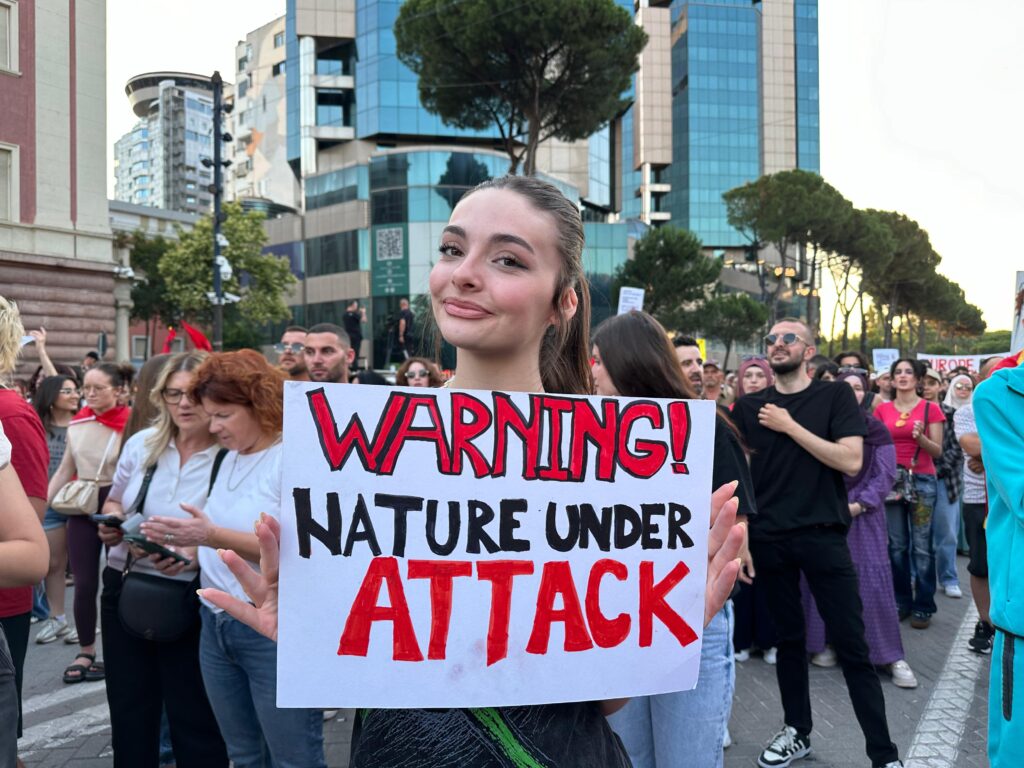
The Law on Protected Areas, which Prime Minister Edi Rama has defended for more than two years as an instrument for balancing nature conservation with economic development, will now be revised to bring it into line with European Union standards.
The announcement was made on July 14 in Brussels, during the ninth Albania-EU Intergovernmental Conference, at a time when the repeal of the 2024 amendments had already been included among the five formalised demands of the protest that began on May 31.
European Commissioner for Enlargement Marta Kos said that, before the protests began, the European Commission and the Albanian government had agreed that the 2024 amendments to the Law on Protected Areas would be repealed during 2026, along with the Law on Strategic Investments.
According to Kos, the changes are necessary for the closure of negotiations on Chapter 27, which covers the environment and climate change.
Rama intervened to draw a distinction between repealing the Law on Strategic Investments and revising the Law on Protected Areas.
Regarding the latter, he insisted that there was “nothing to repeal,” describing it as one of the government’s best laws. At the same time, however, the prime minister acknowledged that anything within the law that does not comply with European standards would be changed, and that the law would be adjusted until it reached “100%” compliance with those standards.
This wording contrasts with the statements made by Rama and then Minister of Tourism and Environment Mirela Kumbaro when the legal amendments were proposed and adopted.
“We do not accept moral lectures”
Rama’s defence of the amendments was already evident in December 2023, when the initiative was still under discussion.
During an event dedicated to the Vjosa National Park in December 2023, Rama explained that the revision of the legal framework had been driven by requests from municipalities and by pressure for economic development.
According to him, a “harmonious balance” had to be found between nature conservation and development.
The prime minister also said that Albania needed luxury tourism, saying that such investments would generate higher revenues that would also benefit ordinary citizens.
Faced with criticism from environmental experts, Rama said the government would not accept “moral lectures” on how it should treat nature.
He repeated this position in March 2024, just weeks after the amendments had been adopted.
Rama said that, considering what the government had done over the previous 10 years for nature and cultural heritage, no one was in a position to lecture it. He presented high-end tourism as a way to increase revenues without relying solely on a higher number of tourists, arguing that success depended on achieving a balance between protection and development.
The law was “100% aligned with the EU”
The amendments were adopted by Parliament on February 22, 2024, through Law No. 21/2024.
Following a reaction from the Delegation of the European Union, which said it would closely monitor the implementation of the new provisions, Rama stated that the government was “100% aligned with the European Union.”
According to him, the amendments strengthened the path towards sustainable development and would help Albania become a high-end tourism destination while simultaneously protecting biodiversity.
Then Minister Mirela Kumbaro also defended the law.
She said the amendments did not harm the environment and did not violate EU directives. According to her, there were “red lines” that would not be crossed, while any interventions allowed under the law would be ecological, environmentally friendly and controlled through strict rules.
The official position in 2024 was, in essence, that the amendments did not weaken territorial protection and were in line with European obligations.
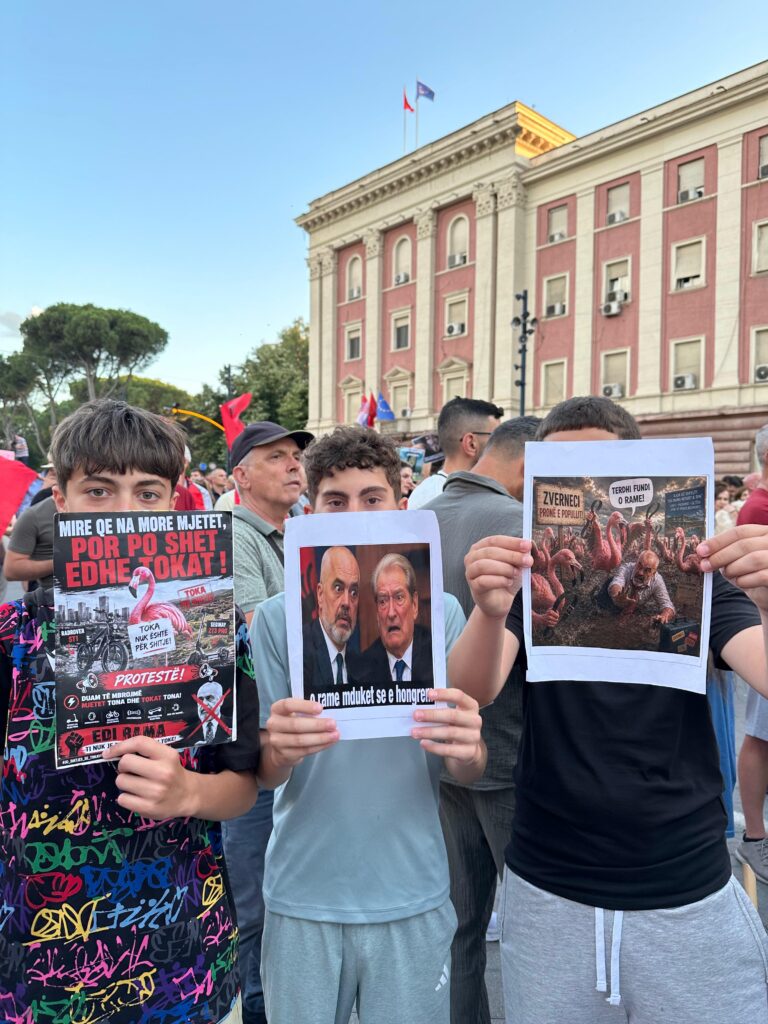
The protest and the defence of the law
The protest that began on May 31, 2026 brought the law back to the centre of public debate.
Alongside opposition to the tourism project in the Pishë Poro-Nartë area, one of the first demands was the repeal of the amendments adopted in 2024.
In his first reaction following the protest, Rama gave no indication that the government intended to step back from the law.
On June 1, he said the government had not removed any territory from protected areas and that the protection categories had been brought into line with the highest international standards.
According to him, Pishë Poro was a Category V protected landscape, where nature protection did not exclude development.
His position became even firmer on June 9, during a meeting with journalists and media representatives from EU countries.
Rama said that no one could lecture the government on the environment and described as a “lie” the claim that the law had been amended in order to pave the way for the project linked to Jared Kushner.
According to him, the 2024 amendments were intended to clearly define the activities permitted within the different categories of protected areas.
The prime minister insisted that, under European standards as well, a protected landscape is an area where construction may be permitted.
He said the aim was for the project to serve as proof that nature and development could coexist.
Rama did not present the law as an act that needed correction in order to comply with EU standards.
On the contrary, he argued that both the amendments and the classification of the area were based on European standards, while dismissing as a “lie” the claim that the law had been changed specifically for the project.
The Revision
The first change in the language used by Rama appeared on June 18, following the adoption of a resolution by the European Parliament.
Rama rejected the claim that the resolution represented the protest’s first victory.
He said protesters had already had their “victory in their pocket” before the demonstrations began, because environmental protection was already a government priority.
At the same time, however, he acknowledged that the amendments to the Law on Protected Areas were part of the EU negotiation agenda and that, during the analytical process with the European Commission, any provision that did not comply with European criteria and standards would be identified.
The July 14 statement took this acknowledgement further.
Rama publicly said that the law would be adjusted until it achieved full compliance with European standards.
“As for the Law on Protected Areas, we have nothing to repeal, even though there has been a resolution in the European Parliament calling for this. In fact, we will revise this law on the basis of all European standards and we will change anything within it that is not in line with European standards…” Rama said.
Rama continues to defend the law as one of the government’s best and rejects the term “repeal.”
However, his acknowledgement that the law may contain provisions that are not compliant with EU standards marks a shift from the unequivocal defence he offered in 2024 and during the first days of the protest.
The case of the Law on Strategic Investments is different.
As early as February 2026, before the protest began, it had been announced that the current law would expire on December 31, 2026, and that the government was preparing a new legal framework.