
Rama described the square as a “television studio for the algorithm.” Eight voices involved in the protest tell Faktoje how work is divided on the ground, where different approaches clash, and what may come after day 51.
Author: Jona Cenameri
The original article was published on Faktoje, you can read it here.
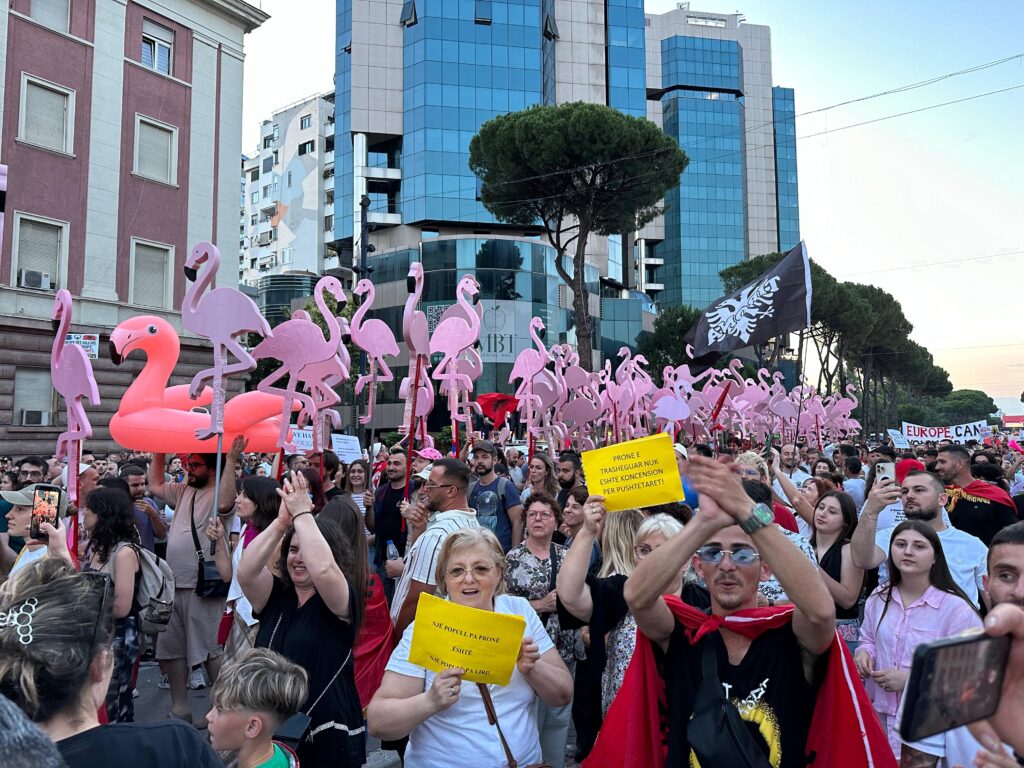
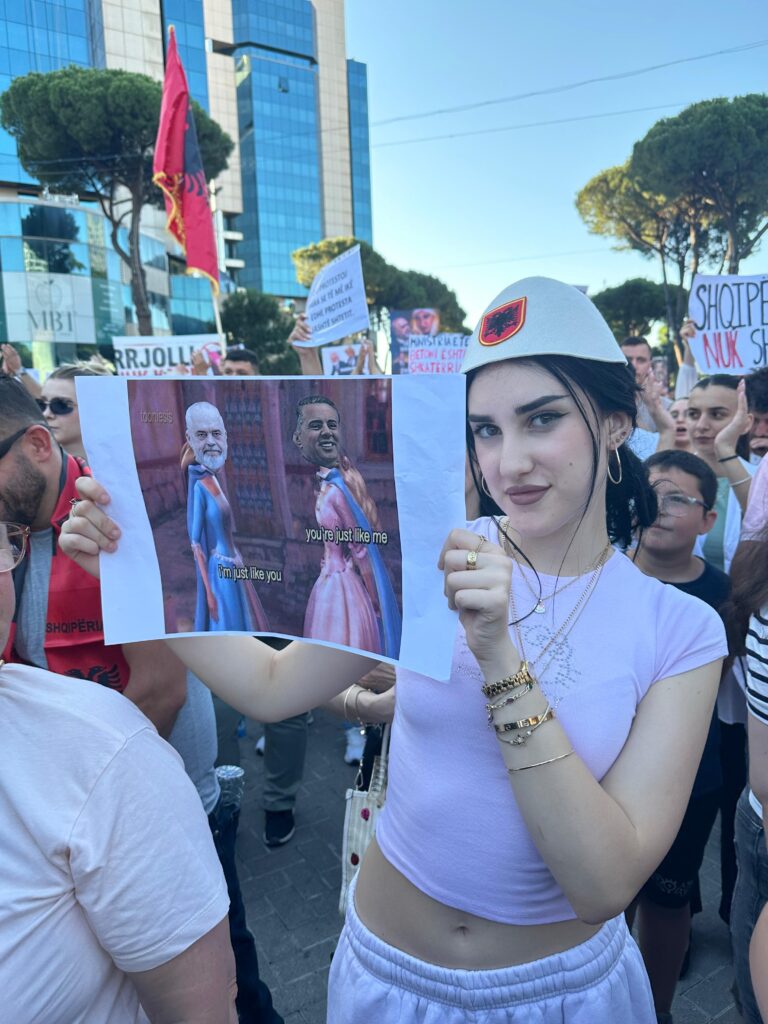
“The square is simply a television studio for the algorithm. It is the place where material is filmed to feed the algorithm and justify it,” Prime Minister Edi Rama said on June 20 during a meeting of the Socialist Party Parliamentary Group.
Rama argued that the algorithm rewards conflict, outrage and intimidation, while describing the protest in these terms:
“A protest is no longer a protest. It is a stage, a marketplace, a marketplace of emotions, clicks, morality, and even careers.”
On July 11, during a conversation with young people in Jalë, the prime minister added nuance to this position.
“I did not say that the algorithm was the reason for the protest,” Rama said. He acknowledged that the protest had causes rooted in citizens’ everyday lives, but argued that the algorithm amplified noise, dissatisfaction, manipulated videos and fake news, which, according to him, “pour fuel on a fire that was not started by the algorithm, but by people.”
Rama added that the algorithm was not the organiser of the protest and that a distinction had to be made between “where the protesters’ genuine motivation ends” and where manipulation by other actors begins.
On July 19, protesters gathered in Tirana for the 50th consecutive day to demand Prime Minister Rama’s resignation.
The nightly protest in the capital, which began as a reaction to violence and in defence of Zvërnec, has continued without interruption since May 31, 2026.
What is happening?
To understand what is happening beyond the content circulating on social media, Faktoje interviewed eight people involved in the protest in different ways.
Their accounts do not represent the entire protest and do not claim to summarise the views of every participant. They are some voices among the many voices, groups and currents that coexist in the square.
Nevertheless, they help shed light on the origins of the discontent, the way the protest is organised, the role of digital platforms and the debates over how it should continue.
Zvërnec
For environmental expert Olsi Nika, the events in Zvërnec were “the last straw,” though not necessarily the only event that could have triggered such a reaction.
According to him, the spark could just as easily have come from the dragging of a woman in Rrjoll, the protest by mussel farmers in Butrint, or an issue such as the treatment of cancer patients, among others.
“The glass has to fill before it overflows. This was the drop that made it overflow,” Nika says.
He considers it significant that the spark this time was environmental, since interventions in the territory and protected areas had long generated dissatisfaction but had never before provoked such a broad reaction.
For Nika, Zvërnec should not be seen only as the place where the episode that triggered the protest occurred.
He describes it as “one of the most representative images” of the problems created during Albania’s transition.
In his view, “Zvërnec brought together unresolved property disputes, the dominance of private interests, the role of private security and the lack of an immediate institutional response.”
He sees the fence and the violence against the protester as “symbols of a relationship in which the citizen is confronted not by institutions, but by private interests operating on the ground.”
Nika also criticises the way part of the media covered the event and the protest.
According to him, the incident in Zvërnec initially did not receive the attention it deserved, while later coverage focused mainly on the microphone and the speakers outside the Prime Minister’s Office, leaving out other voices from the square.
“Zvërnec is a mirror that showed how things are done in Albania,” he says.
According to Nika, the protest quickly moved beyond its initial environmental cause.
The leadership
Those interviewed generally agree that the protest is not being directed by a single hand.
“Is there one central organiser? No. Are there groups coordinating in order to contribute? Yes, and there are several of them,” says Migen Qiraxhiu, activist and co-founder of Civic Resistance.
According to him, one of the reasons the protest has maintained participation is the belief among citizens that they are not being used to serve a single individual or political force.
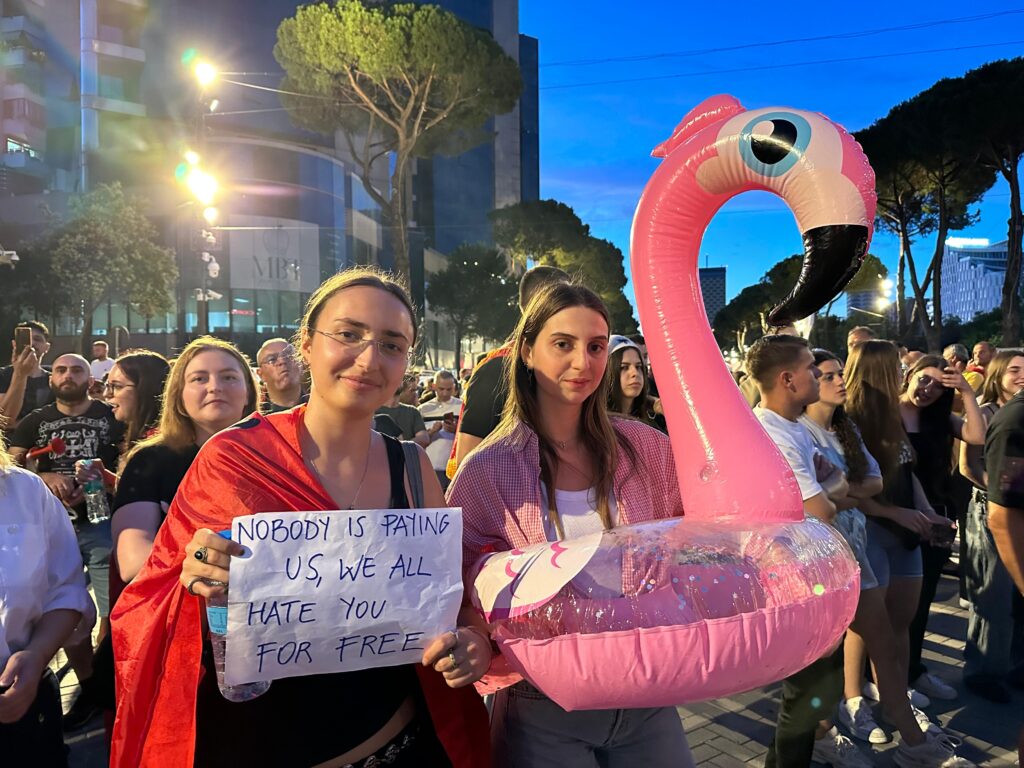
Within the protest, Qiraxhiu says, there are young people who take care of the children’s area, students who create installations and placards, the drum and flamingo group, people who manage the sound area, and young people who organise the march after the formal part of the protest outside the Prime Minister’s Office ends.
“The protest has many voices, many groups and many forms of contribution, and that is precisely one of its greatest strengths,” Qiraxhiu says.
Natasha Paja, a designer and member of the Trivet Art group, describes the organisation through the concrete division of tasks.
“Someone makes sure the microphone runs smoothly, someone takes care of the children’s creative corner, someone handles the rhythm of resistance, someone else the chants. There are people who contribute to communication with the diaspora and a group that takes care of the evening march,” she says.
According to Paja, the organisation is horizontal: people become involved wherever they are able to contribute, without a leader who has the legitimacy to make decisions on behalf of the entire protest.
Entela Ndrevataj, a feminist activist and member of the Feminist Collective, a voluntary and autonomous community, also says the protest does not have a classical structure, but that this is precisely what has created space for different groups.
“The square is a shared space and, as such, no group has imposed itself over another,” she says.
For Ndrevataj, corruption is also “intertwined with an authoritarian and patriarchal way of exercising power, where decisions are made from above and public wealth is treated as private property.”
The flamingos
Sokol Çunga, an activist, historian and translator, participates as an individual rather than as part of an organisational structure.
He describes the protest as sincere and articulated not only through the microphone, but also through placards and the flamingos.
When it comes to the level of coordination, Çunga is more sceptical.
“The only coordination I see is the time and place, and ‘who is going to transport the flamingos?’” he says.
According to him, the crowd changes every day in form, size and composition and does not come to the square under direction or with a completely unified goal.
For this reason, Çunga does not believe that the protest, as a single body, can draft detailed political or institutional plans.
“The next steps remain simpler and more tangible: every day on the boulevard!”
The organising group
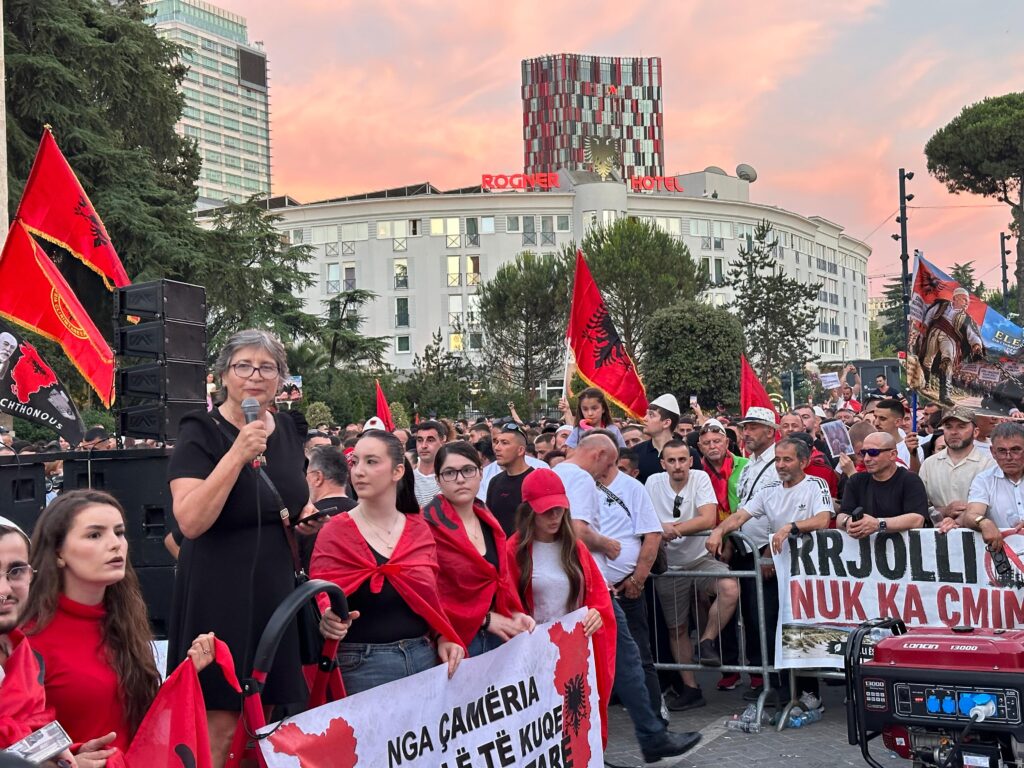
Unlike participants who see only dispersed coordination, Ilir Xhemalaj, activist and founder of the National Union of Telephone Operators, says that from the first day there has been a group of activists responsible for the smooth running of the formal part of the protest.
According to him, the group is made up of environmental activists, trade unionists, oil workers and people from other fields.
They take care of the sound system, the speakers and the organisation of the gathering outside the Prime Minister’s Office.
“The sound system comes at a cost, which all of us activists have paid out of our own pockets,” Xhemalaj says.
He explains that, apart from several intellectuals who were invited at the beginning, the other speakers wait their turn to take the microphone.
“The only criterion for speakers is to wait your turn. One person comes off, another goes on, and everyone speaks about their own views and concerns,” he says.
According to Xhemalaj, the group’s responsibility ends when the speeches finish.
The march that follows and other actions may be organised by different people and are not automatically decisions made by the same group.
For Xhemalaj, the importance of digital platforms has been undeniable.
“It is precisely social media that has made it possible for this protest to function, develop and grow in size. Gen Z has managed to use social media very effectively to call on people to come out into the square,” he says.
The algorithm
Migen Qiraxhiu turns the prime minister’s argument about the algorithm in the opposite direction.
According to him, Rama had no problem with the algorithm when digital communication kept attention focused on the government and on Rama himself.
“The problem begins when the algorithm is no longer on his side. The algorithm does not create events by itself; it follows the interest, reaction and attention generated by a real event,” Qiraxhiu says.
In his view, the protest “has taken not only the square and the public debate, but the algorithm as well.”
Arnen Sula clarifies that the organisation he leads is not part of the protest’s organisational structure and that he participates as a citizen and activist.
“Every protest is measured by the people who take part in it, not by algorithms,” Sula says. “Digital platforms can help with organisation and communication, but they cannot replace the physical presence of citizens.”
According to him, when citizens continue to come to the square for weeks, it shows that there is a concern that cannot be reduced to a social media phenomenon.
Olsi Nika interprets Rama’s focus on the algorithm as an attempt to avoid responsibility for the causes that produced the protest.
“To deny that there is a protest when people are in the square, when the protest is being covered across the media and when there is an extraordinary outpouring of anger online as well, and to call all of this simply an algorithm, is a tactic belonging to a failed strategy,” he says.
The microphone
The very element that Xhemalaj presents as organisational work, the sound system and the speaking order, is viewed sceptically by Olsi Nika.
Nika says that the people around the microphone represent only one part of the protest.
“Both technically and physically, there is another protest where the microphone can no longer be heard,” he says.
According to him, the cameras’ focus on the improvised podium creates the impression that the speakers represent the entire square, while leaving out participants standing farther away and their reasons for protesting.
Nika also sees the microphone as carrying the risk of personal protagonism and the controlled release of revolt.
“I consider the microphone to be the instrument that kills the protest and kills the revolt,” he says.
For Xhemalaj, the sound system is necessary infrastructure for giving different groups and citizens a voice.
For Nika, focusing on the microphone can create a hierarchy of visibility within a protest that presents itself as horizontal.
Politics
There are also activists and representatives in the square with political affiliations.
Emiljando Kita, an activist with Together Movement (Lëvizja Bashkë), says he supports the demands articulated by protesters, from the repeal of the contested laws to the resignation of the prime minister.
“When people take to the streets, coordination happens naturally because the objective is shared,” he says.
The protest has also brought representatives and activists from other political forces into the square, including the Opportunity Party (Partia Mundësia), the Albania Becomes Movement Party (Partia “Lëvizja Shqipëria Bëhet”) and the Democratic Party (Partia Demokratike), the latter mainly through its youth members.
Migen Qiraxhiu argues that one reason the protest has not become fully identified with any single political force is that its messages have been critical of the two main political figures of Albania’s transition, Edi Rama and Sali Berisha.
The “National Assembly”
The clearest disagreement over the future of the protest concerns the idea of creating a “National Assembly” or citizens’ assembly.
Ilir Xhemalaj says the initiative is not intended to speak on behalf of the protest or to establish parallel institutions.
It is meant to serve as a space where citizens and intellectuals can offer ideas about how the protest should continue.
Xhemalaj clarifies that the Assembly has not yet been created; only a few meetings of the working group for its formation have taken place.
“We are preparing for a marathon, we are preparing for a long battle, and naturally we need everyone’s ideas,” he says.
Other protesters view the initiative with reservations.
Migen Qiraxhiu says he had joined a WhatsApp group where the idea was being presented, but left after reading the materials.
He considers it legitimate to create new initiatives, including organisations or political parties, but opposes any claim to speak on behalf of the entire protest without a clear mandate.
“Every initiative has the right to organise and propose ideas, but it must be clear that it represents only its founders and supporters, not automatically all protesters,” he says.
Arnen Sula also believes that a National Assembly could create the perception that one group is assuming representation of a square that has no centralised structure.
Natasha Paja calls the initiative “an old method for an old concept,” while Entela Ndrevataj says that, at this stage, the square should remain the main space and that one group should not place itself above the majority.
For Sokol Çunga, the information circulated about the initiative was unclear and gave the impression of a chaotic process.
He does not believe that such an assembly could confront the existing political forces and sees mass, peaceful protest as the main instrument.
Olsi Nika is more critical.
He regards such structures as parallel ones and argues that change should come through existing mechanisms: the vote, parliament, the justice system and the media.
According to him, the energy of the square should exert pressure on these mechanisms to function, rather than replacing them with a structure that has no mandate from all protesters.
What comes next
After 51 days of protest, those interviewed do not present a single strategy.
Their positions can broadly be divided between continuing pressure in the square, moving towards institutional action, and the need for more structured organisation.
Sokol Çunga calls for a continued daily presence on the boulevard.
Natasha Paja also sees the square as the priority, but says that work should continue in parallel on legal aspects, communication with European institutions and actions in other parts of the country.
Entela Ndrevataj believes it is still too early to create a movement with a leadership and formal representation.
She proposes closer cooperation among legal, media and environmental experts while preserving transparency and the horizontal character of the protest.
Arnen Sula places emphasis on sustainability and on linking public pressure with justice institutions.
“The protest cannot replace justice, but it can support it by demanding accountability and by not allowing issues to be forgotten,” he says, mentioning SPAK and other responsible bodies.
Migen Qiraxhiu proposes legal initiatives, institutional requests, monitoring, documented reports of wrongdoing and stronger mechanisms of civic oversight.
“The wounds of 36 years of transition cannot be healed in 43 days,” he says.
For Qiraxhiu, one of the most important outcomes of the protest could be a change in the relationship between citizens and those in power: from citizens asking politicians for photographs to citizens filming them and demanding accountability.
Ilir Xhemalaj calls for broader organisation, stronger links with regions outside Tirana and with the diaspora, and preparation for continuing through the summer.
“The protest will continue without stopping until September,” he said during the interview, describing the summer as the main challenge to maintaining participation.
Emiljando Kita sees the way forward as a combination of pressure in the square, political action and legal complaints.
Olsi Nika offers the most critical assessment of the stage the movement has reached.
According to him, the protest clearly knows what it does not want, the government and the current way in which power is exercised, but has not yet managed to articulate with equal clarity the political and institutional model it wants to build.
“The protest is dead; long live the protest,” Nika says.
He calls for lawyers, economists, journalists, analysts and experts to reorganise so that the energy of the protest can be transformed into argument, institutional pressure and concrete action.
According to him, the protest could enter a phase in which it is “smaller in numbers, but much stronger in argument,” a process he believes could take shape in September.
Social media
Social media has played an important role in the mobilisation, growth and visibility of the protest.
None of the voices interviewed denies this.
But behind the online content there is also real organisation, even if it remains dispersed and without a single centre of leadership.