
How Can We Make Philosophy Teaching FAIR? – Principles of Feminist Reconstructed Philosophy Education is a groundbreaking book that reimagines how philosophy can be taught in high schools—making it fairer, more just, and more inclusive. Developed through action research in classrooms across southern Serbia, this book is both a critical reflection on traditional teaching and a practical handbook filled with ready-to-use lesson ideas.
The authors explore one central question through a feminist lens: How can philosophy help change the world?
Download the book for free here:
👉 Get the PDF
What’s Inside?
The book offers:
- A clear analysis of the current education system in Serbia, mapping challenges and exploring why previous reforms often fell short.
- Principles and methods for FAIR (Feminist Reconstructed) philosophy teaching, where theory and practice come together as equally important tools.
- Detailed lesson plans, workshop ideas, and classroom activities, from discussions on gender stereotypes to creative exercises that connect philosophy to everyday life.
- Open-access materials, all available to download via QR codes in the book, so teachers can easily apply this approach.
Accessible even to those new to feminist or education theory, the book draws on current research and real experiences from classrooms. It’s intended for philosophy teachers—and educators in other social sciences—who want to make learning more relevant and engaging.
The authors stress that this is not a quick-fix recipe but an invitation to rethink, question, and learn together with young people, in a spirit of solidarity and respect.
Action Research That Inspired the Book
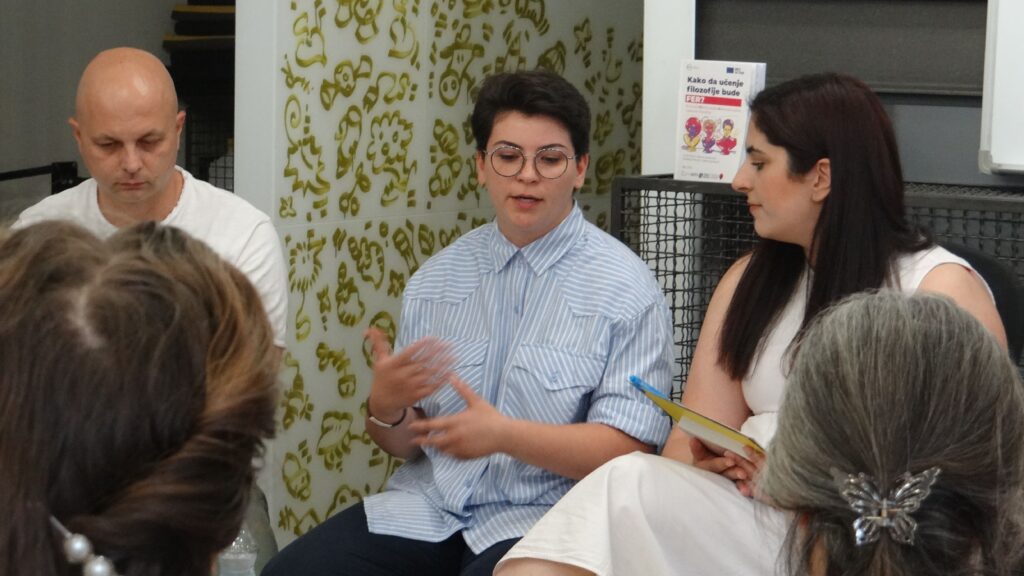
The book is rooted in action research carried out in late 2024 and early 2025 in five high schools in Niš, Bujanovac, Bela Palanka, and Vlasotince. The authors worked closely with students and teachers to design and test a new approach to philosophy.
Lessons were fully participatory—students discussed, shared ideas, and reflected on what they learned and how it made them feel. Many encountered feminist philosophy for the first time, opening space for important conversations about equality, identity, and democracy.
The research showed that young people—especially girls—are eager to see contemporary topics and gender equality reflected in their education.
A Call for Change
Based on this experience, the authors prepared an official proposal to update Serbia’s philosophy curriculum. The proposal calls for:
- Introducing more women philosophers and gender perspectives.
- Adopting interactive, student-centered teaching methods.
While the Institute for the Improvement of Education has formally received the proposal, it hasn’t yet been approved. Officials have said it will be considered during curriculum revisions planned for late 2025 and early 2026.
Meanwhile, the authors and their partners are continuing to advocate for change. They invite teachers, students, parents, and anyone interested to join this effort—by discussing it, sharing information, or reaching out to institutions.
This isn’t just about feminist philosophy; it’s about building an education system where critical thinking and fairness truly matter.
What Reviewers Are Saying
This book was shaped by a community of scholars, teachers, students, and activists. Reviewers describe it as an ambitious and much-needed innovation in Serbian education.
Here’s what some of them said:
“One of the book’s greatest contributions is that it avoids pseudo-feminist critiques and superficial trends, and instead seriously engages with the question: How does philosophy change the world?”
– Eva D. Bahovec, Professor of Philosophy, University of Ljubljana
“This is one of the pioneering efforts in our education system, filling a gap that has existed for far too long.”
– Daša Duhaček, Professor of Political Theory, University of Belgrade
“I hope future generations will learn about feminism early enough that something finally changes—and that girls will feel safer walking alone.”
– Adrijana Tomić, high school student, Bujanovac
Download the Book
How Can We Make Philosophy Teaching FAIR? – Principles of Feminist Reconstructed Philosophy Education is available as a free PDF.
👉 Download here
Feel free to share it with colleagues, students, and anyone interested in more inclusive and thoughtful education.
This project was supported by the National Coalition for Decentralization, Proaktiv, and the Human Rights Committee Niš, funded by the European Union in Serbia.