
Women’s function as change agents in nonviolent protests in Ukraine and the Balkan states
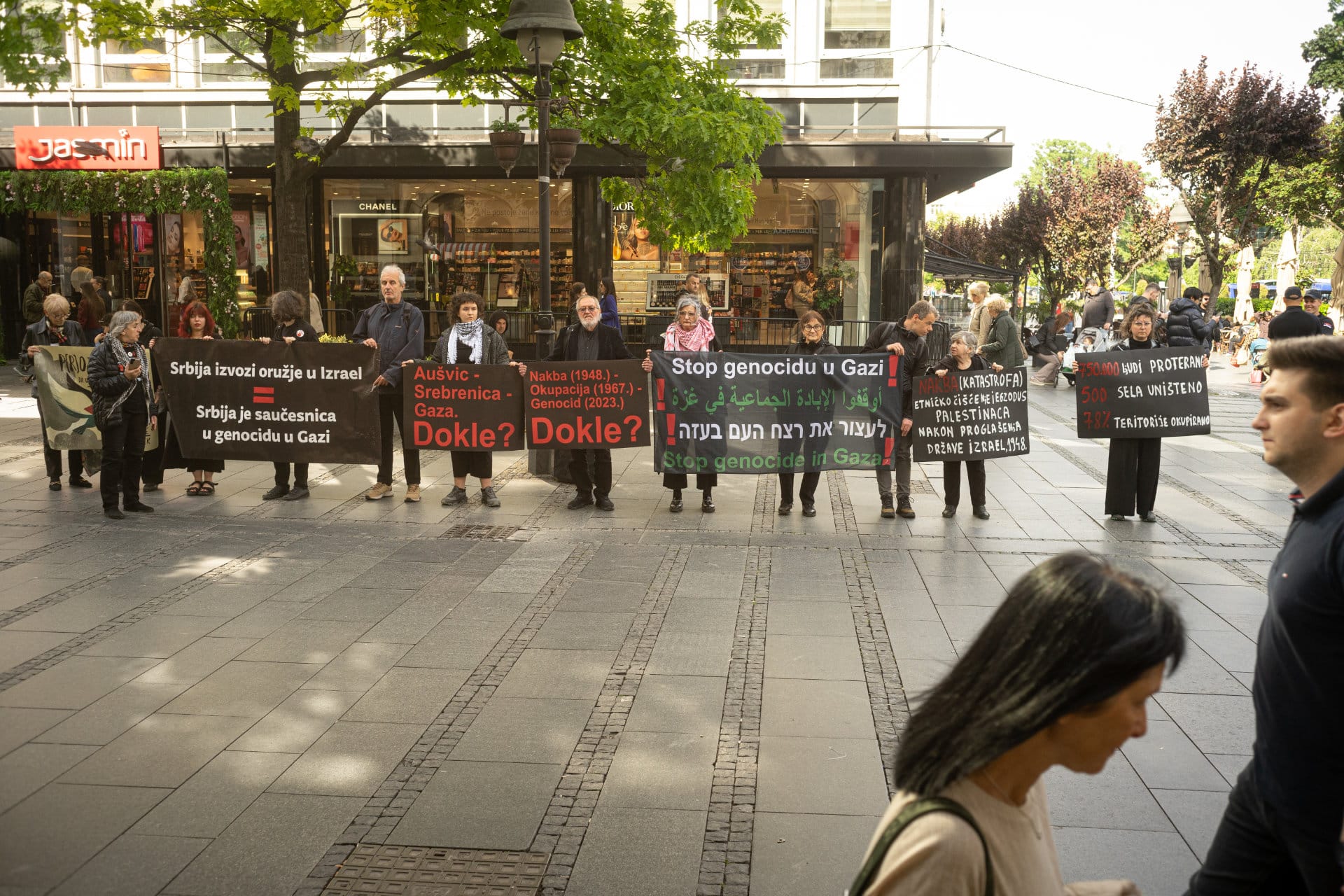
Author: Silvia Fabijanić Conflicts or rebellion against authority do not necessarily have to be violent. Nonviolent resistance does not seek victory over the enemy but the overcoming of injustice, thus a real solution and thereby the liberation of both those affected by the injustice and the opponents."1 It is about shaping actions that seek to stop wrong and harmful policies as they are being implemented, not an abstract idea that peace is "built" by the very act of resistance. Nonviolent movements throughout history have opened up space for reflection and the reshaping of social structures, often questioning relations between power, material inequalities, and dominant social norms. During the 1990s in Serbia, public space was dominated by fear, war propaganda, and the onset of armed conflicts. While much of society passively observed the events of the war, the organization Women in Black appeared on the streets of Belgrade. Their activism was based on the clear conviction that war is wrong and must be publicly and consistently opposed while it is happening. Women in Black had no institutional power or weapons, but they possessed a strong political stance and a visible, symbolically powerful presence in public spaces, which makes their activism particularly significant. This paper focuses on the work of Women in Black during the 1990s because of the specific historical and political context, marked by war, nationalism, and strong repression. Although armed conflicts did not take place on the territory of Serbia, the state was directly involved in the wars in the territory of the former Yugoslavia. A socio-political framework characterized by propaganda, militarization, and political control was established. Under such circumstances, nonviolent resistance takes on a special gravity and risk. Photograph from the Women in Black archive, documenting the “Stop the Genocide in Gaza” protest held in Belgrade in May 2026 Years later, during 2013 and 2014, in Ukraine, under conditions of peace and without armed conflict, the pro-democracy protest movement Euromaidan emerged. The protest movement began as a response by the people to the decision by the then-President of Ukraine not to sign an agreement with the European Union and to turn the country's policy toward Russia. The movement started as a peaceful protest but later escalated into a violent conflict. This paper focuses on the role of women during the nonviolent period of Euromaidan. During Euromaidan, women stepped out of socially imposed traditional roles and actively participated in political and social changes. Although the historical, political, and social contexts of the Women in Black and the women during Euromaidan differ, they are comparable in the way women enter the political sphere nonviolently through public activism during times of profound political and social change. Neither the Women in Black nor the women during the (nonviolent) part of Euromaidan were overshadowed by men; rather, they sought to be equal to men. We live in patriarchal social structures that systematically diminish or ignore women's overall contributions. Does women's activism in nonviolent movements serve as a corrective to social invisibility, rather than as an affirmation of difference? Based on this thesis, the paper focuses on the actions of Women in Black during the 1990s and on the participation of women in the nonviolent part of the Euromaidan protests. Although they operate in different historical and political contexts, this paper aims to present their nonviolent resistance, the motives that drive them to enter the public sphere, the risks they face, their level of visibility, and the contribution they have made to society through their nonviolent actions. This paper is based on a qualitative analysis of secondary sources. The analysis was conducted using thematic analysis of scientific, media, and audiovisual sources. NONVIOLENT RESISTANCE AND THE ROLE OF WOMEN IN SOCIAL MOVEMENT A passive attitude toward injustice in society is considered a greater problem than violence itself. Passivity represents implicit support for the violent structures of social power. Nonviolence is not a sign of weakness, but a conscious and deliberate abstention from violence while actively fighting against injustice. Nonviolent resistance does not seek victory over the enemy but the overcoming of injustice, thus a real solution and thereby the liberation of both those affected by the injustice and the opponents.2 It is useful to point out that nonviolent resistance is not the same as pacifism. Pacifism is a moral conviction, while nonviolent resistance is a strategic choice. People choose it because they think it will make it easier to win, not necessarily because they "love peace."3 Nonviolent movements offer various methods of action, from public protests and strikes, through boycotts and symbolic actions, to information campaigns. Their main characteristic is that they do not create moral constraints4 or other forms of obstacles.5 The accessibility for participation enables mass mobilization of citizens. Compared to violent methods, nonviolent resistance also demonstrates strategic effectiveness. Empirical data confirms that nonviolent campaigns are twice as likely to succeed (53%) compared to violent uprisings (26%), and they also leave behind more stable and democratic societies.6 The first key reason is the aforementioned mass participation, and the second is "political jiu-jitsu." It is a mechanism in which brutal repression of peaceful protesters backfires, destroying the authorities' reputation.7 It is precisely in these mechanisms of mass participation and strategic countereffect that women are a key strategic advantage. Since women make up approximately 50% of the total population, their active involvement in resistance movements is a crucial factor in achieving critical mass. Without women, a movement cannot reach the critical mass needed to exert effective pressure on the regime's "pillars of power." The presence of women on the front lines in 99% of cases directly undermines the regime's patriarchal authority and forces security forces to question their loyalties.8On the other hand, violence directed against unarmed women dramatically increases the moral and political cost of repression.9 That women's participation is not just a statistical figure but a reality is demonstrated by the Women in Black organization in Belgrade and the massive turnout of women at the Euromaidan in Ukraine. Although they may seem difficult to compare due to different political and social circumstances, the bridge connecting them is their entry into the public sphere through nonviolent resistance. WOMEN IN PEACE INITIATIVES IN THE BALKANS DURING THE 1990S: THE CASE OF SERBIA AND 'WOMEN IN BLACK' The political context of 1990s Serbia was marked by strong militarism and nationalist homogenization of society, as well as the breakup of SFRY10. Slobodan Milošević11used mass rallies to consolidate his power and create an atmosphere in which any voice of reason was branded "treasonous." Although the first multi-party elections were held, the system was not truly democratic. A strong retraditionalization of society occurred. The war discourse required men to be warriors and women to be "mothers of the nation" who would bear new soldiers and remain silent. 12 The political crisis of 1990 was merely a prelude to the armed conflicts that would follow on the territory of Croatia and Bosnia and Herzegovina. Serbia found itself in the paradoxical position of a state with no war on its own territory, yet simultaneously carrying out mass mobilization and sending resources to the battlefields. In such a specific context—where the war is waged 'in the name of the people,' but not on their territory—a strong internal resistance emerges in the form of the organization Women in Black. Women in Black is an activist group and network with a feminist-anti-militarist orientation, composed of women and men from different generations and ethnic backgrounds, with varying levels of education, social statuses, lifestyles, and sexual orientations. The organization grew out of earlier feminist initiatives, including Women's Studies and anti-war centers13, in response to the militaristic regime of Slobodan Milošević and the start of the war in Croatia and Bosnia. In Belgrade, on October 9, 1991, the organization began its weekly "vigil."14Every Wednesday on Republic Square in Belgrade, they stood in silence, dressed in black, holding banners. They used the traditional Eastern European/Christian custom of wearing black for the deceased, but gave it a new meaning: mourning the victims on "all three sides," which was a radical act because the regime only recognized Serbian victims. The silence served as a shield against the aggressive, male discourse of war. They chose silence as a rejection of speaking unnecessary words that prevent and hinder reflection on oneself and others. 15 They used black clothing as an "instrument of reason" and a method for their nonviolent entry into the social sphere. Through their engagement, they consciously distanced themselves from socially gender-imposed female roles and "sending sons to war," instead articulating their resistance as an independent political choice. This approach represented a radical critique of the very foundations of society, as they recognized militarism and war as direct extensions of patriarchal power structures. It was a direct blow to the very core of nationalist ideology. The members of the organization stated: We are a group of women who stand in silence and in black every week to express our disagreement with the war. We decided to show what the female side of this war is. Women in our countries wear black to express their sorrow for the deaths of their loved ones. We wear black for the deaths of all the victims of war. We wear black because people have been driven from their homes, because women have been raped, because towns and villages have been burned and destroyed."16 In addition to showing solidarity with the victims of war, the Women in Black also organized safe spaces for all men who refused military service. By practically protecting these men, they opposed the militaristic regime and shielded individuals from the state's repressive apparatus. "Women in Black also set up in a rented apartment that became a refuge for opponents of conscription and deserters. When the wars began, it is estimated that 300,000 Serb men of military age went into exile rather than fight. Providing emotional, moral, and political support to these men who refused to participate in the fighting was one of the practical ways the women acted on their feminist and anti-militarist ideas. Some of these men, in turn, became valued members of the organization." 17 Because of their views, Women in Black were subjected to various forms of attacks. The attacks included verbal and physical assaults on the streets, both during and outside of street actions, destruction of the organization's property, death threats against members, organized witch hunts and calls for lynching, and sexist outbursts. The use of sexist insults served to reduce their political message to "female hysteria" or moral depravity. Regime media called them "traitors," "foreign mercenaries," and other derogatory names and conducted media campaigns against the members. Almost no street action by Women in Black went by without physical and/or verbal attacks.18The attacks were not spontaneous actions or random incidents but were organized and systemic acts aimed at discrediting, isolating, and intimidating the members. In addition to random passersby, they were often attacked by organized groups such as members of paramilitary formations or far-right extremists. The sources of repression were society and the state apparatus. They were "traitors" because they rejected national homogenization and spoke publicly about the crimes being committed at the time by their own nation. One of the members stated: "We protested in the street and exposed our bodies [using the body as an integral part of the political message] against the regime…people would come up to us who spat on us, pushed us, pulled our hair, and yelled that we were traitors.." 19 Police officers would often stand by while passersbys attacked the women, intervening only when the situation escalated. Sometimes, the police officers themselves would hurl insults at the activists. The police's lack of reaction to these events indicated how complicit state authorities were in restricting the right to freedom of assembly.20 By standing in black, remaining silent, showing courage, and engaging in nonviolent action, they became highly visible in the public sphere of Serbian society in the 1990s. Women in Black were the first to show that it was possible to "take to the streets" in a strictly controlled regime. Their concept of long-term persistence (standing every week for years) is proof of the "possibility of nonviolent resistance" even under the harshest conditions. In doing so, they proved that a 'minority' movement can become the 'moral compass' of a society, ensuring that a critical voice is heard even in moments of greatest silence. They created a recipe for nonviolent resistance and perseverance. After the end of all the armed conflicts in which Serbia was involved, Women in Black did not stop their work. They shifted their focus to confronting the past, being in solidarity with all victims of war, honoring the victims by visiting war crime sites, and insisting that the crimes not be forgotten and that Serbia's institutions confront what was done.21 From the 1990s to today, the government in Serbia has changed, but the deep-seated mechanisms of the system have remained the same. After the collapse of the overhang at the Novi Sad train station (November 1, 2024), which killed 16 people, a new turning point was reached in Serbian society. A new wave of nonviolent resistance has begun, initiated by students demanding accountability for the deaths of 16 people and a change in political leadership. At the time of writing, the protests are still ongoing. The organization Women in Black has offered its full support to the students. In the new nonviolent resistance on the streets across Serbia, female students are not just participants; they actively take part in the blockades and are also targeted by police intimidation and physical and verbal attacks by the authorities. WOMEN AS AGENTS OF NONVIOLENT RESISTANCE DURING EUROMAIDAN On November 21, 2013, in Ukraine, protesters gathered on the main square in Kyiv to protest President Viktor Yanukovych.22 At that time, Ukraine was at a deeply divided crossroads between European integration and a renewed strong bond with Russia. Uncertainty about the country's future direction was caused by President Yanukovych's sudden withdrawal from Ukraine's Association Agreement with the European Union. For some Ukrainian citizens, membership in the European Union represented the only hope of bringing prosperity to Ukraine.23Aside from the latter reason, discontent among Ukrainian citizens had been smoldering for years. The causes lay in the oligarchic-clan system of power, corruption that permeated every sphere of society, and distrust in state institutions.24All of these were key drivers that brought the people of Ukraine onto the streets and sparked the Revolution of Dignity, better known as Euromaidan. Depending on the authors, the uprising can be divided into two phases: the first phase, which began in 2013 with peaceful student protests in Kyiv, and the second phase in 2014 when the protests spread across the entire country, and police repression turned them from peaceful demonstrations into mass violent protests.25This paper is based on the nonviolent part of Euromaidan and at a time when there is no immediate danger of war. Although Ukraine has experienced earlier revolutions, during Euromaidan women nonetheless transitioned from the role of "helpers" to that of "creators" of the revolution. "Women of Euromaidan" do not operate as an organization, like Women in Black, and therefore cannot be precisely defined. They are a generation of women who simultaneously navigated imposed traditional roles and actively participated in other protest roles, thereby permanently redefining public space in Ukraine. Their presence was multifaceted, and they occupied a space that was often under the strict supervision and regulation of male protesters. Although the media often emphasized the male aspects, women made up a huge part of the movement. At the very beginning of the protests, women made up as much as 44% of all participants.26According to the research, the motives for participating in the protest were multiple and often overlapping. The most common motive was opposition to corruption and human rights violations (60%), solidarity with the protesters (32%), the fight for a better future for their children (27%), and a sense of civic duty and helping society (24%).27 Many women embraced traditional female roles and were often seen by fellow protesters, as well as the broader public, as aides to the male protesters rather than as revolutionaries in their own right.28Their reproductive work—such as cooking, cleaning, laundry, and logistics—was often undervalued and considered less important than the "real" fighting on the barricades.29 In the post-Soviet context of Ukraine, such work in the private sphere (associated with women) is considered less prestigious and rarely receives public recognition compared to "real" work in the public sphere. However, although at the start of the protests women were pushed into traditional roles, they took on the roles which marked the beginning of their growing visibility within the patriarchal environment. Women began offering legal aid to protesters, organizing public lectures and documentary film screenings within the camp, patrolling barricades, distributing food and providing medical assistance, participating in negotiations, providing informational support, and handling logistics.30Ukrainian women thus fought for and occupied spaces traditionally reserved for men in the public sphere of a patriarchal society. Thanks to their participation in the Euromaidan protests, they became equal partners who shaped the protest and occupied male public spaces, unlike in earlier revolutions.31 The most prominent example of their organization was the founding of the Euromaidan SOS initiative.32The leaders of the initiative were women, most of whom were human rights activists.33Within the framework of the initiative, they coordinated activities, monitored cases of abuse, and ensured access to legal protection, thereby shielding individuals from the state's repressive apparatus. In addition to their involvement in mixed-gender collectives, they also operated through independently organized initiatives. They founded independent Women's Battalions ("Women's Sotnya") with the aim of making women's contributions visible and as a direct initiative by feminists appalled by the revolution's sexism. The most famous was the "Olga Kobylianska" Women's Battalion.34Although it was called a "battalion," it was not a military or violent formation, but rather an independent women's initiative focused on self-defense, guard duty, and organizational support within the nonviolent protest movement. The activists organized special actions like "Women's Solidarity Night" to draw attention to their contributions, marching through Euromaidan with instruments and chanting "Freedom, equality, women's solidarity!". Their actions provoked hostile reactions from some protesters; they were told, "You're provocateurs! What are you doing?" and their banners were torn down.35Examples of sexism and misogyny were common. In the kitchens, you could find signs like: "Dear women, if you see trash - clean it up, [male] revolutionaries will be pleased," and there were also ads looking for "young women to create a positive atmosphere."36There was also strong rhetoric among the male protesters and their "concern for women" that aimed to keep women away from "danger zones," not viewing them as capable of making decisions on their own.37 One of the more creative nonviolent actions by the protesters was the "Mirror Action." It was a powerful tactic in which protesters held torso-sized mirrors with the message "God, is that me!" as a counter-response to the police shields. The idea was for the police to see their reflections in the mirrors and confront their own actions. In addition, the protesters offered tea to the police officers, played their national anthem, and attached flowers to the officers' shields.38 Unfortunately, clashes with the police soon broke out, and Euromaidan became a violent protest. The police's violent crackdown on the protesters led to a large number of injuries and deaths, the radicalization of the protesters, and ultimately the flight of President Yanukovych. "I realized that this was serious, that the state had now turned against its own people."39It was precisely this realization of a state attacking its own citizens that was key to mobilizing women who had not previously considered themselves politically active. However, during Euromaidan, women in Ukraine had already shown how important they are in the public sphere through nonviolent engagement and participation, and how they can stand on equal footing with men. After Euromaidan in 2014, there was the Russian annexation of Crimea40and the war in Donbas.41Tensions continued over the following years, until the end of February 2022, when Russia launched a full-scale invasion of Ukraine, which remains an ongoing conflict. Unlike the Women in Black who were active in Serbia in the 1990s, a territory where no war was taking place, the women of Ukraine find themselves in a situation where an armed conflict is currently being waged on their territory. Thus, due to the newly emerged political and social circumstances, Ukrainian women have developed the view that defending the country is a prerequisite for preserving women's rights. They believe that a Russian victory means the end of human rights and feminist achievements in Ukraine, and therefore, defense (which includes both men and women) is necessary.42
Roma in Bosnia and the Unfinished Violence of the 1990s
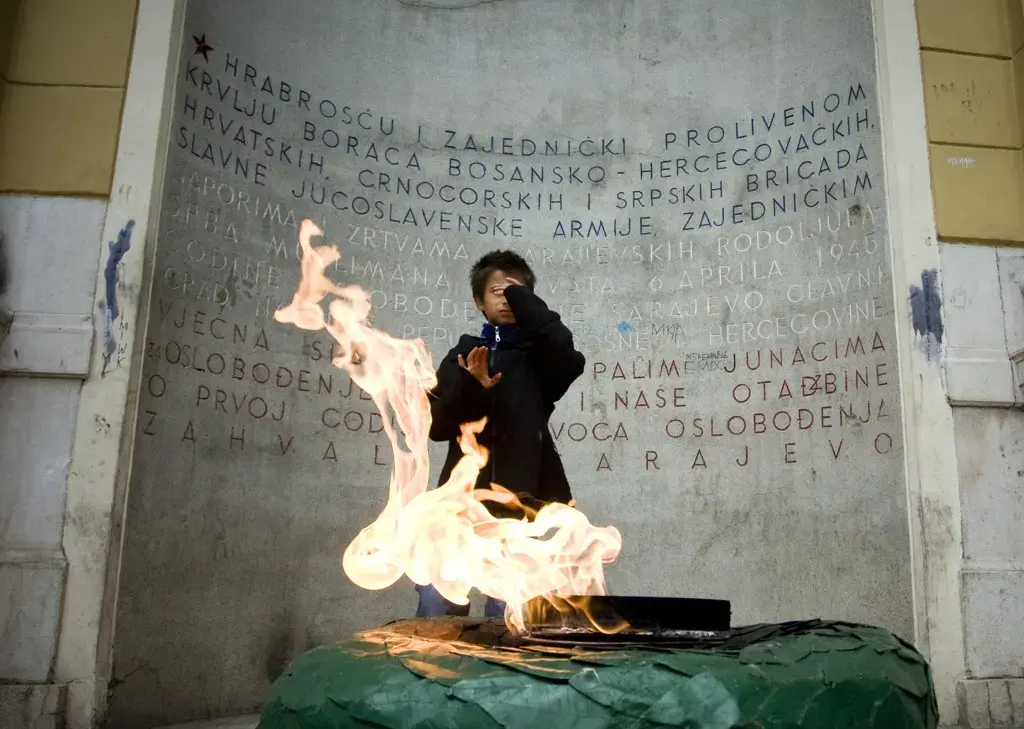
Historically speaking, the Roma population has been one of the most marginalised and discriminated groups in the Western Balkans. During the middle and new ages, Roma people were slaves to the other nations in the Balkans, with Roma slavery being officially abolished only in 1856 in Romania. Estimates say that up to half a million Roma people were killed during the Second World War by Nazi Germany and its fascist collaborators. According to data from the United States Holocaust Memorial Museum, tens of thousands of Roma in the territory of the former Yugoslavia under German occupation were sent to concentration camps such as Sajmište and Jasenovac. The Roma population in Croatia and Bosnia and Herzegovina was nearly decimated (Post-conflict Research Center, 2018, 4). A Roma child stands in front of the "Eternal Flame" in downtown Sarajevo. The plaque does not mention the casualties of Sarajevan minorities. Image by Jasmin Brutos. Bosnia, July 2008. Taken from: https://pulitzercenter.org According to the last available population census from 2013, Roma population in B&H amounts to 12,583 or 0,36% of the total population (Agency for Statistics of Bosnia and Herzegovina, 2019, 27), which makes them the biggest national minority in B&H an the fourth nationality. However, these figures do not depict the real situation for many reasons, two of them most important in the regard of this article. (1) Data collection like population census is carried out from door to door of households and this is the main obstacle since Roma people very often do not have a household in a usual sense of the word and reside in informal settlements where it is very challenging to keep track of the recorded households and their members. (2) Those who do take part in the data collection are hesitant to declare themselves as Roma due to the systemic and individual discrimination they have been experiencing for their whole lives. Instead, they either use their constitutionally guaranteed right not to declare their ethnicity/nationality or say that they are Bosniacs, Serbs or Croats. According to the report by the Institution of Human Rights Ombudsman of Bosnia and Herzegovina the estimation of the real number of Roma population in B&H is around 50.000 in total (Institution of Human Rights Ombudsman of Bosnia and Herzegovina, 2014, 23). Data shows that 71% of Roma households in Eastern Europe live in absolute poverty, a concept used to describe the living conditions in which people do not have enough resources to meet basic needs such as food, water, clothing and shelter (Singer, 1993, 218). The Institution of Human Rights Ombudsman claims that the Roma people do not exercise their human rights. Between 50% and 70% of Roma in B&H live in substandard housing, most often consisting of one room and no sanitary facilities. As far as 30% of Roma who participated in UNICEF research did not have a kitchen, while 17% lived without electricity (UNICEF, 2013, 24). When it comes to the legislative of the B&H, it is important to stress that “the Constitution of B&H does not recognize Roma and other minority groups as citizens with rights equal to those of their Bosniak, Croat, and Serb counterparts” (Post-conflict Research Center, 2018, 6-7). This gradually enables institutional discrimination and exclusion of Roma people, despite the ratification of international agreements that oblige B&H to fight against this kind of discrimination. Socio-economic status of Roma in B&H (Employment, healthcare, and education) Comprehensive, detailed and up to date data on socio-economic status of Roma in B&H is missing, but different reports and research results show that Roma in B&H is an especially vulnerable population. According to these findings, Roma people in Bosnia and Herzegovina face the highest level of discrimination in terms of employment opportunities and are almost completely absent from the workforce, which means that they have little choice but to find unregistered work in the informal sector (“grey economy”) or remain without an income. The unemployment rate among Roma is 56%, which is among the highest in the Western Balkan region and twice as high as that of non-Roma (European Commission, 2019, 55). Roma youth from Kakanj, a town 40 km northwest of Sarajevo, pose for a portrait. Image by Jasmin Brutos. Bosnia, September 2009. Taken from: https://pulitzercenter.org Main cause for the high unemployment rate among Roma is the inaccessibility of the labour market. This comes as a consequence of either being undocumented, living in informal settlements away and separated from the urban areas where the job offer rate is higher or the sheer lack of education, skills and required work experience (Civil Rights Defenders, 2018, 10-11). These deep systemic problems require intervention from the government, on all institutional levels. Qualitative analysis of the public policies which should result in a more satisfactory level of inclusion of Roma in B&H shows that the strategies only mention Roma briefly as one of the vulnerable groups and only few envisage Roma specific activities (Sarajlic, 2020). Most recent report of the European Commission points out that there is no significant progress in this area. Roma children are particularly vulnerable to the worst forms of child labour (European Commission, 2024, 41). Although Bosnia and Herzegovina’s healthcare system is formally based on principles of solidarity, inclusiveness, and accessibility, significant disparities between declared aspirations and real life persist. Unequal access to healthcare, poor service quality, financial opacity, outdated technology, and insufficient investment in new equipment remain key challenges. Vulnerable groups are often treated as homogeneous in policy documents, overlooking their diverse needs. Roma, in particular, face persistent barriers to healthcare, primarily due to a lack of personal identification documents and residence registration. Without these, they cannot access services like healthcare, social security, or education. The situation is even more challenging for those in rural areas, where healthcare services are less accessible (Sarajlic, 2020, 29-31). According to the results of the 2013 Multiple Indicator Cluster Survey, more than 30% of Roma children of school age in Bosnia and Herzegovina do not attend primary school. Additionally, less than half complete primary education on time - 46% of boys and only 34% of girls (CAHROM, 2016, 17-19). Since the end of the war in 1995, 294 Roma children have dropped out of primary school in the Federation of Bosnia and Herzegovina alone, despite support measures implemented by the relevant ministries (Civil Rights Defenders, 2018, 14). Given the importance of education, especially for children from vulnerable families, it is alarming that only 1.5% of Roma children attend preschool. In addition to the poor living conditions faced by the Roma population in Bosnia and Herzegovina, another contributing factor to high dropout rates and low preschool attendance may be the lack of recognition of Roma culture within the education system. The European Commission's 2016 Progress Report on Bosnia and Herzegovina highlights that the Roma language is not offered as an optional subject in any school in the country, nor are there alternative opportunities to learn it. Not only is education in the Roma language nonexistent, but it is also neither mentioned as a requirement nor considered a possibility in any official reports (European Commission, 2016). Roma in the Wars of the 1990s and as Refugees in Bosnia and Herzegovina As a result of the wars in the former Yugoslavia, tens of thousands of Roma from Bosnia and Herzegovina, Macedonia and Serbia were forced to leave their homes. In Bosnia and Herzegovina, hundreds of Roma were killed, but Roma were never recognised as victims of the war (Rorke, 2016). There is very little information about the exact number of Roma victims during these wars. Additionally, there is a lack of information about war crimes committed against Roma. According to a 2021 study by the Forum of Roma in Serbia, Roma over the age of 65 in Serbia testified that every twelfth elderly person had lost someone in the wars of the 1990s, and nearly the same proportion reported that a close family member had been wounded (Autonomija, 2024). Addressing war crimes is a problem that exists at the national level in BiH. War crimes researchers from non-governmental organizations have stated that Roma people were victims of all sides during the war, despite not being involved in starting the conflict. On top of that, unlike other ethnic groups, there were no paramilitary groups to protect Roma people. (DWP, 2024). To this day, only one case involving crimes against Roma has been prosecuted. The Skočić case involves members of the Simini Chetniks unit, who in July 1992 destroyed a mosque in the village of Skočić near Zvornik and killed 27 Roma civilians. They raped three Roma women, then took all the captured individuals in a truck to the village of Malešić, where the three women were singled out and taken to a house, where they were detained for several months. They were kept as slaves, raped, beaten, and forced to serve the members of the unit. One of them was 13 years old, and the other was 15. The remaining Roma men were taken to a pit in the village of Hamzići, where they were individually pulled out of the vehicle, killed with knives or firearms, and their bodies thrown into the pit. A bomb was then thrown into the pit. For these crimes, two members of the unit were sentenced to eight years, and one to five years, for the following acts: inhumane treatment, bodily harm, sexual humiliation, and rape. For example, one of the two sentenced to eight years, Zoran Djurdjević, committed the crime of raping a Bosniak woman a month before this crime, for which he was sentenced to 13 years (Nikolic, 2010). The Humanitarian Law Center points out that no one has been convicted for the murder of 27 Roma men, and that sentences for the prolonged sexual violence and rape of Roma women were significantly lighter than those for similar crimes against women of other nationalities. Based on this, the Center believes that Serbian institutions responsible for prosecuting war crimes are indifferent to investigating and prosecuting crimes against Roma during the conflicts in the former Yugoslavia. This lack of action, coupled with a clear absence of empathy for the victims, reveals a discriminatory attitude toward Roma within these institutions. (Humanitarian Law Center, 2019). The fact that cases of war crimes committed against Roma are rarely even initiated, and when they are, they result in lenient sentences, is alarming enough. Even more concerning is the fact that many accused and even convicted war criminals move freely and work across the former Yugoslavia, making the region highly unsafe for vulnerable groups such as the Roma people. As we have already noted, a large number of proceedings have yet to be initiated or are still in their early stages, and the Humanitarian Law Center has repeatedly warned about the potential dangers posed by the absence of lustration for war criminals. For example, a war criminal who was sentenced to 22 years in prison for the most serious crimes against the Muslim population was, with the approval of a primary school principal and the support of the mayor, allowed to give a lecture to children in a school in Novi Sad last year - on the topic of "heroism" (Bursać, 2023). Similarly, in the most recent elections held in Serbia, Vojislav Šešelj, who was convicted by the Hague Tribunal for hate speech, participated in the elections and is currently part of the ruling coalition in the country's capital (N1, 2023). Thus, individuals who participated in or supported war crimes remain embedded in the structures of power today. Given that Bosnia and Herzegovina has a three-member presidency, with each member representing one of the three constituent peoples, it is also worth noting that the party representing Serbs was founded by Radovan Karadžić, a convicted war criminal sentenced to life imprisonment by the International Criminal Tribunal for the former Yugoslavia (United Nations, 2016). The circumstances are even more challenging for Roma who left for foreign countries during the war and returned to Bosnia and Herzegovina afterward. The post-war political and social structures often excluded them, leaving many without access to housing, healthcare, or education. A large number of Roma lack proper identification documents, preventing them from obtaining refugee status or state assistance. Furthermore, the destruction of their homes and displacement disrupted their traditional ways of life, pushing many into extreme poverty. Reports from organizations such as the United Nations and Human Rights Watch have documented cases of discrimination against Roma in the post-war period. The United Nations even declared Roma as a Category of Persons from Bosnia and Herzegovina who are in Continued Need of International Protection after the war (UNHCR, 1999). Many Roma settlements were destroyed during the conflict, and those who attempted to return often faced hostility from local communities. For these reasons, the EU signed an agreement with Bosnia and Herzegovina, obligating the country to reintegrate all Roma who were deported from the European Union back to Bosnia and Herzegovina (Efendic & Ferré, 2023). To achieve this goal, national governments developed “reintegration policies.” However, these policies do not always take into account the specific situation of Romani returnees, particularly the discrimination and other forms of anti-Gypsyism they face. More concretely, they fail to address the lack of adequate housing and the limited access to the labor market that Roma experience due to their ethnicity. Moreover, the “reintegration policies” do not always acknowledge the different circumstances of returnees. For instance, Roma banished in the aftermath of the war in Kosovo who spent more than 15 years in Western Europe face a different situation upon return compared to Roma who left their home countries only a few years ago. Additionally, the measures outlined in these “reintegration policies” are not fully implemented, primarily due to a lack of financial resources (Civil Rights Defenders, 2018, 26). Thus, even when bound by an agreement, Bosnia and Herzegovina fails to provide adequate protection for returning Roma. The situation is significantly worse when Roma return from countries that are not EU members, as there is no regulation obligating Bosnia and Herzegovina to reintegrate them into society. Exclusion as a post-war reality The Roma population in Bosnia and Herzegovina faces deep-rooted systemic discrimination, socio-economic exclusion, and political marginalization. Despite being the largest national minority, Roma remain largely invisible in official policies, lacking fundamental rights such as access to education, employment, healthcare, and legal recognition. Their historical and contemporary suffering, including the atrocities committed against them during the wars of the 1990s, remains unacknowledged, perpetuating cycles of marginalization. The lack of institutional commitment to justice and inclusion, coupled with rising nationalist rhetoric, further exacerbates their vulnerability. Non-governmental organizations in Bosnia and Herzegovina, as well as international human rights organizations, often describe the position of Roma in BiH as a "vicious cycle." There is no doubt that Roma are excluded from society, and their integration requires a chain reaction that the government and institutions of Bosnia and Herzegovina show no willingness to initiate. Roma in Bosnia and Herzegovina are, above all, unsafe, exposed to violence that goes unpunished, and their frequent lack of access to healthcare makes them even more vulnerable. References Agency for Statistics of Bosnia and Herzegovina. (2019). Census of Population, Households and Dwellings in Bosnia and Herzegovina. Agency for Statistics of Bosnia and Herzegovina. https://www.popis.gov.ba/popis2013/doc/Knjiga2/K2_S_E.pdf Autonomija. (2024, August 31). MARKO MILOSAVLJEVIĆ: Romske žrtve jugoslovenskih ratova ostale marginalizovane i nepriznate. Portal građanske Vojvodine, Autonomija. https://autonomija.info/marko-milosavljevic-romske-zrtve-jugoslovenskih-ratova-ostale-marginalizovane-i-nepriznate/ Bursać, D. (2023, May 17). Bursać: Tišina tamo, ratni zločinac djeci drži čas! ALJAZEERA. https://balkans.aljazeera.net/opinions/2023/5/17/bursac-tisina-tamo-ratni-zlocinac-djeci-drzi-cas CAHROM. (2016). THEMATIC REPORT BY THE GROUP OF EXPERTS ON VOCATIONAL EDUCATION AND TRAINING FOR ROMA. Ad Hoc Committee of Experts on Roma and Traveller Issues. https://rm.coe.int/16806a9332 Chileva, A., Clarke-Habib, S., & Kut, G. (2021). A Manual for Trainers in the Western Balkans: Youth peer education for peacebuilding and conflict transformation. Regional Youth Cooperation Office. https://www.rycowb.org/wp-content/uploads/2022/03/Y-Peer_PB_Manual_English_web.pdf Civil Rights Defenders. (2018). The Wall of Anti-Gypsyism: Roma in Bosnia and Herzegovina. Civil Rights Defenders. https://crd.org/wp-content/uploads/2018/02/The-Wall-of-Anti-Gypsyism-–-Roma-in-Bosnia-and-Herzegovina-BiH.pdf DWP. (2024, Jun 22). Zločini nad Romima na području bivše Jugoslavije nikad nisu procesuirani. Dealing with the past. https://dwp-balkan.org/bs/zlocini-nad-romima-na-podrucju-bivse-jugoslavije-nikad-nisu-procesuirani/ Efendic, A., & Ferré, C. (2023). ASSESSMENT OF POLICY, INSTITUTIONAL AND SERVICE GAPS RELATED TO SUSTAINABLE SOCIO-ECONOMIC REINTEGRATION OF RETURNEES IN BOSNIA AND HERZEGOVINA. UNDP. https://www.undp.org/sites/g/files/zskgke326/files/2024-10/returnee_assessment_bih_report_final.pdf European Commission. (2016). Bosnia and Herzegovina 2016 Report. Europian Commission. European Commission. (2019). Commission Opinion on Bosnia and Herzegovina’s application for membership of the European Union. European Commission. https://eur-lex.europa.eu/legal-content/EN/TXT/PDF/?uri=CELEX:52019SC0222 European Commission. (2024). Bosnia and Herzegovina 2024 Report. European Commission. https://enlargement.ec.europa.eu/document/download/451db011-6779-40ea-b34b-a0eeda451746_en?filename=Bosnia%20and%20Herzegovina%20Report%202024.pdf Humanitarian Law Center. (2019, March 11). Sentences for rape of Roma women from Skočić too mild. Humanitarian Law Center. http://www.hlc-rdc.org/?p=36418&lang=de Institution of Human Rights Ombudsman of Bosnia and Herzegovina. (2014). Special report on the status of Roma in Bosnia and Herzegovina. OSCE Office for Democratic Institutions and Human Rights. https://www.osce.org/files/f/documents/2/a/110495.pdf International Criminal Tribunal for the former Yugoslavia, United Nations. (2023, September 23). THE ICTY INDICTED 161 INDIVIDUALS for serious violations of international humanitarian law committed in the territory of the former Yugoslavia. ICTY. https://www.icty.org/en/cases/key-figures-cases Kulkova, M. (2019). From Negative to Positive Peace in Western Balkans. Central European Journal of International and Security Studies, 13(3), 26-47. https://cejiss.org/images/issue_articles/2019-volume-13-issue-3/02-kulkova.pdf N1. (2023, November 1). Šešelj: Radikali u koaliciji sa SNS na beogradskim i lokalnim izborima. Danas. https://www.danas.rs/vesti/politika/seselj-radikali-u-koaliciji-sa-sns-na-beogradskim-i-lokalnim-izborima/ Nikolic, M. (2010, February 1). Prvi proces za zločine nad Romima. Radio Slobodna Evropa. https://www.slobodnaevropa.org/a/skocic_romi_zlocin/1944992.html Perviz, I. (2023, April 16). Dosije Stava: Sud BiH osudio najviše ratnih zločinaca u historiji. stav.ba. https://stav.ba/vijest/dosje-stava-sud-bih-osudio-najvise-ratnih-zlocinaca-u-historiji/ Post-conflict Research Center. (2018). Roma on the Margins. OSCE Mission to BiH. https://www.osce.org/files/f/documents/8/2/406001.pdf Rorke, B. (2016, July 20). 25 Years after Yugoslavia: Roma Exclusion (Part 1). European Roma Rights Centre. https://www.errc.org/news/25-years-after-yugoslavia-roma-exclusion-part-1 Sarajlic, A. (2020). Analysis of mainstream policies targeting Roma integration in Bosnia and Herzegovina. Regional Cooperation Council Roma Integration Action team. https://www.rcc.int/romaintegration2020/files/admin/docs/246777234263684e42c5e9739dfcbdab.pdf Singer, P. (1993). Practical ethics (2nd ed.). Cambridge University Press. Tokača, M. (2012). The Bosnian Book of the Dead. Istraživačko dokumentacioni centar. https://exyugenealogy.net/wp-content/uploads/2019/12/bosanska-knjiga-mrtvih_tom-i.pdf Trepanic, A. (2023, January 11). U BiH 172 potjernice za licima koja izbjegavaju pravdu u vezi ratnih zločina. BIRN. https://balkaninsight.com/sr/2023/01/11/u-bih-172-potjernice-za-licima-koja-izbjegavaju-pravdu-u-vezi-ratnih-zlocina/ UNHCR. (1999, May 1). Update of UNHCR's Position on Categories of Persons from Bosnia and Herzegovina who are in Continued Need of International Protection. UNHCR. https://www.unhcr.org/news/update-unhcrs-position-categories-persons-bosnia-and-herzegovina-who-are-continued-need UNICEF. (2013). Položaj Romske djece i porodica u Bosni i Hercegovini. UNICEF. https://www.unicef.org/bih/media/436/file/Položaj%20romske%20djece%20i%20porodica%20u%20Bosni%20i%20Hercegovini.pdf United Nations. (2016, March 24). Karadžić (IT-95-5/18). International Criminal Tribunal for the former Yugoslavia. https://www.icty.org/en/case/karadzic War Crimes Database. (n.d.). WAR CRIMES TRIALS DATABASE AT A GLANCE. Retrieved February 2, 2025, from https://www.warcrimesdatabase.net Zatega, E. (2025, January 28). Hiljade ratnih zločina u BiH vjerovatno nikad neće biti sudski procesuirano. Slobodna Evropa. https://www.slobodnaevropa.org/a/ratni-zlocini-bih-sudovi/33290353.html
Istorija nije počela 1999.
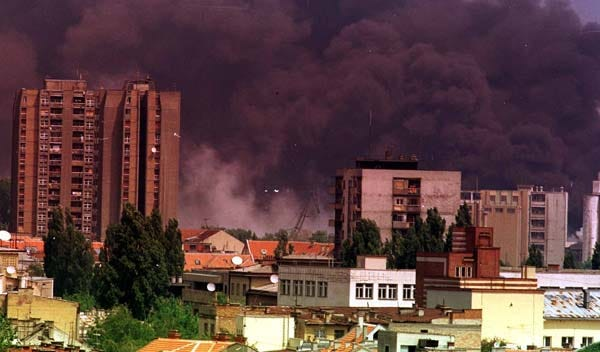
Autorka: Ana Milosavljević Na godišnjicu NATO bombardovanja Srbije — pogled na to šta javni diskurs pamti, a šta briše. Transparent ispred Skupštine Srbije koji osuđuje ubijanje dece od strane NATO-a. Svake godine 24. marta, isti narativ dominira javnim diskursom u Srbiji: više od 2.000 civila ubijenih u ilegalnoj, neosnovanoj NATO agresiji pod izgovorom spasavanja kosovskih Albanaca. Političari, mediji, i nažalost, mnogi iz takozvane levice u Srbiji fokusiraju se na vrlo konkretnu štetu koju je bombardovanje nanelo, ali to čine bez ikakvog priznanja onoga što je srpska vlast radila na Kosovu u godinama koje su prethodile bombardovanju. Razgovarala sam sa dvoje kosovskih Albanaca i jednom kosovskom Srpkinjom o njihovom tumačenju današnjeg obeležavanja, njihovim stavovima o NATO-u i nasilju srpske vlasti, i o tome šta je potrebno da bi se Srbi i Albanci ujedinili u zajedničkoj borbi. Danas političari i mediji (i režimski i opozicioni) predstavljaju događaje od pre 27 godina kao situaciju u kojoj je Srbija bila jedina žrtva. Često prikazuju stradanje Albanaca od strane Srbije kao zaveru koju je Zapad osmislio kako bi opravdao intervenciju. Činjenice govore sasvim drugačiju priču. NATO bombardovanje Novog Sada, Srbija, 1999. godine. Između 1998. i 1999. godine, srpske snage su nasilno proterale oko 850.000 Albanaca iz njihovih domova na Kosovu. Do kraja rata, ubijeno je više od 10.000 Albanaca, a hiljade su silovane ili mučene. Masovne grobnice Albanaca kasnije su pronađene na više lokacija u Srbiji, sa gotovo 1.000 tela koja su prebačena i tajno sahranjena. Mnogi se i danas vode kao nestali. Svedočenja vojnika se takođe zanemaruju u srpskom javnom diskursu. Jedan komandant tenkovske jedinice zabeležen je kako kaže: „Za sve vreme dok sam bio na Kosovu, nikada nisam video nijednog neprijateljskog vojnika i moja jedinica nijednom nije gađala vojne ciljeve. Tenkovi koji koštaju 2,5 miliona dolara korišćeni su za masakriranje albanske dece… Stid me je.“ Povodom sistematskog izostavljanja ovih istorijskih činjenica iz današnjeg diskursa, razgovarala sam sa kosovskim Albancima: sa Leom1, koja živi u Prištini, i Arberom, koji je deo kosovsko-albanske dijaspore u Londonu. Lea je primetila da način na koji se predstavlja NATO bombardovanje, bez ikakvog priznanja kroz šta su Albanci prošli, u njoj izaziva osećaj da je „izluđena“ i „dehumanizovana“. „To nije polazna tačka sa koje možemo da razgovaramo, posebno imajući u vidu da je sa naše strane uložen značajan trud da se priznaju i srpske žrtve rata“, dodaje ona. Arber je slično komentarisao da on takav narativ doživljava kao „šamar u lice“, navodeći da takav narativ odražava širi trend brisanja iskustava kroz koja su Albanci na Kosovu prolazili, ne samo tokom 1998–1999, već kroz čitav 20. vek. To brisanje nije počelo 1999. godine. Za Albance, ono predstavlja dužu istoriju represije, od jugoslovenskih kolonizacionih kampanja početkom 20. veka do institucionalne diskriminacije i nasilja tokom 1990-ih. Mapa iz 20. veka koja prikazuje jugoslovensku kolonizaciju na Kosovu i u Severnoj Makedoniji. Ovaj diskurs ne kritikuju samo Albanci. Marija Savić iz Gnjilana opisala je dominantni srpski prikaz bombardovanja kao primer „selektivnog sećanja“ koje „služi reprodukciji nacionalističkog narativa“. „Fokus je isključivo na Srbiji kao žrtvi spoljne agresije, dok ne postoji sistemsko suočavanje sa kontinuiranom represijom albanskog naroda na Kosovu: od kolonijalnih politika i nasilja početkom 20. veka, preko institucionalne diskriminacije u Jugoslaviji, do otvorenog sistema aparthejda i represije nad Albancima tokom 1990-ih“, rekla je. Upravo taj kontekst pomaže da se razume zašto su mnogi kosovski Albanci podržali NATO intervenciju, koja je okončala srpsku kontrolu nad Kosovom. Kako Lea objašnjava: „Intervencija 1999. zaustavila je rat i omogućila nam da se vratimo svojim životima, domovima, institucijama. Može biti istina da je intervencija bila kolonijalne prirode i da je izazvala civilne žrtve i druge negativne posledice, ali je takođe istina da je period nakon rata i nakon proglašenja nezavisnosti 2008. doneo mnogo nade mnogim ljudima ovde, koji su samo deceniju ranije živeli svakodnevni život u stalnom strahu.“ Arber je slično opisao svoja kontradiktorna osećanja prema NATO-u: „Iako priznajem da je NATO prisustvo na Kosovu uklonilo Srbiju, koja je bila regionalni kolonizator naše zajednice, takođe priznajem i probleme NATO-a kao upravljačkog tela… Neću do kraja života osećati dug njima, niti ću dozvoliti da budem moralno manipulisán od strane NATO-a kako bih izbrisao realnosti i problematične stvari koje rade kao institucija.“ Kosovske novine koje izveštavaju o proglašenju nezavisnosti Kosova 17. februara 2008. godine. Marija je takođe naglasila da je neophodno kritički sagledati i NATO i srpsku državu, te da te dve stvari nisu međusobno isključive. „Diskurs u Srbiji o ovom pitanju je potpuno binaran; ako kritikujete ulogu Srbije, označeni ste kao izdajnik iz nevladinog sektora, dok ako kritikujete NATO agresiju, označeni ste kao srpski nacionalista — a nijedno od toga nije tačno. NATO i srpska vlast su vrlo slični u svojim represivnim i kolonijalnim politikama.“ Izjave američkih zvaničnika dodatno potkrepljuju argument da NATO intervencija nije bila humanitarne prirode. Kako je napisao Stroub Talbot, zamenik američkog državnog sekretara od 1994. do 2001: „Otpor Jugoslavije širim trendovima političkih i ekonomskih reformi — a ne sudbina kosovskih Albanaca — najbolje objašnjava NATO rat.“ Lea i Arber su oboje izrazili spremnost da kritički preispitaju ulogu NATO-a na Kosovu — pod uslovom da se srpsko društvo suoči sa sopstvenim revizionističkim narativima. „Spremna sam da učestvujem u svakom razgovoru koji kritikuje postojanje NATO-a, ali osećam odgovornost da se prvo suočimo sa predrasudama koje nas sprečavaju da budemo ravnopravni učesnici u tim razgovorima“, rekla je Lea. Kako Arber kaže, „na osnovnom nivou, ne možeš biti u solidarnosti sa ljudima koji ne žele da imaš jednaka prava kao oni.“ Percepcija da Srbi ne žele da žive u jednakosti sa Albancima može se videti u brojnim primerima, a najskorije u upotrebi pogrdnog naziva za Albance u skandiranjima protiv predsednika Srbije Aleksandra Vučića na protestima tokom protekle godine. Marija opisuje sopstveni put suočavanja sa tim realnostima: „Bilo je potrebno mnogo odvikavanja da bih se oslobodila anti-albanskog sentimenta i nacionalizma… Verujem da su internacionalizam i klasno jedinstvo u borbi protiv kapitalizma jedini put ka oslobođenju svih balkanskih naroda.“ Nedostatak informacija o represivnoj ulozi srpske vlasti nad Albancima otežava prevazilaženje ovih predrasuda. Nakon što je video da mnogi Srbi ne znaju osnovne istorijske činjenice o Kosovu, Arber je 2020. osnovao edukativno-kulturnu platformu „Balkanism”. Balkanism teži dekonstrukciji etnonacionalističkih narativa širom regiona kroz slavljenje sličnosti i razlika, uz priznanje istorijske represije različitih zajednica. „Razumem da smo u okviru nacionalnih država svi sebe povezali sa državom kao produžetkom sebe. Ali mislim da onog trenutka kada počnemo to da dekonstruišemo i da sebe vidimo više kao nosioce kulture, istorije i identiteta koji se preklapaju, možemo da komuniciramo na mnogo humaniji način“, kaže on. Naslovna strana prvog broja časopisa „Balkanism“, objavljenog u septembru 2024. godine. Dok je Marija kroz obrazovanje i suočavanje sa sopstvenim predrasudama doživela transformaciju, smatra da se stvarna promena ne može svesti na pojedinca. „Anti-albanski sentiment i odbijanje suočavanja sa prošlošću duboko su ukorenjeni u ideološkim aparatima srpske države.“ Da bi se srpsko društvo adekvatno transformisalo, potrebno je promeniti njegove političke i ekonomske sisteme, kaže ona. Za nju to podrazumeva klasnu analizu koja prepoznaje da radnici u Srbiji i na Kosovu imaju zajedničke interese protiv vladajuće kapitalističke elite u obe zemlje. Smatra da pristup treba da bude dvostruk: Srbi bi trebalo bezuslovno da priznaju pravo Kosova na samoopredeljenje, razgrade mit o Kosovu kao „srcu Srbije“, i obnove klasnu politiku i internacionalizam. S druge strane, radnička klasa na Kosovu treba da odbaci sopstvenu vladajuću elitu i radi na proterivanju imperijalističkih sila sa svoje teritorije. Da li je takvo jedinstvo moguće — Lea i Arber se razilaze. „S obzirom na duboko nepoverenje koje postoji, toliko bola i nedostatka odgovornosti, teško je zamisliti kako se to može prevazići. I vidimo kako se Albanci tretiraju u Srbiji 2026. godine, kroz iredentističke grafite o Kosovu i anti-albanske povike, da se ništa nije promenilo. Sa naše strane takođe postoji mnogo neprijateljstva koje deluje nepremostivo. Zbog toga kako su rat i naša politička situacija oblikovali mene, deo mene se već neko vreme mentalno priprema za novi rat. I to mi daje motivaciju da se uključim u ovu diskusiju“, rekla je Lea. Za Arbera, rad na zajedničkoj budućnosti počinje građenjem stvarnih veza preko etničkih linija. „Ja sam veoma optimistična osoba. Deo moje životne prakse je izgradnja odnosa sa zajednicama sa takozvane ‘druge strane’. To je suštinski deo mog života. Vidim to kao ispravljanje istorijskih nepravdi i poništavanje kolonijalnog nasilja koje je nametnuto Kosovu, kao i uspostavljanje odnosa sa zajednicama sa kojima delimo mnogo toga istorijski i kulturno“, kaže on. U različitim kontekstima, istorija se prikazuje kao da počinje u politički pogodnom trenutku. U Palestini, zapadni mejnstrim mediji i političke elite žele da verujete da istorija počinje 7. oktobra 2023. U Srbiji, slični akteri tvrde da istorija počinje 24. marta 1999, čineći sve što je prethodilo nevažnim. Ovakav pristup instrumentalizuje nedostatak obrazovanja kako bi opravdao sistemske predrasude koje u konačnici ne služe interesima običnih ljudi. Kao što razgovori u ovom tekstu sugerišu, suočavanje sa ovim narativima zahteva više od samih informacija. Potrebna je spremnost da se sluša, da se preispituju nasleđene pretpostavke i da se suočimo sa neprijatnim istinama. Put ka trajnom miru na Balkanu ne uključuje selektivno sećanje, već se zasniva na iskrenom i objektivnom pogledu na prošlost — onom koji ostavlja prostor za sve čija su iskustva dugo bila negirana. Ovaj članak je u originalu objavljen na autorkinom blogu Substack, gde možete čitati još njenih članaka.

History Did Not Begin in 1999
Ovaj članak možeš pročitati na naškom ovde. Author: Ana Milosavljević On the anniversary of NATO’s bombing of Serbia, a look at what public discourse remembers — and what it erases. A banner outside the Serbian parliament condemning NATO’s killing of children Every year on March 24, the same narrative dominates public discourse in Serbia: over 2,000 civilians killed in an illegal, unprovoked NATO aggression under the pretext of saving Kosovar Albanians. Politicians, the media, and unfortunately, many part of the so-called left in Serbia focus on the very real damage that the bombing inflicted, but do so without any recognition of what the Serbian state was doing in Kosovo in the years preceding the bombing. I spoke with two Albanian Kosovars and one Kosovar Serb about their interpretation of today’s commemoration, their thoughts on NATO and Serbian state violence, and what it will take for Serbs and Albanians to unite in a common struggle. Today, politicians and media outlets (both regime and opposition) frame the events of 27 years ago as one wherein Serbia was the sole victim. They frequently convey Albanian suffering at the hands of the Serbian state as a conspiracy conjured up by the West in order to justify intervention. The facts tell a very different story. NATO bombing of Novi Sad, Serbia in 1999 Between 1998 and 1999, Serbian forces displaced around 850,000 Albanians from their homes in Kosovo. By the end of the war, over 10,000 Albanians were killed and thousands were raped or tortured. Mass graves of Albanians were later found in multiple locations in Serbia, with nearly 1,000 bodies transferred and buried in secret. Many people are still missing to this day. Soldier testimonies are similarly disregarded in Serbian public discourse. One Serbian commander of a tank unit was recorded stating, “For the entire time I was in Kosovo, I never saw a single enemy soldier and my unit was never once involved in firing at military targets. The tanks which cost $2.5 million each were used to slaughter Albanian children… I am ashamed.” Regarding the systematic exclusion of these historical realities from today’s discourse, I spoke with Kosovar Albanians: Lea1, living in Prishtina, and Arbër, part of the Kosovar Albanian diaspora in London. Lea remarked that the presentation of the NATO bombing without any recognition of the suffering Albanians went through leaves her feeling “gaslit” and “dehumanized.” “It’s not a starting point that we can engage with…Because on our side there has also been a lot of work done to recognize victims of the war who were Serbs” she adds. Arbër similarly commented that “it feels like a slap in the face in many ways,” saying that such a narrative reflects a broader trend of erasure of the experiences Albanians in Kosovo have faced, not only during 1998–1999, but throughout the 20th century. This erasure did not begin in 1999. For Albanians, it reflects a longer history of repression, from early 20th century Yugoslav colonization campaigns to institutional discrimination and violence in the 1990s. A map from the 20th century that reads “Post-war colonization in southern Serbia” and includes Kosovo and North Macedonia. It’s not only Albanians who criticize this discourse. Marija Savić, from Gnjilana, Kosovo described the Serbian mainstream portrayal of the bombing as one of “selective memory” which “serves to reproduce a nationalist narrative.” “The focus is exclusively on Serbia as a victim of external aggression, while there is no systemic reckoning with the continuous repression of the Albanian people in Kosovo: from colonial policies and violence in the early 20th century, through institutional discrimination in Yugoslavia, to the open system of apartheid and repression against Albanians during the 1990s,” she said. It is precisely that context which helps explain why many Kosovar Albanians welcomed NATO’s intervention, which brought an end to Serbian rule in Kosovo. As Lea explains: “The intervention in 1999 stopped the war and enabled us to go back to our lives, homes, institutions. It can be true that the intervention was colonial in nature and caused civilian casualties and had other negative effects, and also that the period after the war and after the declaration of independence in 2008 brought a lot of hope to a lot of people here, who just a decade before were living their everyday lives in constant fear.” Arbër similarly described his own contradictory feelings about NATO: “Although I acknowledge NATO’s presence in Kosovo removed Serbia, which was a regional colonizer of us as a community, I also acknowledge the problems of NATO as a governing body as well… I’m not going to feel indebted for the rest of my life, and I’m not going to be morally manipulated by NATO as a governing body to erase the realities and the problematic things that they do as an institution.” Newspapers in Kosovo reporting the declaration of Kosovo Independence on February 17, 2008. Marija similarly stressed that it was necessary to critically assess both NATO and the Serbian state and that the two are not mutually exclusive. “The discourse in Serbia on this issue is entirely binary; if you criticize the role of the Serbian state, you are labeled an NGO traitor, while if you criticize NATO aggression, you are labeled a Serbian nationalist - yet neither of these is true. NATO and the Serbian state are very similar in their repressive and colonial policies.” Statements by US officials reinforce the argument that NATO’s intervention was not humanitarian in nature. As Strobe Talbott, US Deputy Secretary of State from 1994 to 2001, wrote: “It was Yugoslavia’s resistance to the broader trends of political and economic reform — not the plight of Kosovar Albanians — that best explains NATO’s war.” Lea and Arbër both expressed a willingness to critically examine NATO’s role in Kosovo — on the condition that Serbian society confronts its own revisionist narratives. “I’m open to participating in any conversation that critiques the existence of NATO, but I feel a responsibility to first contend with the prejudices that prevent us from being equal participants in such conversations,” Lea said. As Arbër puts it, “on a fundamental basis, you can’t be in solidarity with people who don’t want you to have the same level of equality that they do.” The perception that Serbs do not want to live in equality with Albanians can be seen in many instances, most recently with the use of the pejorative word for Albanian used in chants against Serbian President Vučić at anti-government protests in the past year. Marija describes her own journey in confronting these realities: “It took a great deal of unlearning to free myself from anti-Albanian sentiment and nationalism… I believe that internationalism and class unity in the struggle against capitalism are the only path to the liberation of all Balkan peoples.” A lack of information about the oppressive role of the Serbian state against Albanians makes overcoming such biases difficult. After witnessing Serb after Serb not know basic historical facts about Kosovo, Arbër founded the educational and cultural platform Balkanism in 2020. Balkanism strives to deconstruct ethno-nationalist narratives from across the region through celebrating similarities and differences, while acknowledging historical oppression of various communities. “I understand that within a nation-state framework, all of us have associated ourselves with our state as an extension of ourselves. But I feel like the moment we start deconstructing that and see ourselves more as vessels of culture, history, and identity that overlap, we’re able to communicate in a way that feels much more human-centered” he says. Cover of Balkanism magazine’s first issue, published in September 2024. While Marija transformed through education and a reckoning of her own anti-Albanian biases, she believes that meaningful transformation cannot be reduced to the individual. “Anti-Albanian sentiment and the refusal to confront the past are deeply rooted in the ideological apparatuses of the Serbian state.” To adequately transform Serbian society, its political and economic systems must be changed, she says. For her, that necessitates a class-based analysis which sees that workers in Serbia and Kosovo have common interests against the ruling capitalist elite in both countries. She believes the approach should be two-fold: Serbians should unconditionally recognize Kosovo’s right to self-determination, dismantle the myth of Kosovo as the “heart of Serbia”, and rebuild class politics and internationalism. On the other end, the working class in Kosovo should reject their own ruling elite and work to expel imperialist forces from its territory, she says. Whether such unity is possible, Lea and Arbër are split. “Considering the deep distrust that exists, and so much pain and lack of accountability, it is hard to imagine how that can be overcome. And we see with how Albanians are being treated in Serbia in 2026, the irredentist Kosovo graffiti and anti-Albanian chants, that nothing has changed. On our side there is a lot of what feels like insurmountable enmity as well. Due to how the war and our political situation shaped me, there’s a part of me that for a while now has been mentally preparing for another war. And that is what gives me urgency to get involved with this conversation” Lea revealed. For Arbër, working towards a common future begins with forging genuine connections across ethnic lines. “I’m a very hopeful individual. A part of my own practice in my life is all about forging relations with communities from supposedly “the other side.” This has been a core aspect of my life and my practice. I see it as righting historical wrongs and undoing the colonial violence that was imposed on Kosovo, and establishing relations with communities that we share so much with historically and culturally,” he said. In various contexts, history is presented as beginning at a politically convenient moment. In Palestine, Western mainstream media and political elites would have you believe history began on October 7, 2023. In Serbia, a similar establishment class claims history began on March 24, 1999, rendering what came before irrelevant. This approach weaponizes a lack of education to justify systemic prejudices that ultimately do not serve the interests of ordinary people. As the conversations in this piece suggest, confronting these narratives requires more than information alone. It demands a willingness to listen, to question inherited assumptions, and to engage with uncomfortable truths. The path towards lasting peace in the Balkans does not include selective memory, but is instead based on an honest, objective look at the past: one which makes space for all those whose experiences have long been denied. This article was originally published on author's Substack, where more of her critical writing is available.
The Transformation of Josip Broz Tito’s Image in Ukrainian Soviet, Émigré, and Nazi Occupation Press
Author: Daryna Lynnyk This article is an attempt to present the image of Josip Broz Tito not in a one-dimensional interpretation, but in a broader context - in addition to Soviet sources, the materials of periodicals published under German occupation, as well as in emigration publications in Germany and Austria, are also analysed here. At the same time, due to limited access to the contemporary Ukrainian press, which is independent of ideological pressure, most of the research sources belong to the opposing propaganda poles of the Soviet and Nazi regimes. The image of Tito in these materials often serves as an ideological marker, which is used to construct ideas about ‘friends’ and ‘foes’ in the context of international politics and domestic legitimation of regimes. Picture taken from the website https://gradskiportal018.rs The figure of Josip Broz Tito vividly illustrates how the media can artificially construct public opinion under the pressure of ideological directives of totalitarian regimes, flexibly adapting narratives to changes in the political situation. The 71 sources analysed from Ukrainian periodicals allow us to trace a clear change in the rhetoric about the Yugoslav leader depending on the time, type of media and their political control. Given the specifics of political changes and the transformation of propaganda strategies, media coverage of Josip Broz Tito in the Ukrainian press is conditionally divided into four key periods: 1. 1943-1945 – Nazi German-controlled media and Tito’s “gangs” 2. 1945-1947 – Postwar glorification in the Soviet press. 3. 1948-1952 – Ideological rift between Stalin and Tito. 4. 1956-1973 – Rehabilitation of the image and return to moderate approval. This periodisation demonstrates the direct dependence of rhetorical changes in the media on the foreign policy and ideological course of the regimes that controlled the contemporary press in Ukraine. Nazi German-controlled media and Tito’s “gangs” The period of 1943-1945 is represented by 21 publications, exclusively in the media that operated under the supervision of the Nazi authorities. The largest number of references falls on 1944, the period of active hostilities between the Red Army, Bulgarian troops and the Yugoslav People's Liberation Army led by Tito and the German coalition. In these publications, the image of Tito is presented exclusively in a negative light: he is called a ‘Bolshevik bandit leader’, and the official title of Marshal of the Federal People's Republic of Yugoslavia is either put in quotation marks or accompanied by the designation ‘so-called’, which was intended to delegitimise his political status and separate him from representing the interests of the Balkan peoples1. One of the leading strategies of German propaganda was to portray Tito as a direct leader of Soviet policy, an “Agent” prepared and inspired by Moscow. However, at the same time, they do not consider him to be their puppet, which indirectly indicates his autonomy. The publication ‘Bolshevik Work in the Balkans: Who is the Communist “Marshal” Tito?’ (‘Volya Pokuttya’) notes that his units were ‘organised on the Bolshevik model’ and that he ‘received special training in Moscow’. Interestingly, they were not lying there – Tito’s army structure was heavily inspired by the Soviet, to the extent that Stalin even feared that this could damage his relations with the Western allies2. Stalin, according to the same publication, viewed Tito as “the front line of Bolshevism in Europe”3. This indicates Tito's ideological dependence on the USSR, his subordination to the Soviet secret services, and his desire to imitate the Soviet model. This characterisation shaped the image of Tito as an immediate threat, an ideological enemy, while singling him out, rather than the Balkan peoples, as the main object of confrontation. German publications systematically shaped the idea of the power of the Wehrmacht, which inflicted devastating blows on Tito's “communist gangs”4. At the same time, the Nazi press clearly demonstrated a tendency to devalue Soviet forces: communist units were labelled as "gangs" and their activities were presented as chaotic and illegitimate. In contrast, the American and British military are seen as equal adversaries, which underscores the Nazi propaganda's attempts not only to humiliate the communists but also to question the legitimacy of Western support for the Yugoslav resistance movement. Another element of the propaganda was the emphasis on the internal discord among Tito's “bandits”, the mass defections of Serbs and Italians to the German army, which was presented as supposed proof of the moral superiority of the Third Reich5. This representation was intended not only to delegitimise Tito, but also to contrast the "chaos" of the communist movement with the "order" of German control, reinforcing the message of Germans as civilizational liberators. To reinforce the dehumanisation of the Bolshevik forces, statistics were provided on the numerous crimes committed by the "communist robber gang" led by “comrade” Tito against the civilian population - rape, looting of churches, destruction of houses, murder of children, women and the elderly - which he had committed in the ‘Moscow style’ after receiving training there. Such claims were supported by geopolitical pretexts: according to the authors, these brutal methods were part of a broader Soviet strategy to reach the shores of the Adriatic Sea, implemented by Stalin's "agent" Tito6. “Tito as a conspiracy against the Serbs” A separate propaganda narrative was formed around Tito's ethnicity, a Croat who was portrayed as a fierce opponent of the Serbs. In this discourse, the Serbian people were portrayed as victims of a conspiracy of international forces: it was claimed that “Churchill and Eden betrayed the former Yugoslavia, its government and king”, and the Serbs were credited with a “historic mission” – the destruction of Bolshevism. The Tito government, according to the rhetoric of the publications, was portrayed as a "tool of the red Kremlin" and a "bandit provocation" to which there could be only one response - "the concentration of all Serbian national elements under the banner of Nedić"7. In this context, British policy was condemned as cynical and treacherous: England had first forced Serbs to "shed blood for her benefit", and when General Mihajlović, the leader of the Chetniks, the monarchist partisan resistance movement in Yugoslavia, became unnecessary to her, he was "thrown away like a squeezed citrine" in favour of a new favourite, Tito, a leader "alien to the Serbs"8. This is confirmed by a quote from Captain Jovovic used in another article: "We want to fight against our gravediggers, together with the brave German armed forces, which are not replaced by any territorial aspirations in our country"9. In this way, Tito and his allies are presented as an existential threat to the Serbian nation, which is instead heroised and given a historical role. As an alternative to Tito's "treacherous" course, the support of the pro-regime Serbian leader Milan Nedić, the head of Serbia's puppet government during the Nazi occupation, is offered. Overall, it can be argued that the Ukrainian media, controlled by the Nazi authorities, systematically denied the legitimacy of Josip Broz Tito as the head of the newly created Yugoslav state. The publications formed a stable image of Tito as a follower of Bolshevik ideology and an instrument of Soviet expansion (or at least its “agent”). Much attention was paid to attempts to oppose him to the Serbian people, presenting the latter as a victim of a conspiracy between the Communists and the Western allies. Instead, the figure of Milan Nedić, the head of the pro-regime government, was glorified as the only nationally acceptable alternative. Postwar glorification in the Soviet press. After the victory of the anti-Hitler coalition forces and the consolidation of Soviet influence in Eastern Europe, the media space on the territory of Ukraine came under the control of the USSR. The analysed corpus of materials for this period revealed only 10 publications, nine of which belong to the Soviet "Literary Gazette" [Літературна газета] and one to the émigré publication "Our Life" [Наше життя], published in West Germany. The rhetoric of heroising Tito and demonstrating him as an equal ally of Stalin became characteristic of the Soviet discourse. Thus, in an article written by the Soviet actor, People's Artist of the USSR Yuri Shumsky, the author shares his impressions of a trip to the Balkans, where, according to him, he had long wanted to go. He describes a Victory Day celebration in Yugoslavia, where the atmosphere was permeated with slogans: "Long live Marshal Stalin!", "Long live Marshal Tito!", "Stalin - Tito!", "Moscow - Belgrade!". This emotional palette is aimed at reinforcing the image of both leaders as equal heroes of the liberation struggle, united by a political union. Further, the text gives preference to the depiction of the Yugoslav partisans as heroic fighters against the Nazi occupiers. Describing the monuments, Shumsky emphasises that “from this impregnable fortress, the heroic Yugoslav partisans drove out their enemies — the German invaders.” Thus, the landscapes of Yugoslavia are intertwined with a pathos story of a common victory10. The style of this publication is journalistic – a personal, emotionally coloured story written by a popular actor inspires trust within the reader. Vivid epithets, emotional impressions, and images of festive Yugoslavia are intertwined with political slogans that gently but persistently impose the official Soviet political course through the image of culture, brotherhood, and victory. In another publication published in the “Literary Gazette”, Bulgarian literary critic Lyudmil Stoyanov provides an overview of modern Bulgarian literature, closely linking its development to the collapse of “fascism” in the region. He notes: “In the first days after the overthrow of fascism, poets came up with many poems that glorified the exploits of the Red Army, the wisdom of Stalin, the struggle of the Bulgarian partisans and the people’s army, the heroism of Marshal Tito’s troops, and the brotherhood of Slavic peoples.” Such a hierarchically constructed list of images—from the Red Army to Tito—points to the central motifs of officially approved post-war poetry. The author not only notes their presence but also approves of them, effectively legitimising the cultural orientation toward the Soviet narrative. Thus, Marshal Tito organically fits into the system of ideological symbols, as part of the liberation struggle and Slavic unity, and the article itself performs the function of cultural confirmation of this new political reality11. Ally of Lenin and Stalin The close connection between the Soviet leadership and the Yugoslav political elite is also evidenced by the article dedicated to the funeral of Mikhail Kalinin – one of the leading figures of the October Revolution and the Soviet Union. From the very first lines, Kalinin appears as a "faithful ally of Lenin and Stalin", which partially levels his own personality as a prominent politician, and instead strengthens the cult of the main Soviet leaders. At the same time, the culminating moment of the article is the description of the appearance of “Marshal Josip Broz Tito, accompanied by members of the Yugoslav government delegation,” who lays a wreath “from the fraternal Yugoslav people, in whose hearts gratitude will forever live to one of the leaders of the Soviet state for his assistance in liberating Yugoslavia from the yoke of the fascist invaders.” Such a gesture symbolises not only official political loyalty, but also demonstrates Yugoslavia’s ideological dependence on the USSR in the post-war period. Formal expressions of gratitude consolidate a hierarchical model of relations, where the USSR appears as a liberator and mentor, and Yugoslavia as a dependent follower12. The analysis of the materials also indicates the active development of cultural ties between the Soviet Union and Yugoslavia in the post-war period. The publications cover congresses, official meetings, and literary evenings during which creative works with a clear ideological undertone were exchanged. In particular, the report on the meeting with Yugoslav writers in Kyiv emphasizes the common historical struggles of the two peoples and the role of literature as a means of ideological consolidation: “The revolutionary democratic literature of Yugoslavia, like the literature of the Soviet Union, was closely connected with the struggle of its people against a fierce enemy.” At the meeting, Pavlo Tychyna read a translation of an excerpt from “Songs about the Life of Comrade Tito,” emphasising the unity of the experience of both countries: “We fought together and won together. And nothing can break our friendship, which was born in the fight against a mortal enemy.” The material pays special attention to the role of Ukrainian intellectuals, who, through translations and literary initiatives, contributed to the establishment of cultural dialogue. At the same time, the emphasis is placed on the heroization of the common past, emphasizing the “great role of the Russian people in the development of the culture of other Slavic peoples” and on the figure of Tito as a leading leader, thanks to whom, according to the narrative, these ties became possible13. A striking example of the ideological content of cultural interaction between the USSR and Yugoslavia is the publication of Maksym Rylsky’s translation of the poem by the Yugoslav poet Vladimir Nazor “Friend Tito”. In the poetic text, Tito appears as a multifaceted image — a symbol of national revival, a leader who unites disparate forces, cares for the people and embodies the features of an ideal leader. Thus, the metaphor of revival — “fire under the ashes” — indicates renewal after the destruction of the war, and the image of a river with many streams symbolises the unity of the peoples under his leadership. Tito is depicted as someone who provides prosperity—“sows flour,” “kneades new bread”—and at the same time has authority and power—“stern as a lion,” but with a “father’s heart.” The poem also emphasizes trust in the leader even in an uncertain future: Tito is depicted as a “gift of great fate” for the people14. Another example is Rodovan Zogovich’s poem “Song about the Life of Comrade Tito,” published on the front page and translated by Pavlo Tychyna. It uses the rhetoric of total identification of the leader with the people: “Tito is all of us… And he is a multitude of us.” Such poetics of merging the individual with the collective is characteristic of totalitarian discourses, where the leader personifies the masses. The lines "He was born into the world from the first branch of the CP" directly and inextricably link Tito to the Communist Party of Yugoslavia15. Both works not only testify to the formation of a cult of Tito’s personality in the Yugoslav cultural space, but also demonstrate his full approval by the official Soviet line. Their appearance in the Soviet press, in particular in translations of recognised Ukrainian poets such as Rylsky and Tychyna, testifies to the institutional legitimisation of the positive image of Tito as an “allied and fraternal leader”. Criticism of Tito’s regime The only mention of Josip Broz Tito found in the émigré press, namely in the newspaper “Nashe Zhyttia”, published in Augsburg (West Germany), is a publication in which Tito is called “marshal” without quotation marks. This form of mention indicates a certain recognition of his official status as the leader of Yugoslavia. At the same time, the general tone of the material is critical. The author of the text draws attention to Tito's silence in public speeches about the role of the international humanitarian organisation United Nations Relief and Rehabilitation Administration (UNRRA) in the post-war reconstruction of the country, in particular, noting that without its help, "half of the people in Yugoslavia would have had to die of hunger". In addition, an ironic attitude is expressed towards the implementation of the Soviet model of the five-year plan ("five-year plan") in Yugoslavia, which is depicted as an ineffective instrument for "making the people happy" according to the model of Moscow's centralised policy16. Thus,the publication combines formal recognition of Tito's political status with criticism of his regime, in particular for concealing information about foreign aid and adopting Soviet models of governance. As a result, in the Soviet public discourse of 1945–1947, Josip Broz Tito appears as a heroic ally, equal to Stalin in the fight against "fascism". His activities are systematically portrayed as the embodiment of brotherhood, revolutionary devotion and care for the people, which ideologically brings Yugoslavia closer to the USSR. Through artistic images, journalistic materials and translations of Yugoslav poets, a cult of Tito's personality is gradually formed in the Soviet media, approved and supported by the official line. Thus, Yugoslavia is presented not only as a political, but also as a cultural and ideological ally, and its leader is an exemplary leader, legitimised by the Soviet state and sphere. Ideological rift between Stalin and Tito While reading Soviet publications from 1945 to 1947, it would be hard to imagine that by June 1948, the Cominform would officiallycondemn Yugoslavia for “ideological deviations,” and a sharp political conflict would erupt between Josip Broz Tito and Joseph Stalin. This sudden change in relations, which ended in an effective break, can be explained by Tito’s desire to pursue a more independent domestic and foreign policy, particularly through active participation in the Greek Civil War, the initiative to create a federation with Bulgaria, and increased influence over Albania. These actions contradicted the strategic interests of the USSR and undermined Moscow’s monopoly on setting the political course in the socialist bloc17. Among 35 analysed publications from 1945 to 1952, about 70% were printed in the émigré newspaper “Promin” (Salzburg, Austria), while the remaining 30% appeared in the “Literary Gazette”. Notably, in 1948–1949, the period immediately after the split, the “Literary Gazette” only featured one article mentioning Tito. In contrast, between 1950 and 1952, the number of such mentions increased, suggesting a shift in the Soviet media’s approach to covering the topic, although the exact reasons remain open to interpretation. In early June 1948, the “Promin” briefly reported on political purges conducted by Tito, comparing them to Stalinist purges18. This was based on the dismissal and arrest of top Yugoslav ministers, close to Tito and comrades, during the partisan war19. This suggests that Tito employed the Soviet model of political cleansing, but did so to break away from USSR influence and establish sovereign control over his state. Comparing Yugoslavia and Ukraine In the context of the political split between Stalin and Tito, one article drew a comparison between the situation in Yugoslavia and that in Ukraine, stating: “The accusations made by Moscow against Tito are the same as those once made against Ukrainian communists.” This points to shared repressive mechanisms used by Moscow against independent-minded communist leaders. Despite a certain sympathy for these “victims,” the author remains critical of Tito and his Ukrainian counterparts, calling them “lackeys” who failed to please their Moscow patrons: “Thus Tito stands as a bankrupt before his people… and a bankrupt before his master.” Still, the author supports Tito’s opposition to broader Russian imperialism, stating: “Moscow, as the centre of imperialism and as the embodiment of brutality and cynicism, must be destroyed.” However, this support does not translate into respect for Tito himself, who, according to the author, remained a follower of Stalin and never fully broke from Soviet influence20. Another article takes a more sympathetic tone toward Tito, drawing historical parallels between his resistance to Soviet pressure and the efforts of Ukrainian revolutionaries in the 1920s—such as Mykola Skrypnyk, Mykola Khvylovy, and Oleksandr Shumsky—to establish autonomous Ukrainian policies within the USSR. This comparison emphasises the continuity of the struggle for national liberation and highlights the stronger position Tito enjoys. Unlike the Ukrainian national communists, whose influence was limited to intellectuals and students, Tito, the article notes, had much broader support: “Tito enjoys far more advantageous and solid positions compared to Skrypnyk and Khvylovy… He has not only the whole nation behind him but also a fully armed army—even his own NKVD.” The author thus places hope in Tito as a potential symbol of resistance to imperial pressure, where Ukrainian predecessors failed21. Assumptions about the world war The “Promin” also underscores the significance of the Moscow-Yugoslavia conflict, calling it “the first serious defeat of Moscow in the Balkans” and “the first major crack in Moscow’s offensive front in Europe.” The article highlights that Tito violated the only concrete “principle” — obedience to Moscow — thereby openly defying Kremlin control. In this context, “the foundation of Moscow’s power… is terror,” but “Tito has proven that… Moscow’s terror can be resisted.” Therefore, Tito not only defied the Kremlin’s line but challenged the effectiveness of Stalinist terror as the primary tool of control. The article concludes with a broader implication: “The defeat of Moscow’s expansionism in the Balkans… will reduce the power of terror along the entire front.” The author sees the Yugoslav conflict as the beginning of the weakening of Stalin’s dominance model in other occupied countries22. In another article featuring commentary by Randolph Churchill, Winston Churchill’s only son, the conflict between Tito and Stalin is seen as a potential precursor to a large-scale armed confrontation, possibly even a world war. The author presents a grim scenario: should the USSR invade Yugoslavia, Western nations—due to alliance obligations—would have to intervene on Tito’s side, potentially sparking a third world war. A comparison of the Kremlin’s tactics to those of Nazi Germany intensifies the threat: “Moscow will follow Hitler’s pre-war strategy.” The article emphasises how swiftly Stalin could overtake Yugoslavia, stating that the Kremlin “needs an easy and cheap victory.” These statements aim to instil a sense of impending catastrophe, fueled by the belief that “Stalin and his criminal gang” could replicate the horrors of World War II. The use of historical analogies, appeals to authority (Churchill), and the framing of a civilized West against an aggressive East helps shape the article’s political message: the conflict with Tito is not local, but a sign of a wider imperialist threat from the USSR23. A review of a Daily Mail article titled Discord in the Moscow Family shows how the Western press used irony and strategic quotations from communist sources to dismantle the image of a united Soviet front — a tactic that the Ukrainian émigré community leveraged to reinforce its anti-Soviet narrative. The article opens with a telling statement: “The Soviet Union now has trouble not only on the external front but also internally,” portraying the USSR as a crumbling hegemon. Criticism is particularly sharp in examples from allied states: Finnish communists fall out of favour after electoral losses; Polish leader Bolesław Bierut is depicted as a puppet of Moscow’s agents; and Hungarian police are depicted as a terror instrument against “enemies of the people.” In this context, though Tito is not mentioned directly, he serves as a shadow hero of the discourse. The paper implies that Yugoslavia’s independence became a chilling precedent for the Kremlin: “Intended… for those party cadres tempted by Tito’s heresy.” This reflects the Soviet perception of any alternative political line as an existential threat. Thus, Tito becomes a symbol of political courage and independence — a challenge to the centre — used as a “negative example” to discipline other socialist bloc countries24. Further interpretations of the Belgrade-Moscow split Further confirmation comes in another article analysing Soviet-Chinese relations, where the author poses a striking question: could Mao be “another Tito”? This short yet conceptually significant question shows that by 1949, Tito had become a symbol of the “independent communist”— a leader able to challenge Moscow not from the West, but from within the communist camp. Thus, Tito and Yugoslavia acquired new global meaning as markers of political autonomy inside the “socialist bloc”. In Soviet literary journalism of the USSR-Yugoslavia conflict period, the image of Josip Broz Tito was consistently demonised using extremely aggressive language. In the cited texts, he is depicted as an “executioner” and leader of a “fascist agency” working for the “Anglo-American imperialists.” This rhetoric presents Tito as a traitor to socialism and a servant of Western capitalism, aligned with the “imperialist” anti-Soviet front. This narrative became particularly prominent in 1949, when Albania, under Enver Hoxha, aligned closely with the USSR as its main strategic ally. After the 1948 split between Moscow and Belgrade, Tito was perceived by the Albanian leadership as the embodiment of “betrayal” within the socialist camp. Yugoslavia, which previously had significant influence over Albania, particularly through military and economic aid, came to be seen as the main threat to Albania’s independence and ideological purity. That same year, Albania launched major political purges, including the arrest and execution of Koçi Xoxe, a former deputy premier accused of links to Yugoslavia. His name appears in quotes as a symbol of a conspiracy organised by Tito to destabilise the country. The article’s conclusion about the failure of the “black schemes” of Yugoslav agents serves not only an ideological purpose but also helps consolidate the internal political legitimacy of Hoxha’s regime25. Despite its economic weakness, Albania sought to present itself as an independent and Kremlin-loyal state in a newly divided communist world. Thus, the analysed text demonstrates how publicist writing of the era became a tool for ideological mobilisation, anti-Yugoslav propaganda, and an affirmation of loyalty to the “correct” Soviet line. In another article, while glorifying the Stalinist army, Tito is described as a “mercenary of American intelligence,” a direct accusation of betrayal and collaboration with the Soviet bloc’s enemies. This branding likens him to spies and hostile agents, emphasising distrust and hostility. Tito’s actions are portrayed as a string of failures—“suffering failure after failure”—creating the image of a weak and unsuccessful opponent, unable to stop the socialist movement. The harsh label “cutthroats” used for Tito’s supporters emphasises their violent and negative portrayal in Soviet propaganda. The overall tone is purely propagandistic, casting Tito as an enemy of peace and progress, a “traitor” and “mercenary” of Western imperialists. Meanwhile, the Soviet Army is depicted as a force of peace, justice, and protector of the working class’s interests, positioning itself as the moral and political counterpoint to the enemy figure of Tito26. Tito as agent to the West In an important article by Ivan Statyvko titled “Tito’s Clique — The Arch-Enemy of Humanity”, Tito’s achievements in fighting the Nazis, which were once described by the Soviet media as “heroic” are either ignored or outright denied. The author accuses him of collaborating with Anglo-American forces, which Soviet propaganda claimed sought to occupy the Balkans, and asserts that Tito actively assisted in that plan. Particular emphasis is placed on his hostility toward the Red Army, which had “liberated” Yugoslavia, used as evidence of his disloyalty to the Soviet bloc: “…Even during the war, Tito appealed to the American-English cannibals for help in fighting the national liberation movement.” Tito is thus portrayed as a vassal and agent of the West—a classic propaganda tactic used to justify Soviet confrontation with Yugoslavia. The use of the term “Tito’s gangs,” which was widely used by Nazi-controlled media during WWII, adds further negative and demoralising connotations and deliberately associates Tito with terrorist and criminal elements27. This reinforces Tito’s image as an enemy of the people and ideological adversary of the socialist ideal, which, according to Soviet propaganda, was best realised by the USSR. Thus, in the media of the Ukrainian émigré community in Austria, the image of Tito was initially received—albeit with some scepticism—with hope that he could emerge as an independent, ideologically consistent "only orthodox Marxist"28, capable of standing up to "Russian imperialism" in a broad sense. This image resonated with the legacy of Ukrainian revolutionaries and fighters who had unsuccessfully attempted to challenge Moscow’s dominance. Even in materials where Yugoslavia was not the direct subject of analysis, Tito appeared as a symbol of defiance against Stalinist orthodoxy and a possible form of independence that continued to threaten the “Soviet family” beyond the Balkans. This gave rise to analogies like the “Polish Tito”29 or the “Asian Tito”30, representing deviations from the Soviet political line and dependency. In response, Soviet newspapers aggressively and persistently labelled Tito with emotionally charged accusations of "betrayal," revising and discrediting the heroic narrative of their joint struggle against fascism. His image was transformed into that of a capitalist “imperialist” agent, a view reinforced by comments from Soviet military and party officials, which lent credibility and amplified the propagandistic narrative. 1956–1973 – Rehabilitation of the Image and Return to Moderate Approval. From 1952 to 1956, based on available sources, there is an almost complete absence of mentions of Tito in the Soviet Literary Gazette. This can be explained by several major political transformations in the USSR that began after Stalin died in 1953. Nikita Khrushchev’s rise to power marked a significant policy shift, including the launch of the de-Stalinization process in 1956, which was accompanied by the "Thaw" and the rehabilitation of Stalin’s victims. As noted by scholar Svetozar Rajak31, for Khrushchev, normalising relations with Yugoslavia was a vital component of successfully implementing de-Stalinization, since without reestablishing dialogue with Tito, the process could not be considered complete or coherent. With the start of the "Thaw," mentions of Tito were scarce and mostly limited to events such as his official visit to Moscow or friendly football matches with Yugoslav teams. At the same time, there were no public statements recognising past slander or acknowledging the mistakes of the Stalinist-era campaign against Tito. Instead, articles began to appear that gradually restored a positive image of Tito as an "outstanding leader of the Yugoslav people", "one of the leading figures in the international workers’ movement", and an honoured guest — especially since his 1956 visit to Moscow marked the beginning of reconciliation between the two socialist countries32. An example of a notable shift toward positive rhetoric about Tito in the Soviet press is a 1962 publication in the Literary Gazette. The article describes Tito’s official visit to Kyiv, emphasising his status as a "respected and welcome guest." The joint presence of Tito and Chairman of the Soviet Council of Ministers Nikita Khrushchev highlighted the parity of the two leaders and the high diplomatic level of relations between their countries. Of particular symbolic importance is the joint tribute paid to the memory of those fallen in World War II — specifically, Tito’s laying of a wreath at the obelisk on the Tomb of the Unknown Soldier in Kyiv’s Park of Eternal Glory. This gesture illustratesthe Soviet side’s acceptance of a shared narrative of the struggle against fascism, contrasting sharply with the propaganda of the Stalin-Tito conflict period, when Soviet media tried to erase Yugoslavia from the collective "heroic" past33. Positive image of Tito, again In the 1970s, the image of Josip Broz Tito in the Soviet “Sportyvna Hazeta” was shaped exclusively in a positive, ceremonial, and diplomatically emphasised light. In issues from 1972 and 1973, he is portrayed as a high-ranking allied leader—President of the SFRY and head of the League of Communists of Yugoslavia—whose visits to Moscow or Kyiv were accompanied by official ceremonies, meetings with top Soviet officials such as Brezhnev, Kosygin, Podgorny, and Shcherbytsky, and mass support from the working people. Public displays of welcome, such as applause at airports, flag-decorated streets, national anthems, and the presentation of bread and salt, symbolised not only respect for Tito but also a desire to demonstrate unity between Yugoslavia and the USSR. The entire discourse aimed to showcase restored fraternity after the Stalin-era conflict. Interestingly, even in a sports newspaper—traditionally focused on physical culture—Tito’s image was politicised and integrated into the state’s ideological rhetoric34. Brezhnev’s rise to power contributed to stabilising Soviet foreign policy, and during this time, official visits became an important tool for demonstrating loyalty, partnership, and ideological convergence. The solemn coverage of such events in the press, including the “Sportyvna Hazeta”, served as a marker of strong intergovernmental relations and proof that Yugoslavia—despite its independent path—remained a desired ally in the socialist camp. Thus, even in media not intended for political analysis, visual and semiotic means were used to form and solidify the image of Tito as an equal and respected "comrade" who reinforced socialist unity. Accordingly, Soviet propaganda in the 1960s–70s sought to gradually and moderately transition toward normalising relations with Yugoslavia and with Josip Broz Tito personally. Symbolic recognition was returned to him as the leader of a socialist state, albeit without the hyperbolic heroization that characterised the immediate postwar years. At the same time, it’s important to emphasise that this process took place without any public reconsideration or even mention of the earlier Soviet propaganda campaign against Tito, when he was vilified as a “traitor to socialism” and an “agent of imperialism.” The former rhetoric was simply ignored, while a new narrative was constructed, focusing on “friendship,” “cooperation,” and “socialist solidarity.” The methods used by the Soviet propaganda apparatus remained unchanged: tightly controlled press, centralised message formulation, ritualised coverage of visits (official ceremonies, mass greetings, children with flowers, bread and salt, etc.), and the manipulative creation of a positive image through visual and textual markers. All of this served as a tool for shaping the collective imagination of “unity among socialist nations,” even when this unity was built on past conflict and contradictions. Thus, Soviet media created the illusion of uninterrupted friendship, denying the ideological war of the past, and instead convincing Soviet citizens of the stability and inviolability of international socialist unity, now once again symbolised by Josip Broz Tito. Conclusion: from hero, to traitor, to ally again The Ukrainian community—both under Soviet control, during Nazi occupation, and in emigration—showed significant interest in the geopolitical developments centred around Yugoslav leader Josip Broz Tito. His persona deserves special attention and in-depth study, as he navigated between competing ideologies, both of which exploited his image for their own political goals. Accordingly, his portrayal changed multiple times to suit the rhetoric that was advantageous at any given moment — facts were manipulated, information was withheld, or reality was deliberately distorted. From the analysis, it becomes clear that the media of the postwar Ukrainian émigré community in Austria are less biased and more reliable sources than all others analysed. These outlets were sceptical of both the Nazis and the Soviets but viewed events through the lens of their primary goal—restoring Ukrainian statehood. During the short but active period of German occupation, Tito was portrayed exclusively as a "follower of Soviet Bolshevik policy," which they perceived as criminal and illegitimate. In Soviet discourse, Tito’s image underwent dramatic transformations: from glorification—being placed on the same level as Stalin and celebrated in poetry—to complete repudiation, accusations of betrayal, distortion of the recent “heroic” past, and being labelled an "agent of Anglo-American imperialism" and an "enemy of the working people." This turning point was a result of the political split between Stalin and Tito. However, with the rise of a more liberal leadership, and without publicly acknowledging past mistakes or expressing regret, a process of cautious normalisation began—a return to a positive portrayal of Tito, though in a more reserved form. This example shows how perceptions of historical figures depend less on their actual actions and positions than on how they are portrayed, shaped by personal, ideological, and political biases. Footnotes
From Kyiv to the Balkans: How a Museum Opened My Eyes to Shared Wartime Childhoods
Author: Vladyslava Oliinyk What do a child in Sarajevo in the 1990s and a child in Ukraine today have in common? A historian and student shares how moderating an exhibition at the War Childhood Museum in Kyiv sparked a personal and academic journey into Balkan history, empathy, and the power of cultural memory. This blog reflects on how museums can connect past and present across borders—and how stories of childhood in wartime can bring people and nations closer together. Last summer, I had the unique opportunity to moderate a temporary exhibition at the War Childhood Museum in Kyiv. Although the exhibition was managed by the museum’s Ukrainian branch, moderators like myself had to familiarize ourselves with the institution’s origins in Sarajevo, Bosnia and Herzegovina. The War Childhood Museum is a relatively young institution—its permanent exhibition opened only in 2017—but its conceptual depth is striking. The idea behind the museum lies in the tension between the uniqueness and universality of growing up during wartime, as first explored in the book War Childhood by Bosnian entrepreneur and author Jasminko Halilović. Halilović transformed his personal experiences as a child during the Bosnian War (1992–1995) into a literary work and, eventually, a cultural institution. Photo by Oliinyk Vladyslava As a historian, I was familiar with the basic chronology and causes of the Bosnian War, but I had never examined the conflict on a micro level. During my undergraduate studies, my focus was on the history of visual art in Victorian Britain, and I gave little attention to Central or Eastern Europe. It wasn’t until Russia’s full-scale invasion of Ukraine that I felt a personal urgency to understand the region’s post-Soviet transitions and the independence movements of neighboring countries. The complex and often painful recent history of the Balkans earned my deep respect, but at first, I struggled to see how our experiences were connected. Encountering the War Childhood Museum changed that. I began to recognize parallels between the Russian-Ukrainian war and the Bosnian conflict—especially in how children navigate trauma, displacement, and interrupted childhoods during wartime. The museum made these connections tangible, offering a space where individual stories speak across national and temporal boundaries. Photo by Oliinyk Vladyslava In my growing curiosity about the Balkans, I chose to join a Central European University specifically because it offered a course on Balkan Studies. Ukrainian universities also offer Central and Eastern European studies, but I realized that to truly understand the region, I needed to learn from the people who live there. Who can speak more vividly about the intricacies of student protests in Serbia than those participating in them? Who can reflect more truthfully on the Bosnian war than those who lived through it? Through my studies and encounters, these questions are finding meaningful answers. My experience taught me how cultural institutions, like museums, can provide powerful tools for rethinking war, trauma, and identity. Today’s museums can connect the histories of different nations, revealing shared tragedies and common challenges—particularly for children navigating the chaos of war. This renewed focus on the experiences of minors has led me to new research interests and opened a new chapter of European history I had never expected to engage with so deeply. Museums, I’ve learned, can simultaneously build bridges and highlight difference—and in doing so, they provide a space where empathy, inquiry, and healing can coexist. Photo by Oliinyk Vladyslava Photo by Oliinyk Vladyslava