
Author: Daryna Lynnyk
This article is an attempt to present the image of Josip Broz Tito not in a one-dimensional interpretation, but in a broader context – in addition to Soviet sources, the materials of periodicals published under German occupation, as well as in emigration publications in Germany and Austria, are also analysed here. At the same time, due to limited access to the contemporary Ukrainian press, which is independent of ideological pressure, most of the research sources belong to the opposing propaganda poles of the Soviet and Nazi regimes. The image of Tito in these materials often serves as an ideological marker, which is used to construct ideas about ‘friends’ and ‘foes’ in the context of international politics and domestic legitimation of regimes.
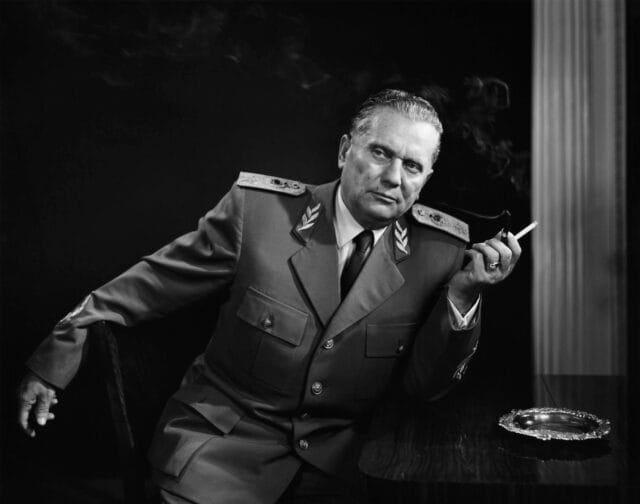
The figure of Josip Broz Tito vividly illustrates how the media can artificially construct public opinion under the pressure of ideological directives of totalitarian regimes, flexibly adapting narratives to changes in the political situation. The 71 sources analysed from Ukrainian periodicals allow us to trace a clear change in the rhetoric about the Yugoslav leader depending on the time, type of media and their political control.
Given the specifics of political changes and the transformation of propaganda strategies, media coverage of Josip Broz Tito in the Ukrainian press is conditionally divided into four key periods:
1. 1943-1945 – Nazi German-controlled media and Tito’s “gangs”
2. 1945-1947 – Postwar glorification in the Soviet press.
3. 1948-1952 – Ideological rift between Stalin and Tito.
4. 1956-1973 – Rehabilitation of the image and return to moderate approval.
This periodisation demonstrates the direct dependence of rhetorical changes in the media on the foreign policy and ideological course of the regimes that controlled the contemporary press in Ukraine.
Nazi German-controlled media and Tito’s “gangs”
The period of 1943-1945 is represented by 21 publications, exclusively in the media that operated under the supervision of the Nazi authorities. The largest number of references falls on 1944, the period of active hostilities between the Red Army, Bulgarian troops and the Yugoslav People’s Liberation Army led by Tito and the German coalition. In these publications, the image of Tito is presented exclusively in a negative light: he is called a ‘Bolshevik bandit leader’, and the official title of Marshal of the Federal People’s Republic of Yugoslavia is either put in quotation marks or accompanied by the designation ‘so-called’, which was intended to delegitimise his political status and separate him from representing the interests of the Balkan peoples1.
One of the leading strategies of German propaganda was to portray Tito as a direct leader of Soviet policy, an “Agent” prepared and inspired by Moscow. However, at the same time, they do not consider him to be their puppet, which indirectly indicates his autonomy. The publication ‘Bolshevik Work in the Balkans: Who is the Communist “Marshal” Tito?’ (‘Volya Pokuttya’) notes that his units were ‘organised on the Bolshevik model’ and that he ‘received special training in Moscow’. Interestingly, they were not lying there – Tito’s army structure was heavily inspired by the Soviet, to the extent that Stalin even feared that this could damage his relations with the Western allies2. Stalin, according to the same publication, viewed Tito as “the front line of Bolshevism in Europe”3. This indicates Tito’s ideological dependence on the USSR, his subordination to the Soviet secret services, and his desire to imitate the Soviet model. This characterisation shaped the image of Tito as an immediate threat, an ideological enemy, while singling him out, rather than the Balkan peoples, as the main object of confrontation.
German publications systematically shaped the idea of the power of the Wehrmacht, which inflicted devastating blows on Tito’s “communist gangs”4. At the same time, the Nazi press clearly demonstrated a tendency to devalue Soviet forces: communist units were labelled as “gangs” and their activities were presented as chaotic and illegitimate. In contrast, the American and British military are seen as equal adversaries, which underscores the Nazi propaganda’s attempts not only to humiliate the communists but also to question the legitimacy of Western support for the Yugoslav resistance movement. Another element of the propaganda was the emphasis on the internal discord among Tito’s “bandits”, the mass defections of Serbs and Italians to the German army, which was presented as supposed proof of the moral superiority of the Third Reich5. This representation was intended not only to delegitimise Tito, but also to contrast the “chaos” of the communist movement with the “order” of German control, reinforcing the message of Germans as civilizational liberators.
To reinforce the dehumanisation of the Bolshevik forces, statistics were provided on the numerous crimes committed by the “communist robber gang” led by “comrade” Tito against the civilian population – rape, looting of churches, destruction of houses, murder of children, women and the elderly – which he had committed in the ‘Moscow style’ after receiving training there. Such claims were supported by geopolitical pretexts: according to the authors, these brutal methods were part of a broader Soviet strategy to reach the shores of the Adriatic Sea, implemented by Stalin’s “agent” Tito6.
“Tito as a conspiracy against the Serbs”
A separate propaganda narrative was formed around Tito’s ethnicity, a Croat who was portrayed as a fierce opponent of the Serbs. In this discourse, the Serbian people were portrayed as victims of a conspiracy of international forces: it was claimed that “Churchill and Eden betrayed the former Yugoslavia, its government and king”, and the Serbs were credited with a “historic mission” – the destruction of Bolshevism. The Tito government, according to the rhetoric of the publications, was portrayed as a “tool of the red Kremlin” and a “bandit provocation” to which there could be only one response – “the concentration of all Serbian national elements under the banner of Nedić”7. In this context, British policy was condemned as cynical and treacherous: England had first forced Serbs to “shed blood for her benefit”, and when General Mihajlović, the leader of the Chetniks, the monarchist partisan resistance movement in Yugoslavia, became unnecessary to her, he was “thrown away like a squeezed citrine” in favour of a new favourite, Tito, a leader “alien to the Serbs”8. This is confirmed by a quote from Captain Jovovic used in another article: “We want to fight against our gravediggers, together with the brave German armed forces, which are not replaced by any territorial aspirations in our country”9. In this way, Tito and his allies are presented as an existential threat to the Serbian nation, which is instead heroised and given a historical role. As an alternative to Tito’s “treacherous” course, the support of the pro-regime Serbian leader Milan Nedić, the head of Serbia’s puppet government during the Nazi occupation, is offered.
Overall, it can be argued that the Ukrainian media, controlled by the Nazi authorities, systematically denied the legitimacy of Josip Broz Tito as the head of the newly created Yugoslav state. The publications formed a stable image of Tito as a follower of Bolshevik ideology and an instrument of Soviet expansion (or at least its “agent”). Much attention was paid to attempts to oppose him to the Serbian people, presenting the latter as a victim of a conspiracy between the Communists and the Western allies. Instead, the figure of Milan Nedić, the head of the pro-regime government, was glorified as the only nationally acceptable alternative.
Postwar glorification in the Soviet press.
After the victory of the anti-Hitler coalition forces and the consolidation of Soviet influence in Eastern Europe, the media space on the territory of Ukraine came under the control of the USSR. The analysed corpus of materials for this period revealed only 10 publications, nine of which belong to the Soviet “Literary Gazette” [Літературна газета] and one to the émigré publication “Our Life” [Наше життя], published in West Germany.
The rhetoric of heroising Tito and demonstrating him as an equal ally of Stalin became characteristic of the Soviet discourse. Thus, in an article written by the Soviet actor, People’s Artist of the USSR Yuri Shumsky, the author shares his impressions of a trip to the Balkans, where, according to him, he had long wanted to go. He describes a Victory Day celebration in Yugoslavia, where the atmosphere was permeated with slogans: “Long live Marshal Stalin!”, “Long live Marshal Tito!”, “Stalin – Tito!”, “Moscow – Belgrade!”. This emotional palette is aimed at reinforcing the image of both leaders as equal heroes of the liberation struggle, united by a political union. Further, the text gives preference to the depiction of the Yugoslav partisans as heroic fighters against the Nazi occupiers. Describing the monuments, Shumsky emphasises that “from this impregnable fortress, the heroic Yugoslav partisans drove out their enemies — the German invaders.” Thus, the landscapes of Yugoslavia are intertwined with a pathos story of a common victory10.
The style of this publication is journalistic – a personal, emotionally coloured story written by a popular actor inspires trust within the reader. Vivid epithets, emotional impressions, and images of festive Yugoslavia are intertwined with political slogans that gently but persistently impose the official Soviet political course through the image of culture, brotherhood, and victory.
In another publication published in the “Literary Gazette”, Bulgarian literary critic Lyudmil Stoyanov provides an overview of modern Bulgarian literature, closely linking its development to the collapse of “fascism” in the region. He notes: “In the first days after the overthrow of fascism, poets came up with many poems that glorified the exploits of the Red Army, the wisdom of Stalin, the struggle of the Bulgarian partisans and the people’s army, the heroism of Marshal Tito’s troops, and the brotherhood of Slavic peoples.” Such a hierarchically constructed list of images—from the Red Army to Tito—points to the central motifs of officially approved post-war poetry. The author not only notes their presence but also approves of them, effectively legitimising the cultural orientation toward the Soviet narrative. Thus, Marshal Tito organically fits into the system of ideological symbols, as part of the liberation struggle and Slavic unity, and the article itself performs the function of cultural confirmation of this new political reality11.
Ally of Lenin and Stalin
The close connection between the Soviet leadership and the Yugoslav political elite is also evidenced by the article dedicated to the funeral of Mikhail Kalinin – one of the leading figures of the October Revolution and the Soviet Union. From the very first lines, Kalinin appears as a “faithful ally of Lenin and Stalin”, which partially levels his own personality as a prominent politician, and instead strengthens the cult of the main Soviet leaders. At the same time, the culminating moment of the article is the description of the appearance of “Marshal Josip Broz Tito, accompanied by members of the Yugoslav government delegation,” who lays a wreath “from the fraternal Yugoslav people, in whose hearts gratitude will forever live to one of the leaders of the Soviet state for his assistance in liberating Yugoslavia from the yoke of the fascist invaders.” Such a gesture symbolises not only official political loyalty, but also demonstrates Yugoslavia’s ideological dependence on the USSR in the post-war period. Formal expressions of gratitude consolidate a hierarchical model of relations, where the USSR appears as a liberator and mentor, and Yugoslavia as a dependent follower12.
The analysis of the materials also indicates the active development of cultural ties between the Soviet Union and Yugoslavia in the post-war period. The publications cover congresses, official meetings, and literary evenings during which creative works with a clear ideological undertone were exchanged. In particular, the report on the meeting with Yugoslav writers in Kyiv emphasizes the common historical struggles of the two peoples and the role of literature as a means of ideological consolidation: “The revolutionary democratic literature of Yugoslavia, like the literature of the Soviet Union, was closely connected with the struggle of its people against a fierce enemy.” At the meeting, Pavlo Tychyna read a translation of an excerpt from “Songs about the Life of Comrade Tito,” emphasising the unity of the experience of both countries: “We fought together and won together. And nothing can break our friendship, which was born in the fight against a mortal enemy.” The material pays special attention to the role of Ukrainian intellectuals, who, through translations and literary initiatives, contributed to the establishment of cultural dialogue. At the same time, the emphasis is placed on the heroization of the common past, emphasizing the “great role of the Russian people in the development of the culture of other Slavic peoples” and on the figure of Tito as a leading leader, thanks to whom, according to the narrative, these ties became possible13.
A striking example of the ideological content of cultural interaction between the USSR and Yugoslavia is the publication of Maksym Rylsky’s translation of the poem by the Yugoslav poet Vladimir Nazor “Friend Tito”. In the poetic text, Tito appears as a multifaceted image — a symbol of national revival, a leader who unites disparate forces, cares for the people and embodies the features of an ideal leader. Thus, the metaphor of revival — “fire under the ashes” — indicates renewal after the destruction of the war, and the image of a river with many streams symbolises the unity of the peoples under his leadership. Tito is depicted as someone who provides prosperity—“sows flour,” “kneades new bread”—and at the same time has authority and power—“stern as a lion,” but with a “father’s heart.” The poem also emphasizes trust in the leader even in an uncertain future: Tito is depicted as a “gift of great fate” for the people14. Another example is Rodovan Zogovich’s poem “Song about the Life of Comrade Tito,” published on the front page and translated by Pavlo Tychyna. It uses the rhetoric of total identification of the leader with the people: “Tito is all of us… And he is a multitude of us.” Such poetics of merging the individual with the collective is characteristic of totalitarian discourses, where the leader personifies the masses. The lines “He was born into the world from the first branch of the CP” directly and inextricably link Tito to the Communist Party of Yugoslavia15. Both works not only testify to the formation of a cult of Tito’s personality in the Yugoslav cultural space, but also demonstrate his full approval by the official Soviet line. Their appearance in the Soviet press, in particular in translations of recognised Ukrainian poets such as Rylsky and Tychyna, testifies to the institutional legitimisation of the positive image of Tito as an “allied and fraternal leader”.
Criticism of Tito’s regime
The only mention of Josip Broz Tito found in the émigré press, namely in the newspaper “Nashe Zhyttia”, published in Augsburg (West Germany), is a publication in which Tito is called “marshal” without quotation marks. This form of mention indicates a certain recognition of his official status as the leader of Yugoslavia. At the same time, the general tone of the material is critical. The author of the text draws attention to Tito’s silence in public speeches about the role of the international humanitarian organisation United Nations Relief and Rehabilitation Administration (UNRRA) in the post-war reconstruction of the country, in particular, noting that without its help, “half of the people in Yugoslavia would have had to die of hunger”. In addition, an ironic attitude is expressed towards the implementation of the Soviet model of the five-year plan (“five-year plan”) in Yugoslavia, which is depicted as an ineffective instrument for “making the people happy” according to the model of Moscow’s centralised policy16. Thus,the publication combines formal recognition of Tito’s political status with criticism of his regime, in particular for concealing information about foreign aid and adopting Soviet models of governance.
As a result, in the Soviet public discourse of 1945–1947, Josip Broz Tito appears as a heroic ally, equal to Stalin in the fight against “fascism”. His activities are systematically portrayed as the embodiment of brotherhood, revolutionary devotion and care for the people, which ideologically brings Yugoslavia closer to the USSR. Through artistic images, journalistic materials and translations of Yugoslav poets, a cult of Tito’s personality is gradually formed in the Soviet media, approved and supported by the official line. Thus, Yugoslavia is presented not only as a political, but also as a cultural and ideological ally, and its leader is an exemplary leader, legitimised by the Soviet state and sphere.
Ideological rift between Stalin and Tito
While reading Soviet publications from 1945 to 1947, it would be hard to imagine that by June 1948, the Cominform would officiallycondemn Yugoslavia for “ideological deviations,” and a sharp political conflict would erupt between Josip Broz Tito and Joseph Stalin. This sudden change in relations, which ended in an effective break, can be explained by Tito’s desire to pursue a more independent domestic and foreign policy, particularly through active participation in the Greek Civil War, the initiative to create a federation with Bulgaria, and increased influence over Albania. These actions contradicted the strategic interests of the USSR and undermined Moscow’s monopoly on setting the political course in the socialist bloc17.
Among 35 analysed publications from 1945 to 1952, about 70% were printed in the émigré newspaper “Promin” (Salzburg, Austria), while the remaining 30% appeared in the “Literary Gazette”. Notably, in 1948–1949, the period immediately after the split, the “Literary Gazette” only featured one article mentioning Tito. In contrast, between 1950 and 1952, the number of such mentions increased, suggesting a shift in the Soviet media’s approach to covering the topic, although the exact reasons remain open to interpretation.
In early June 1948, the “Promin” briefly reported on political purges conducted by Tito, comparing them to Stalinist purges18. This was based on the dismissal and arrest of top Yugoslav ministers, close to Tito and comrades, during the partisan war19. This suggests that Tito employed the Soviet model of political cleansing, but did so to break away from USSR influence and establish sovereign control over his state.
Comparing Yugoslavia and Ukraine
In the context of the political split between Stalin and Tito, one article drew a comparison between the situation in Yugoslavia and that in Ukraine, stating: “The accusations made by Moscow against Tito are the same as those once made against Ukrainian communists.” This points to shared repressive mechanisms used by Moscow against independent-minded communist leaders.
Despite a certain sympathy for these “victims,” the author remains critical of Tito and his Ukrainian counterparts, calling them “lackeys” who failed to please their Moscow patrons: “Thus Tito stands as a bankrupt before his people… and a bankrupt before his master.” Still, the author supports Tito’s opposition to broader Russian imperialism, stating: “Moscow, as the centre of imperialism and as the embodiment of brutality and cynicism, must be destroyed.” However, this support does not translate into respect for Tito himself, who, according to the author, remained a follower of Stalin and never fully broke from Soviet influence20.
Another article takes a more sympathetic tone toward Tito, drawing historical parallels between his resistance to Soviet pressure and the efforts of Ukrainian revolutionaries in the 1920s—such as Mykola Skrypnyk, Mykola Khvylovy, and Oleksandr Shumsky—to establish autonomous Ukrainian policies within the USSR. This comparison emphasises the continuity of the struggle for national liberation and highlights the stronger position Tito enjoys. Unlike the Ukrainian national communists, whose influence was limited to intellectuals and students, Tito, the article notes, had much broader support: “Tito enjoys far more advantageous and solid positions compared to Skrypnyk and Khvylovy… He has not only the whole nation behind him but also a fully armed army—even his own NKVD.” The author thus places hope in Tito as a potential symbol of resistance to imperial pressure, where Ukrainian predecessors failed21.
Assumptions about the world war
The “Promin” also underscores the significance of the Moscow-Yugoslavia conflict, calling it “the first serious defeat of Moscow in the Balkans” and “the first major crack in Moscow’s offensive front in Europe.” The article highlights that Tito violated the only concrete “principle” — obedience to Moscow — thereby openly defying Kremlin control. In this context, “the foundation of Moscow’s power… is terror,” but “Tito has proven that… Moscow’s terror can be resisted.” Therefore, Tito not only defied the Kremlin’s line but challenged the effectiveness of Stalinist terror as the primary tool of control. The article concludes with a broader implication: “The defeat of Moscow’s expansionism in the Balkans… will reduce the power of terror along the entire front.” The author sees the Yugoslav conflict as the beginning of the weakening of Stalin’s dominance model in other occupied countries22.
In another article featuring commentary by Randolph Churchill, Winston Churchill’s only son, the conflict between Tito and Stalin is seen as a potential precursor to a large-scale armed confrontation, possibly even a world war. The author presents a grim scenario: should the USSR invade Yugoslavia, Western nations—due to alliance obligations—would have to intervene on Tito’s side, potentially sparking a third world war. A comparison of the Kremlin’s tactics to those of Nazi Germany intensifies the threat: “Moscow will follow Hitler’s pre-war strategy.” The article emphasises how swiftly Stalin could overtake Yugoslavia, stating that the Kremlin “needs an easy and cheap victory.” These statements aim to instil a sense of impending catastrophe, fueled by the belief that “Stalin and his criminal gang” could replicate the horrors of World War II. The use of historical analogies, appeals to authority (Churchill), and the framing of a civilized West against an aggressive East helps shape the article’s political message: the conflict with Tito is not local, but a sign of a wider imperialist threat from the USSR23.
A review of a Daily Mail article titled Discord in the Moscow Family shows how the Western press used irony and strategic quotations from communist sources to dismantle the image of a united Soviet front — a tactic that the Ukrainian émigré community leveraged to reinforce its anti-Soviet narrative. The article opens with a telling statement: “The Soviet Union now has trouble not only on the external front but also internally,” portraying the USSR as a crumbling hegemon. Criticism is particularly sharp in examples from allied states: Finnish communists fall out of favour after electoral losses; Polish leader Bolesław Bierut is depicted as a puppet of Moscow’s agents; and Hungarian police are depicted as a terror instrument against “enemies of the people.” In this context, though Tito is not mentioned directly, he serves as a shadow hero of the discourse. The paper implies that Yugoslavia’s independence became a chilling precedent for the Kremlin: “Intended… for those party cadres tempted by Tito’s heresy.” This reflects the Soviet perception of any alternative political line as an existential threat. Thus, Tito becomes a symbol of political courage and independence — a challenge to the centre — used as a “negative example” to discipline other socialist bloc countries24.
Further interpretations of the Belgrade-Moscow split
Further confirmation comes in another article analysing Soviet-Chinese relations, where the author poses a striking question: could Mao be “another Tito”? This short yet conceptually significant question shows that by 1949, Tito had become a symbol of the “independent communist”— a leader able to challenge Moscow not from the West, but from within the communist camp. Thus, Tito and Yugoslavia acquired new global meaning as markers of political autonomy inside the “socialist bloc”. In Soviet literary journalism of the USSR-Yugoslavia conflict period, the image of Josip Broz Tito was consistently demonised using extremely aggressive language. In the cited texts, he is depicted as an “executioner” and leader of a “fascist agency” working for the “Anglo-American imperialists.” This rhetoric presents Tito as a traitor to socialism and a servant of Western capitalism, aligned with the “imperialist” anti-Soviet front. This narrative became particularly prominent in 1949, when Albania, under Enver Hoxha, aligned closely with the USSR as its main strategic ally.
After the 1948 split between Moscow and Belgrade, Tito was perceived by the Albanian leadership as the embodiment of “betrayal” within the socialist camp. Yugoslavia, which previously had significant influence over Albania, particularly through military and economic aid, came to be seen as the main threat to Albania’s independence and ideological purity. That same year, Albania launched major political purges, including the arrest and execution of Koçi Xoxe, a former deputy premier accused of links to Yugoslavia. His name appears in quotes as a symbol of a conspiracy organised by Tito to destabilise the country. The article’s conclusion about the failure of the “black schemes” of Yugoslav agents serves not only an ideological purpose but also helps consolidate the internal political legitimacy of Hoxha’s regime25. Despite its economic weakness, Albania sought to present itself as an independent and Kremlin-loyal state in a newly divided communist world. Thus, the analysed text demonstrates how publicist writing of the era became a tool for ideological mobilisation, anti-Yugoslav propaganda, and an affirmation of loyalty to the “correct” Soviet line.
In another article, while glorifying the Stalinist army, Tito is described as a “mercenary of American intelligence,” a direct accusation of betrayal and collaboration with the Soviet bloc’s enemies. This branding likens him to spies and hostile agents, emphasising distrust and hostility. Tito’s actions are portrayed as a string of failures—“suffering failure after failure”—creating the image of a weak and unsuccessful opponent, unable to stop the socialist movement. The harsh label “cutthroats” used for Tito’s supporters emphasises their violent and negative portrayal in Soviet propaganda. The overall tone is purely propagandistic, casting Tito as an enemy of peace and progress, a “traitor” and “mercenary” of Western imperialists. Meanwhile, the Soviet Army is depicted as a force of peace, justice, and protector of the working class’s interests, positioning itself as the moral and political counterpoint to the enemy figure of Tito26.
Tito as agent to the West
In an important article by Ivan Statyvko titled “Tito’s Clique — The Arch-Enemy of Humanity”, Tito’s achievements in fighting the Nazis, which were once described by the Soviet media as “heroic” are either ignored or outright denied. The author accuses him of collaborating with Anglo-American forces, which Soviet propaganda claimed sought to occupy the Balkans, and asserts that Tito actively assisted in that plan. Particular emphasis is placed on his hostility toward the Red Army, which had “liberated” Yugoslavia, used as evidence of his disloyalty to the Soviet bloc: “…Even during the war, Tito appealed to the American-English cannibals for help in fighting the national liberation movement.” Tito is thus portrayed as a vassal and agent of the West—a classic propaganda tactic used to justify Soviet confrontation with Yugoslavia. The use of the term “Tito’s gangs,” which was widely used by Nazi-controlled media during WWII, adds further negative and demoralising connotations and deliberately associates Tito with terrorist and criminal elements27. This reinforces Tito’s image as an enemy of the people and ideological adversary of the socialist ideal, which, according to Soviet propaganda, was best realised by the USSR.
Thus, in the media of the Ukrainian émigré community in Austria, the image of Tito was initially received—albeit with some scepticism—with hope that he could emerge as an independent, ideologically consistent “only orthodox Marxist”28, capable of standing up to “Russian imperialism” in a broad sense. This image resonated with the legacy of Ukrainian revolutionaries and fighters who had unsuccessfully attempted to challenge Moscow’s dominance. Even in materials where Yugoslavia was not the direct subject of analysis, Tito appeared as a symbol of defiance against Stalinist orthodoxy and a possible form of independence that continued to threaten the “Soviet family” beyond the Balkans. This gave rise to analogies like the “Polish Tito”29 or the “Asian Tito”30, representing deviations from the Soviet political line and dependency. In response, Soviet newspapers aggressively and persistently labelled Tito with emotionally charged accusations of “betrayal,” revising and discrediting the heroic narrative of their joint struggle against fascism. His image was transformed into that of a capitalist “imperialist” agent, a view reinforced by comments from Soviet military and party officials, which lent credibility and amplified the propagandistic narrative.
1956–1973 – Rehabilitation of the Image and Return to Moderate Approval.
From 1952 to 1956, based on available sources, there is an almost complete absence of mentions of Tito in the Soviet Literary Gazette. This can be explained by several major political transformations in the USSR that began after Stalin died in 1953. Nikita Khrushchev’s rise to power marked a significant policy shift, including the launch of the de-Stalinization process in 1956, which was accompanied by the “Thaw” and the rehabilitation of Stalin’s victims. As noted by scholar Svetozar Rajak31, for Khrushchev, normalising relations with Yugoslavia was a vital component of successfully implementing de-Stalinization, since without reestablishing dialogue with Tito, the process could not be considered complete or coherent. With the start of the “Thaw,” mentions of Tito were scarce and mostly limited to events such as his official visit to Moscow or friendly football matches with Yugoslav teams. At the same time, there were no public statements recognising past slander or acknowledging the mistakes of the Stalinist-era campaign against Tito. Instead, articles began to appear that gradually restored a positive image of Tito as an “outstanding leader of the Yugoslav people”, “one of the leading figures in the international workers’ movement”, and an honoured guest — especially since his 1956 visit to Moscow marked the beginning of reconciliation between the two socialist countries32.
An example of a notable shift toward positive rhetoric about Tito in the Soviet press is a 1962 publication in the Literary Gazette. The article describes Tito’s official visit to Kyiv, emphasising his status as a “respected and welcome guest.” The joint presence of Tito and Chairman of the Soviet Council of Ministers Nikita Khrushchev highlighted the parity of the two leaders and the high diplomatic level of relations between their countries. Of particular symbolic importance is the joint tribute paid to the memory of those fallen in World War II — specifically, Tito’s laying of a wreath at the obelisk on the Tomb of the Unknown Soldier in Kyiv’s Park of Eternal Glory. This gesture illustratesthe Soviet side’s acceptance of a shared narrative of the struggle against fascism, contrasting sharply with the propaganda of the Stalin-Tito conflict period, when Soviet media tried to erase Yugoslavia from the collective “heroic” past33.
Positive image of Tito, again
In the 1970s, the image of Josip Broz Tito in the Soviet “Sportyvna Hazeta” was shaped exclusively in a positive, ceremonial, and diplomatically emphasised light. In issues from 1972 and 1973, he is portrayed as a high-ranking allied leader—President of the SFRY and head of the League of Communists of Yugoslavia—whose visits to Moscow or Kyiv were accompanied by official ceremonies, meetings with top Soviet officials such as Brezhnev, Kosygin, Podgorny, and Shcherbytsky, and mass support from the working people. Public displays of welcome, such as applause at airports, flag-decorated streets, national anthems, and the presentation of bread and salt, symbolised not only respect for Tito but also a desire to demonstrate unity between Yugoslavia and the USSR. The entire discourse aimed to showcase restored fraternity after the Stalin-era conflict. Interestingly, even in a sports newspaper—traditionally focused on physical culture—Tito’s image was politicised and integrated into the state’s ideological rhetoric34.
Brezhnev’s rise to power contributed to stabilising Soviet foreign policy, and during this time, official visits became an important tool for demonstrating loyalty, partnership, and ideological convergence. The solemn coverage of such events in the press, including the “Sportyvna Hazeta”, served as a marker of strong intergovernmental relations and proof that Yugoslavia—despite its independent path—remained a desired ally in the socialist camp. Thus, even in media not intended for political analysis, visual and semiotic means were used to form and solidify the image of Tito as an equal and respected “comrade” who reinforced socialist unity.
Accordingly, Soviet propaganda in the 1960s–70s sought to gradually and moderately transition toward normalising relations with Yugoslavia and with Josip Broz Tito personally. Symbolic recognition was returned to him as the leader of a socialist state, albeit without the hyperbolic heroization that characterised the immediate postwar years. At the same time, it’s important to emphasise that this process took place without any public reconsideration or even mention of the earlier Soviet propaganda campaign against Tito, when he was vilified as a “traitor to socialism” and an “agent of imperialism.” The former rhetoric was simply ignored, while a new narrative was constructed, focusing on “friendship,” “cooperation,” and “socialist solidarity.”
The methods used by the Soviet propaganda apparatus remained unchanged: tightly controlled press, centralised message formulation, ritualised coverage of visits (official ceremonies, mass greetings, children with flowers, bread and salt, etc.), and the manipulative creation of a positive image through visual and textual markers. All of this served as a tool for shaping the collective imagination of “unity among socialist nations,” even when this unity was built on past conflict and contradictions. Thus, Soviet media created the illusion of uninterrupted friendship, denying the ideological war of the past, and instead convincing Soviet citizens of the stability and inviolability of international socialist unity, now once again symbolised by Josip Broz Tito.
Conclusion: from hero, to traitor, to ally again
The Ukrainian community—both under Soviet control, during Nazi occupation, and in emigration—showed significant interest in the geopolitical developments centred around Yugoslav leader Josip Broz Tito. His persona deserves special attention and in-depth study, as he navigated between competing ideologies, both of which exploited his image for their own political goals. Accordingly, his portrayal changed multiple times to suit the rhetoric that was advantageous at any given moment — facts were manipulated, information was withheld, or reality was deliberately distorted.
From the analysis, it becomes clear that the media of the postwar Ukrainian émigré community in Austria are less biased and more reliable sources than all others analysed. These outlets were sceptical of both the Nazis and the Soviets but viewed events through the lens of their primary goal—restoring Ukrainian statehood. During the short but active period of German occupation, Tito was portrayed exclusively as a “follower of Soviet Bolshevik policy,” which they perceived as criminal and illegitimate.
In Soviet discourse, Tito’s image underwent dramatic transformations: from glorification—being placed on the same level as Stalin and celebrated in poetry—to complete repudiation, accusations of betrayal, distortion of the recent “heroic” past, and being labelled an “agent of Anglo-American imperialism” and an “enemy of the working people.” This turning point was a result of the political split between Stalin and Tito. However, with the rise of a more liberal leadership, and without publicly acknowledging past mistakes or expressing regret, a process of cautious normalisation began—a return to a positive portrayal of Tito, though in a more reserved form.
This example shows how perceptions of historical figures depend less on their actual actions and positions than on how they are portrayed, shaped by personal, ideological, and political biases.
Footnotes
- The Hand of Moscow in the Balkans. 1943. Ukrainskyi Dobrovolets [Український доброволець], December 25, no. 33, 2 ↩︎
- Ivo Banac, “Part I. Divisions,” in With Stalin against Tito: Cominformist Splits in Yugoslav Communism (Ithaca, NY: Cornell University Press, 1988), 9, https://doi-org.bris.idm.oclc.org/10.7591/9781501720833-004. ↩︎
- Bolshevik Activity in the Balkans: Who Is the Communist “Marshal” Tito?, Chortkivska Dumka [Чортківська думка], February 27, 1944, no. 9, 7. ↩︎
- Successful Operation of German Troops Against the Communist Band Headquarters in the Balkans, Lvivski Visti [Львівські вісті], June 8, 1944, no. 130, 2. ↩︎
- Bands in the Balkans, Holos [Голос], January 16, 1944, no. 3, 1. ↩︎
- Tito Is Making a Career. 1943. Myrhorod News [Миргоролські вісті], July 27, no. 60, 2. ↩︎
- Serbs Condemn the Shamelessness of the British. 1943. Ukrainskyi Holos (Lutsk) [Український голос (Луцьк)], December 23, no. 69, 2. ↩︎
- Bolshevism – Serbia’s Greatest Enemy. 1944. Ridna Zemlia [Рідна земля], April 27, no. 1, 2. ↩︎
- Joint Struggle. 1944. Ridna Zemlia [Рідна земля], January 23, no. 4, 4. ↩︎
- Brotherhood and Unity. 1945. Literaturna Hazeta [Літературна газета], July 12, no. 14, 2. ↩︎
- The Literature of the New Bulgaria. 1946. Literaturna Hazeta [Літературна газета], February 1, no. 5, ↩︎
- Kalinin’s Funeral. Literaturna Hazeta [Літературна газета], June 6, 1946, no. 23, 3. ↩︎
- Meeting with Yugoslav Writers, Literaturna Hazeta [Літературна газета], March 12, 1947, no. 11, 1. ↩︎
- Comrade Tito, Literaturna Hazeta [Літературна газета], May 1, 1947, no. 18, 3. ↩︎
- A Song about the Life of Comrade Tito, Literaturna Hazeta [Літературна газета], March 5, 1947, no. 10, 1. ↩︎
- “Five-Year Plan” in Yugoslavia, Nashe Zhyttia [Наше життя], January 22, 1947, no. 3, 2 ↩︎
- Tvrtko Jakovina and Martin Previšić, eds., The Tito-Stalin Split 70 Years After (Zagreb: Sveučilište u Zagrebu, Filozofski fakultet, 2020), 8, https://doi.org/10.17234/9789531758031. ↩︎
- News from Around the World, Promin (Salzburg) [Промінь (Зальцбург)], June 6, 1948, no. 10, 3. ↩︎
- Tito Eliminates Competitors, Promin (Salzburg) [Промінь (Зальцбург)], June 13, 1948, no. 11,8. ↩︎
- Our Commentary: Tito – Hero or Lackey?, Promin (Salzburg) [Промінь (Зальцбург)], July 11, 1948, no.14,1. ↩︎
- Over the Dnipro and Danube, Promin (Salzburg) [Промінь (Зальцбург)], July 25, 1948, no. 16, 5. ↩︎
- Moscow’s Defeat in the Balkans, Promin (Salzburg) [Промінь (Зальцбург)], July 18, 1948, no. 15, 1. ↩︎
- Conflict Between Stalin and Tito May Lead to World War, Promin (Salzburg) [Промінь (Зальцбург)], August 25, 1948, no. 21, 2. ↩︎
- Discord in the Moscow Family, Promin (Salzburg) [Промінь (Зальцбург)], October 27, 1948, no. 30, 4. ↩︎
- New Albania, Literaturna hazeta [Літературна газета], January 12, 1950, no. 2, 4. ↩︎
- Stalin’s Army of Glory and Victories, Literaturna hazeta [Літературна газета], February 23, 1950, no. 8, 4. ↩︎
- Tito’s Clique — The Arch-Enemy of Humanity, Literaturna hazeta [Літературна газета], December 20, 1951, no. 51, 4. ↩︎
- Tito – The Only Orthodox Marxist. 1949. Promin (Salzburg) [Промінь (Зальцбург)], no. 5 (February 4): 1. ↩︎
- The Polish Tito” Resigns. 1949. Promin (Salzburg) [Промінь (Зальцбург)], no. 5 (February 4): 1. ↩︎
- Who Supports Whom in China?, Promin (Salzburg) [Промінь (Зальцбург)], no. 13 (April 1, 1949): 2. ↩︎
- Svetozar Rajak, Yugoslavia and the Soviet Union in the Early Cold War: Reconciliation, Comradeship, Confrontation, 1953-1957 (2011), 18. ↩︎
- Comrade Josip Broz Tito President of the Federal People’s Republic of Yugoslavia. 1956. Literaturna hazeta [Літературна газета], no. 25 (June 21): 1. ↩︎
- “Soviet Ukraine Welcomes Honored Guests: Arrival in Kyiv of the President of the FPRY Josip Broz Tito and the Chairman of the USSR Council of Ministers N. S. Khrushchev.” Literaturna Hazeta [Літературна газета], no. 102 (December 21, 1962): 1 ↩︎
- “Arrival in Moscow of the President of the SFRY, Head of the SKJ Josip Broz Tito.” Sportyvna Hazeta [Спортивна Газета], no. 68 (June 6, 1972): 1. ↩︎
Amazing story