
While official cultural institutions in Serbia remain trapped in bureaucracy and underfunding, something else is growing beneath the surface — fragile, improvised, but stubbornly alive. In Niš, the country’s third-largest city, a generation of young artists and musicians is carving out its own spaces, reshaping culture beyond state control. Their most visible experiment is Underground, a music and art festival that, in just three years, has become a focal point for what many now call the “new new wave” of Niš rock and alternative culture.

From 2 to 5 October this year, Underground will take over the Niš Cultural Centre with twenty bands across four nights, ranging from punk and stoner rock to synth-pop. The program is eclectic but coherent, rooted in the belief that independent music is not just entertainment but a political gesture. The festival’s history reflects this stance: its first edition in 2023 was put together in just two weeks, without institutional support, sustained purely by community energy. Since then, it has grown — with compilations, benefit events, and a steadily expanding audience — while remaining true to its DIY roots.
But what sets Underground apart is not only the sound. It is the image — quite literally. Each year, the festival develops a distinctive visual language designed by young artist Jelena Perić, who has become one of its central creative forces. Her posters are not promotional tools in the traditional sense; they are manifestos. “The visuals change every year, but I try to keep a recognisable identity — something people immediately associate with Underground,” Perić says. “It’s about reflecting the energy of the city and the scene into the artwork.”
This year’s design depicts a young person in freefall. It is an unsettling but also strangely liberating image. For Perić, the fall is not about defeat. “It’s about descending into our underground — into a space of honesty, community, and resistance,” she explains. The poster overturns the usual meaning of falling: what might seem like a collapse becomes a deliberate choice to abandon the surface world of stagnation and enter a deeper, truer dimension.
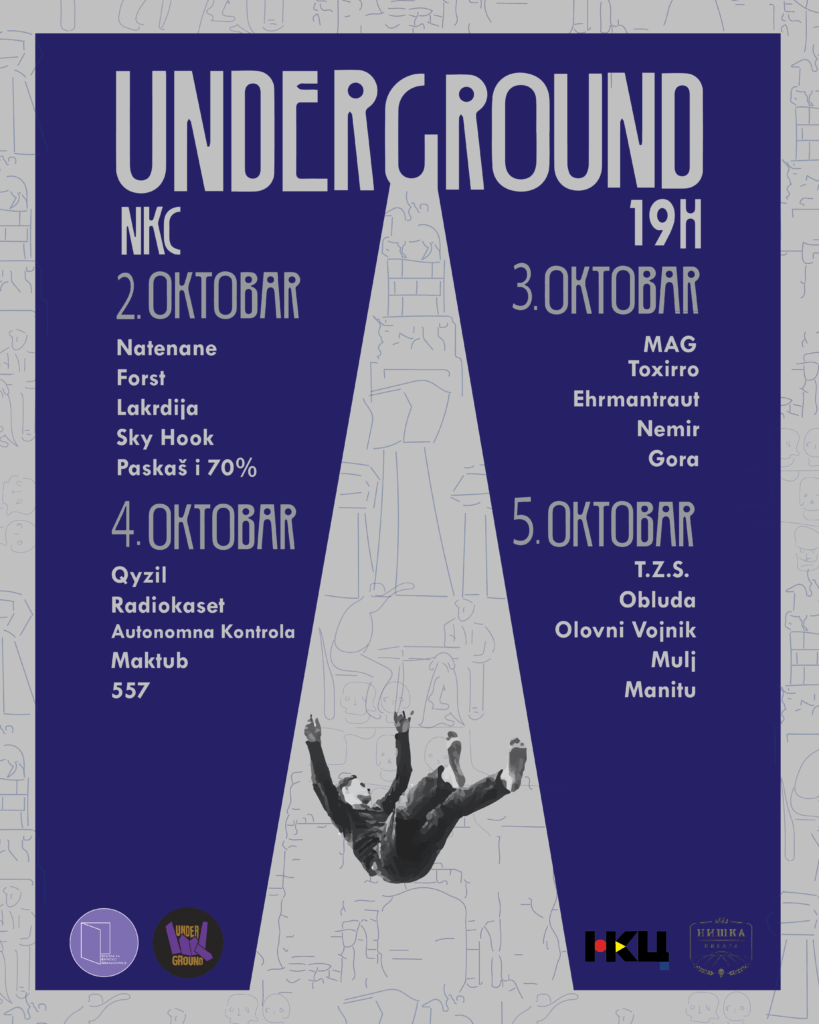
The aesthetics carry unmistakable political undertones. Serbia’s cultural sector has been systematically neglected: for years, less than one percent of the national budget has been allocated to culture, leaving independent initiatives with little chance of survival. In this vacuum, the underground scene becomes more than a subculture — it is a necessity. The visual motif of falling into the underground crystallises that necessity: if official culture cannot sustain life, then life must create its own parallel ecosystem.
The festival’s community-based financing reflects the same ethos. Underground relies on fundraising parties and donations, with local partners such as the Critical Education Centre providing support. This mode of survival is itself a form of critique — exposing the absence of public commitment to culture while demonstrating that art can thrive without state structures. “We don’t see Underground as a once-a-year event,” Perić notes. “It’s an ongoing process, a constant effort to hold space for something independent and real.”
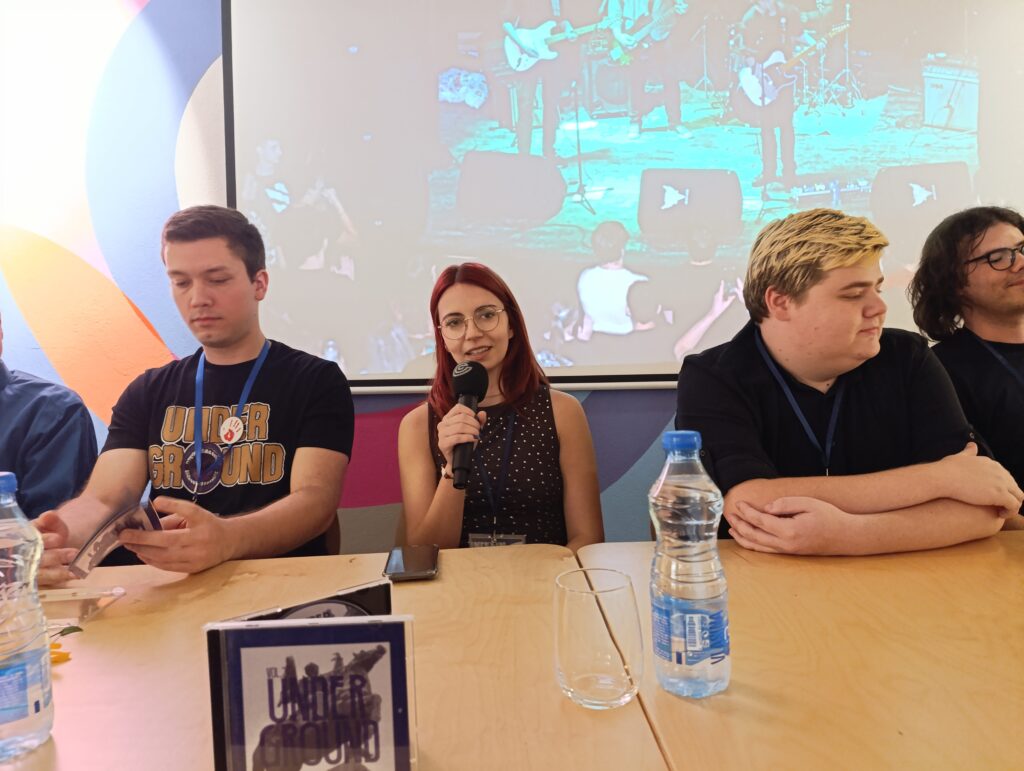
The atmosphere of rebellion also runs through the music. One of the most talked-about acts this year was Bunt — literally “Rebellion” — a young band that recently released Nisam sam (“I Am Not Alone”), a song inspired by student protests and blockades. Their presence on the festival stage directly links Underground to the wider social climate, where young people have turned cultural spaces like Belgrade’s Student Cultural Centre (SKC) into arenas of political and artistic expression. In such moments, art and activism cease to exist as separate spheres: a concert becomes a protest, and a poster becomes a call to action.
Underground is therefore not merely a festival but a living archive of the struggles, hopes, and aesthetics of a generation. Its posters, music, and gatherings together form a counter-narrative to the dominant discourse that treats culture as expendable. The festival reveals that cultural production can still be a site of collective meaning, that rebellion can be joyful, and that falling into the underground is sometimes the only way to rise above the surface.
To outsiders, Niš may not appear to be the capital of cultural innovation. Yet anyone who has witnessed a packed hall at Underground fest — where sound, image, and solidarity collide — understands that something more than a local festival is at stake. This is what culture looks like when it is reclaimed: messy, improvised, fragile, yet fiercely authentic! And in that authenticity lies its greatest strength.
