
In its sixth week, the protest against the project in Pishë Poro-Nartë has entered a more fatigued, but also more hard-edged phase: participation fluctuates, political demands are becoming more visible, the issue has returned to the European Parliament, while tensions with the police and disagreements over how the movement should continue have made the protest more fragile, but it is still there.
Author: Jona Cenameri
This article was originally posted on Faktoje, you can read it here.
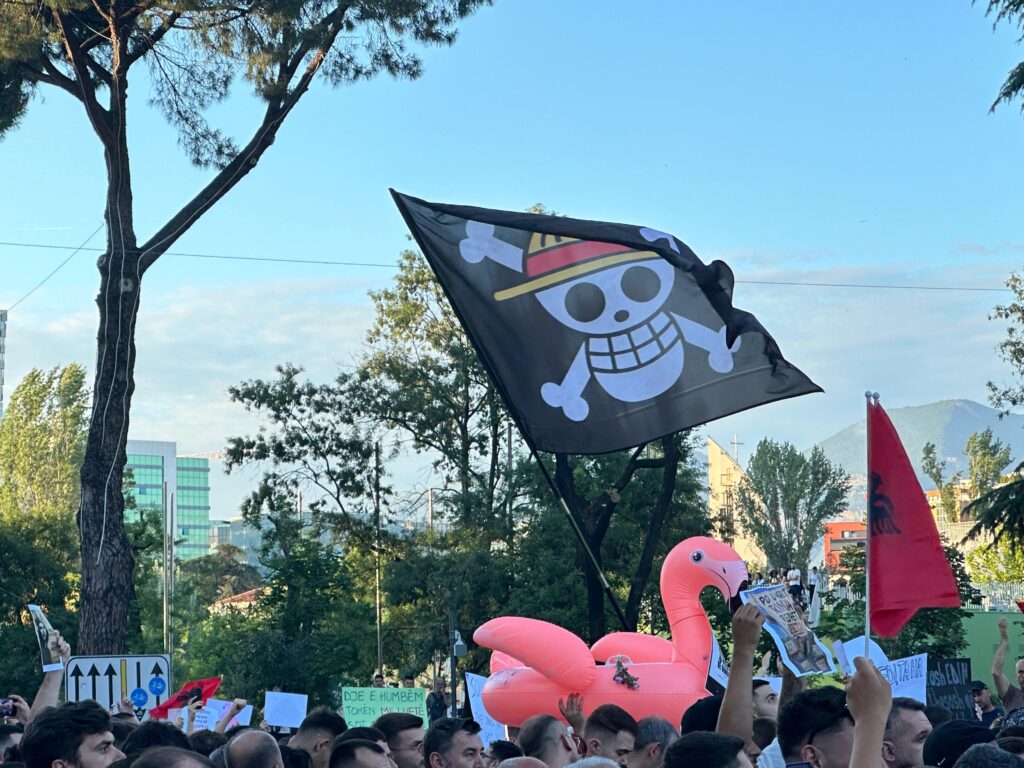
In the sixth week of the protest, two young people who have been there since the first days happen to catch each other’s eye and smile.
Without saying much, like people who know they are tired, but also know they have not given up.
Because after 38 days, the protest against plans for a tourist resort in the protected Pishë Poro-Nartë area is no longer measured only by the number of people in the square.
It is also measured by those who arrive late after work, those who stay for only a few minutes, those who ask each other, “Were you here yesterday?”, and those who have left the country but continue to support the protest through social media.
When the protest began on May 31, no one could have predicted that July, instead of finding Albanians on the beaches, would still find them in the square.
But by its sixth week, what began as a rebellion against a project in Zvërnec that had yet to receive final approval had evolved into a broader revolt against the way public decisions are made, the way common property is treated, the way the state treats its citizens, and the way those in power respond when challenged.
“It has changed a lot,” says a middle-aged man, summing up the protest in one sentence:
“From resistance to a single project, it has become a determined protest against a distorted model of governance.”
At first, it was Zvërnec.
It was the images of the fence and the bulldozers, the confrontations with residents and activists, and the sight of a Zvërnec resident being dragged away by private security personnel in front of the State Police.
It was the debate over the protected area, the legal amendments, the lack of transparency and the fear that one of the country’s most important ecosystems was being opened up to intensive construction.
Then the revolt moved to Tirana.
Tirana
It began on May 31, while on June 1, International Children’s Day, the crowd initially appeared uncertain, mixed together with another protest taking place in Skanderbeg Square.
Gradually, through chants and announcements over a megaphone, the direction became clear: those protesting for Narta were to head towards the Ministry of Environment.
They were protesting against what they saw as a “project advancing without transparency and at the expense of public assets.”
There was no single leader, no podium controlling the crowd and no single message.
People had come out because of Zvërnec, but they were also talking about corruption, emigration, pensions, healthcare, the lack of prospects for the future, the media, the police, the government and the opposition.
The chant that closed the first night was simple:
“More of us tomorrow!”
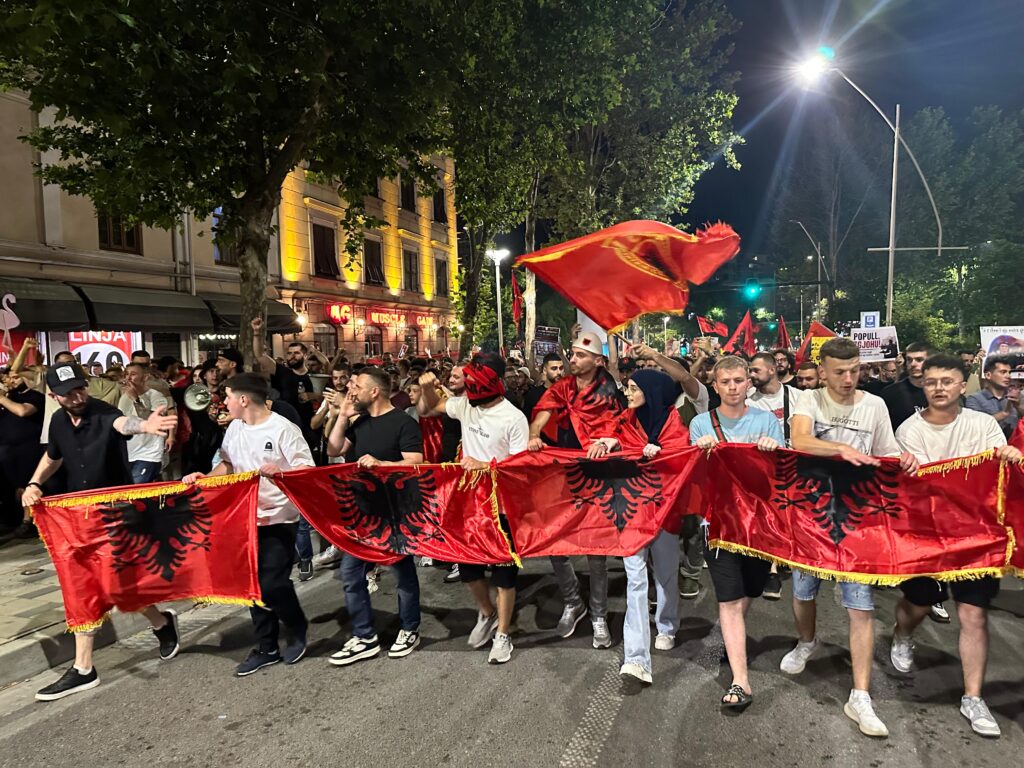
During the first days, the protest took on the face of Gen Z.
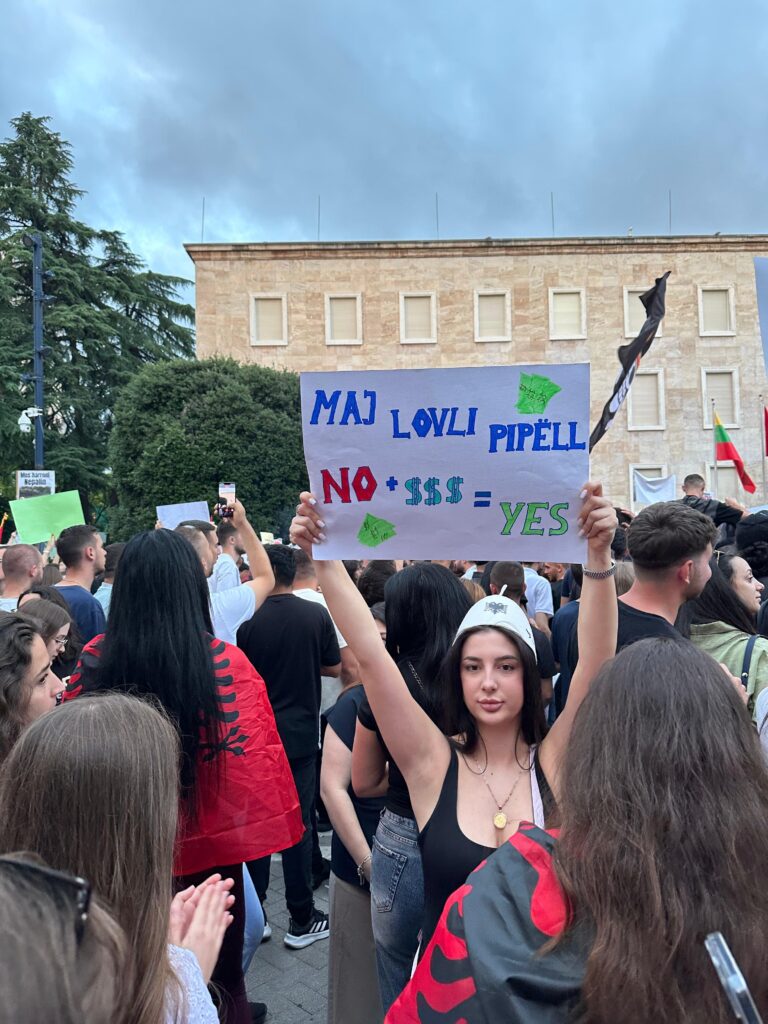
Instead of traditional political placards, the square filled with memes, anime references, television catchphrases, Spotify screenshots, AI-generated illustrations and flamingos that quickly became a symbol of the movement.
TikTok, Instagram and the protest seemed to have merged into one.
A video became a story, a placard became a meme, one friend invited another, and a repost brought dozens of new young people into the square.
In those days, the protest had humour and rhythm.
Its chants were harsh, but its form was light.
There was anger, but also playfulness.
There was patriotism, but also irony.
There were flags, drums, songs, placards and endless photographs taken on young people’s phones.
“The protest was magnificent during the first three days,” says a 20-year-old student from Tirana.
But according to him, something changed when the protest began to take on a more structured form.
“The moment they installed the sound system, it turned into a party rally. And let’s not even get into the level of some of the people who go up there and speak. Get rid of the sound system. Give the protest back to the people, not to a hierarchy,” he says, asking not to be identified by name.
The debate
This is one of the debates that has continued within the protest itself.
Should it remain a protest that leads itself?
Or should it have a structure, clearly articulated demands, speakers and representation?
In the first days, the absence of a leader was one of its strengths.
By the sixth week, that same absence has also become a dilemma.
The demands
From its earliest days, the protest had five articulated demands.
Protesters called for the resignation of the government; the repeal of the status and legal framework related to strategic investors; the cancellation of the so-called “Mountain Package”; the repeal of the amendments to the Law on Protected Areas; and the repeal of amendments to the Cultural Heritage Law, which they argue put the country’s natural and historical heritage at risk.
Initially, the demands were linked to the environmental cause, cultural heritage and a development model that protesters viewed as being geared towards private interests.
But as the days passed, they expanded.
The platform
On the 23rd day of the protest, the organising group presented broader political demands.
These included the resignation of the prime minister and the government, the establishment of a non-partisan transitional technical government with a 12-month mandate, constitutional and electoral changes, the retention of the original demands concerning the contested laws, and the drafting of a new social contract between citizens and the state.
It was the moment when the protest attempted to translate itself into a more comprehensive political platform.
A few days later, a group of 13 signatories issued an ultimatum in the name of the “coordinating group.”
The question mark
But in the square, this did not resolve the question of representation.
For many protesters, the ultimatum exists more on social media and in media reports than in the everyday reality of the protest.
Ask people in the square and not everyone knows it exists.
Not everyone knows what it contains.
Not everyone knows who signed it.
And not everyone feels represented by it.
In the square, each person still seems to arrive carrying their own concern.
A resident talks about Zvërnec and about the fear that one day they may no longer recognise their own home.
An activist talks about the Law on Protected Areas and about laws being changed without citizens being heard.
A young person demands Rama’s resignation because he no longer feels represented.
A citizen standing opposite the police talks about a state that is supposed to protect him, but which many protesters experience instead as a wall.
Someone else criticises the media because they feel that what happens in the square is not reported the way it looks from inside the protest.
A young woman talks about her sister not receiving the healthcare she needs and about the exhaustion of an entire family.
A parent talks about education, about children and about the question of what kind of country is being left to them.
A pensioner talks about financial hardship and growing old without dignity.
So although the protest now has written demands, a political platform, an ultimatum and a group of signatories, it has not yet transformed into a single political body.
The organisers speak in the name of the protest.
But the square continues to speak in many voices.
The demand that has not changed
In the evenings, however, the demand heard most loudly remains the resignation of Prime Minister Edi Rama.
It is repeated through the sound system, by the crowd, on placards and by the groups that march every night outside the Prime Minister’s Office.
Zvërnec was the spark.
But it is no longer the only reason people are taking to the streets.
One young woman, an emigrant living in the European Union, says she has to leave again in the third week of July. But since the protest began, she has put her other commitments aside and remained in the square indefinitely.
She says she will come back again.
Another young man, a content creator living in London, continues to support the protest on Instagram after having to leave Albania.
A man in his thirties from Tirana jokingly called himself a “deserter” because he had gone away on holiday for a few days.
Others come every other day.
Some cannot make it at the beginning and join later.
Some stay for only a few minutes.
The diaspora
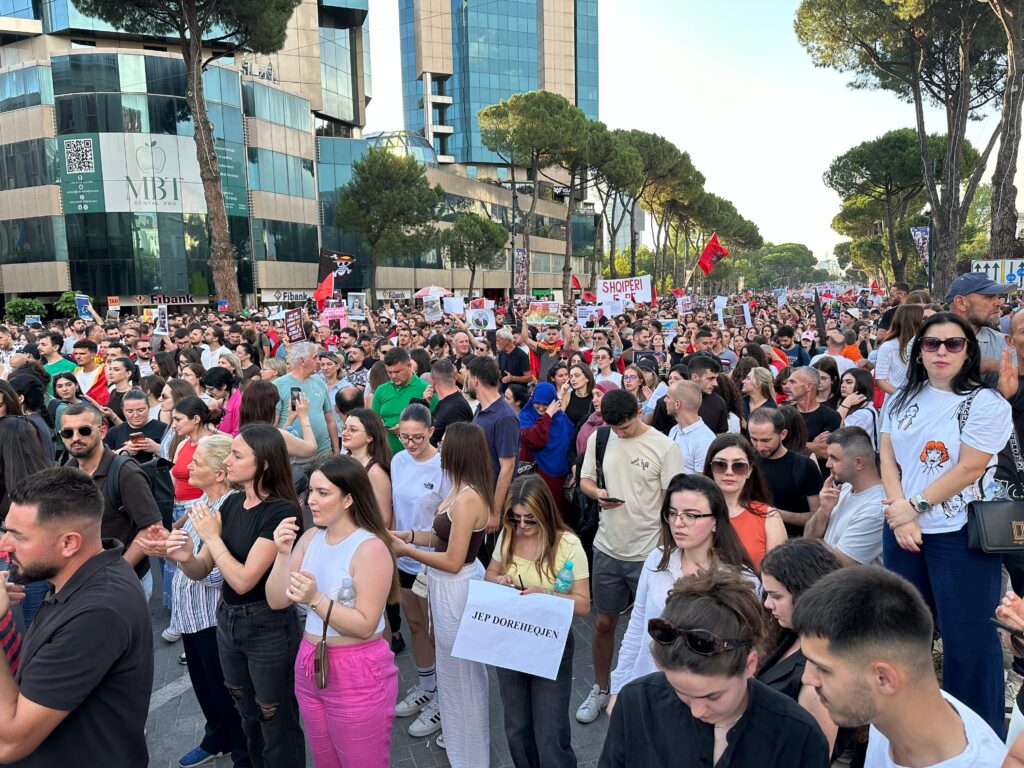
Participation peaked over the weekend of June 20 and 21.
During those days, the square was fuller, the energy stronger and international attention more visible.
People from the Albanian diaspora, as well as from Kosovo and North Macedonia, were there to join the protest.
The European Parliament
Members of the European Parliament visited Albania, spoke at the protest, met citizens and also held meetings with the Minister of Environment.
In June, the European Parliament adopted a resolution on Albania calling for an immediate moratorium in the Vjosa-Narta area and a review of the legal amendments concerning protected areas, while expressing concern over developments in the area.
On July 1, the “Flamingo Revolution” returned once again to the European Parliament, this time through a discussion organised by MEP Pasquale Tridico of The Left group, titled “Democracy, Rule of Law and Civic Participation in Albania.”
Members of the European Parliament, representatives of left-wing parties from several European countries and participants from Albania attended the meeting.
The issue of Vjosa-Narta was discussed in connection with democratic standards, the rule of law, civic participation, emigration and Albania’s relationship with the European integration process.
For several days, it seemed as though Pishë Poro-Narta had become a public test of Albania’s relationship with the environment, democracy, the European Union and private interests.
The fluctuations
But after the peak, participation began to fluctuate.
It was the end of June.
Then came July.
The heat, beach season, holidays planned long in advance and accumulated exhaustion all began to take their toll.
The protest has now lasted more than a month and entered its second.
It no longer has the same momentum every evening that it had at the beginning.
There are fewer humorous placards.
There are fewer people who come simply out of curiosity.
“There is more violence now,” says a young professional in her twenties when asked how the protest has changed.
And July changed the tone.
Clashes outside parliament
On July 2, the second protest near Parliament was marked by violence.
Afterwards, participation increased again, this time driven not by enthusiasm, but by anger.
For several days, protesters marched towards Police Station No. 3, where detained protesters were being held.
In the square, chants directed at the police became harsher.
The relationship between citizens and the State Police, already strained since the beginning of the protest, appeared to have broken down.
A video went viral on social media showing a woman standing face to face with a police officer positioned near the Prime Minister’s Office.
She was holding a placard that read:
“I am disappointed in you.”
Representatives of the governing majority used the violence of July 2 as evidence that the supposedly “peaceful” protest had finally shown its true face.
Protesters, on the other hand, saw this as an attempt to delegitimise the entire movement through a single incident.
Prime Minister Edi Rama, who at the beginning had extended an invitation for a public meeting with a group of protesters, later defended the project and has frequently attacked the protest, public figures who support it and individual participants associated with it.
The Zvërnec protest is not only a confrontation with many of the country’s problems.
It has also become a moment in which everyone’s public stance is being measured.
Who spoke?
Who remained silent?
Who took a position?
Who stepped back?
And who will be remembered for it?
On July 4, the prime minister’s birthday, the protest once again took on a satirical form.
Cakes carrying different symbolic messages were brought into the square.
Songs were sung.
The daily demand for Rama’s resignation was repeated once again.
A symbolic political coffin for Rama also appeared in the square, an image that was strongly criticised by representatives of the governing majority.
The contradictions
By the sixth week, however, the contradictions have become more visible.
The protesters oppose violence, yet some of them are increasingly saying quietly that chants alone may no longer be enough.
Among groups of young people, questions can now be heard that were not voiced so openly at the beginning.
Are the repeated chants “Rama, resign,” “Your time is up,” and “Rama in prison, Berisha in prison” simply lulling the protest into passivity?
Should the tactics change?
Is the government simply waiting for summer, the holidays and exhaustion to take their toll?
Will everything eventually fade away without producing any result?
Placards have also invoked the memory of January 21, the Socialist Party protest held when it was in opposition, the clashes, the burning cars, Tirana in flames and the four citizens who were killed.
For some protesters, that memory raises the central question facing the movement:
How is change achieved in a country where those in power do not step down simply because people demand it?
By its sixth week, the protest is no longer the same crowd that once enthusiastically chanted:
“More of us tomorrow!”
It is something more tired now.